The bottleneck in the development of the fishery Internet of Things lies in insufficient integration of industry, academia and research
Original title: When fisheries meet the Internet of Things
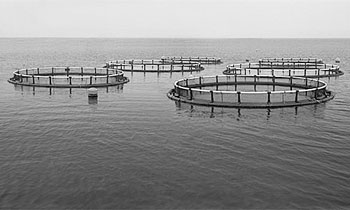
The Internet of Things helps aquaculture carry out intelligent management. Image source: Baidu Images
As a traditional industry, the development of fisheries cannot be separated from the "arming" of modern technology.
Recently, China Agricultural University, the National Fisheries Technology Extension Center, iSoftStone Information Technology Co., Ltd. and other institutions jointly established the China Fishery Internet of Things and Big Data Industry Technology Innovation Strategic Alliance (hereinafter referred to as the Alliance), aiming to promote the transformation and upgrading of China's fisheries through the modern fishery Internet of Things.
"China's overall fishery output value is relatively large, but due to various reasons, problems such as high aquaculture risk and frequent aquatic diseases are prominent. The use of Internet of Things and big data technology can realize the digitization of the aquaculture process and improve the informatization and scientific management level of aquaculture production management." Li Daoliang, vice chairman of the Alliance, director of the Beijing Agricultural Internet of Things Engineering Technology Research Center, and professor at China Agricultural University, told the reporter of "China Science Daily".
Huge room for fishery development
As the saying goes: "No fish, no feast." It is understood that in China, aquatic products provide 27.3% of the total animal protein intake of consumers.
Zhao Xingwu, director of the Fisheries and Fishery Administration of the Ministry of Agriculture, introduced at a press conference on May 5 that China's aquatic products took the lead in realizing market-oriented reform. For more than thirty years, fisheries have maintained rapid development and have long solved the problem of difficulty in eating fish.
Statistics from the Ministry of Agriculture show that in 2015 the total national output of aquatic products reached 66.9 million tons, and the per capita share of aquatic products was 48.65 kg, providing one-third of high-quality protein for urban and rural residents.
At the same time, fisheries have played an important role in improving people's livelihoods and increasing farmers' incomes. Data show that in 2015 the national fishery output value reached 1.09 trillion yuan, and the per capita net income of fishermen reached 15,600 yuan. The trade surplus of aquatic product exports exceeded 10 billion yuan, and the export value ranked first among China's major agricultural products.
But over the past thirty-plus years, China's aquaculture has mostly pursued one-sided improvement of total output through scale expansion and resource consumption. The increase in growth rate has come at the cost of consuming and occupying large amounts of resources. The reporter of "China Science Daily" learned during interviews that this model has led to increasingly prominent problems of ecological imbalance and environmental deterioration.
Zhao Xingwu said: "At present, the supply of aquatic products on the market is sufficient. Traditional aquatic products such as the four major Chinese carps are oversupplied, and some are even seriously backlogged in ponds. Fisheries have entered a new normal of difficulty in selling fish, and are facing new problems of product structure optimization and consumption level upgrading."
Li Daoliang believes that due to the one-sided pursuit of output and insufficient attention to resources, the environment, food safety and sustainable development of the environment, problems such as enormous waste of resources, low labor productivity and high aquaculture risk cannot be effectively guaranteed, seriously restricting the development of China's fishery production.
"Internet of Things and big data technology can comprehensively perceive fishery production sites, reliably and safely transmit fishery information, and intelligently process fishery information." Li Daoliang told the reporter.
According to public information, the waters that account for 70% of the Earth's area currently provide only 10% of all human food, "which means there is huge room for the development of modern fisheries." Li Jiale, a professor at Ocean University of China, said that China's aquaculture output accounts for 73% of the world's total.
The Internet of Things is guiding development according to circumstances
In Li Daoliang's view, modern fisheries must be a high degree of integration of aquaculture technology, equipment technology and information technology. These all require the deep integration of modern fisheries with the Internet of Things, making scientific decisions based on big data analysis, and achieving precision, automation and intelligence.
Luo Xiwen, academician of the Chinese Academy of Engineering and professor at South China Agricultural University, pointed out that accelerating the development of aquaculture at the current stage is an important part of promoting the coordinated development of aquaculture and crop farming, and large-scale standardized aquaculture is the key to accelerating the aquaculture industry.
"Improving the level of informatization and developing 'Internet of Things +' aquaculture is the inevitable path to achieving large-scale and standardized aquaculture." Luo Xiwen said.
The 2015 "Guiding Opinions of the State Council on Actively Promoting the 'Internet +' Action" pointed out the need to promote mature and replicable agricultural Internet of Things application models, popularize networked agricultural environment monitoring systems based on environmental perception, real-time monitoring and automatic control in fields and regions with a relatively good foundation, and build demonstration bases for healthy aquaculture.
"Applying Internet of Things technology to the field of aquaculture can realize 'intelligent perception and intelligent management' in the field of aquaculture supervision and effectively improve the level of safety supervision." Li Daoliang said.
It is understood that the fishery Internet of Things and big data integrate sensing technology, wireless communication technology, and intelligent information processing and decision-making technology into every link of aquaculture, realizing intelligent monitoring of the aquaculture environment and aquaculture facilities, automated control of the aquaculture process, and intelligent decision-making in aquaculture production.
For example, the Internet of Things is used to monitor water quality in real time, and according to the water quality monitoring results, the water quality is improved to reduce aquaculture risk. At the same time, the application of big data intelligent technology enables precise feeding and scientific medication, thereby reducing pollution of aquaculture water bodies and enabling fishery production to shift from experience-dependent to scientific decision-making.
In Li Daoliang's view, true informatization should be "moistening things silently," requiring no lengthy tutorials or difficult training, easy to understand at a glance, effective as soon as it is used, and naturally able to be sought after by farmers and win the market. This should be the best scenario envisioned for the integration of the mobile Internet into the aquatic industry.
"Therefore, the development of the aquatic mobile Internet should not focus on educating front-line aquaculture farmers, but should proceed from the reality and thinking of front-line aquaculture farmers, guide development according to circumstances, and carry out adaptive changes imperceptibly." Li Daoliang told the reporter.
Core technologies urgently need breakthroughs
Li Jiale said that at present the bottleneck most urgently needing breakthrough in "Internet of Things + fisheries" is that people who understand aquaculture do not understand the Internet of Things, and people who understand the Internet of Things do not understand aquaculture. This is precisely an important reason why the Alliance integrates various organizations in the aquatic industry and the Internet of Things field onto one platform.
It is understood that the Alliance, by integrating resources from all parties in the industry, including government, industry, academia, research and application, effectively combines scientific research institutions, enterprises, extension institutions and others at the strategic level, and fully gives play to their respective advantages.
Most importantly, the deep integration of industry, academia, research and application can further study the application characteristics and improvement patterns of sensors, collectors, controllers and fishery big data platform technology, explore the technical integration and assembly of different aquaculture models, and explore the construction of a national fishery Internet of Things standard framework system and big data public service platform.
The 2013 "Guiding Opinions of the State Council on Promoting the Orderly and Healthy Development of the Internet of Things" pointed out the need to realize the wide application of the Internet of Things in all fields of the economy and society, master the core technologies of the Internet of Things, and basically form a safe, controllable and internationally competitive Internet of Things industrial system.
Core technology is the issue Li Daoliang worries about most. "China's technical research on the fishery Internet of Things and big data is relatively backward. Especially in the research, development and manufacturing of perception devices such as intelligent sensors for fisheries, many application projects still mainly rely on imported perception devices."
According to the introduction, most fishery-specific perception devices researched by domestic universities and scientific research institutes are still at the laboratory stage, and the products still lag considerably behind foreign products in performance parameters such as stability, reliability and low power consumption.