Qiaohe only grows three kinds of vegetables, and vegetable vendors compete to come to the door to buy them
Original title: Qiaohe Village farmers have a lot of knowledge about growing vegetables
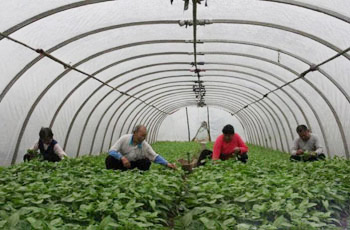
Qiaohe Village farmers picking water spinach (network illustration: Jingmen News Network)
Qiaohe Village is a village in Shihuiqiao Town, Shayang County, Jingmen City, Hubei Province, and is very famous for growing vegetables. It carries a lot of weight in the vegetable wholesale markets of cities such as Chongqing, Chengdu, Changsha, Jingzhou and Yichang. The vegetable farmers of Qiaohe Village grow only 3 kinds of vegetables: water spinach, scallions and celery. Of the village's more than 6,000 mu of land, vegetable plots account for more than 4,000 mu.
By rights, growing vegetables is not too difficult, and many nearby villages and townships also grow vegetables, but they simply cannot outgrow Qiaohe. The vendors who deal in vegetables in Chongqing, Chengdu, Changsha, Jingzhou and other places all run to Qiaohe as long as they are dealing in these 3 kinds of vegetables.
A reporter recently visited Qiaohe Village and specifically asked Chen Xianyun, the village Party branch secretary and also chairman of the village vegetable cooperative, where Qiaohe's trick lies.
With scale comes a market
Historically, Qiaohe was formed by merging two small villages, Shuangyang and Qiaohe, into one large village. People in Shuangyang once had the habit of growing vegetables, but the scale was always small. After the two villages merged in 2005, the village committee team wanted to do something and set its sights on growing vegetables. But Chen Xianyun spent several years mobilizing people, yet they simply would not move, which puzzled him greatly.
An investigation found that the problem lay in the fact that the fields were not concentrated together. When land was first contracted out, in order to be fair and mix good land with poor, one mu of land could be allocated in several places. The largest household had more than 10 mu of land in 26 separate plots. Villagers grabbed him and said, with one plot here and one plot there, how can we grow vegetables well? It turned out that growing vegetables is unlike other crops; it has high requirements for water and fertilizer. If the land is not concentrated and has no access to water and electricity, growing is laborious and it is still hard to make a profit.
"Adjust the way land is divided!" Chen Xianyun made up his mind to consolidate cultivated land by household so that everyone could farm fields that save worry and effort. But with a hundred people, there are a hundred ways of thinking. Most villagers were willing to adjust, but a few families refused. What was to be done?
"If the monkey won't climb the tree, just bang the gong a few more times!" Chen Xianyun stubbornly went from household to household doing the work. Hearts are made of flesh, and soon everyone agreed to the adjustment. Each group, using the group as a unit, divided the land into sections by paddy field, low-lying land, pond and dry land, and determined plots by drawing lots, so that all of each household's land was concentrated in one place. Those willing to raise fish drew ponds, while those willing to grow vegetables or rice drew paddy fields, low-lying land and dry land.
Once the plots were straightened out, in less than 3 years the village's greenhouse vegetable-growing scale grew from less than 1,000 mu to more than 4,000 mu. Once the scale came up, those vegetable vendors came without even being invited.
Qiaohe people grow only three kinds of vegetables
After years of exploration in growing vegetables, the people of Qiaohe found that 3 local vegetables grew best: water spinach, scallions and celery.
Later the cooperative held a meeting and decided to grow only 3 kinds of vegetables, so as to specialize and refine vegetable growing. Scale alone was not enough; they also had to grow them well, grow green vegetables and organic vegetables, so that others would be willing to come.
Lu Renjun, a vegetable vendor from Chongqing, said that the water spinach grown by Qiaohe people is neat and clean, with no pesticides and no chemical fertilizers; the scallions grow glossy and smooth; and the celery is tender and delicious with no fibers.
Take water spinach as an example; the people of Qiaohe have grown it almost to perfection. After harvesting celery in winter, they spread a thick layer of pig manure in the field, then a thin layer of cake fertilizer on top, and begin growing water spinach. Once Spring Festival is over, the first round of water spinach can be picked, and it can be picked all the way until June, six or seven rounds, with the most reaching eight rounds. For each round picked, they only need to sprinkle some water and the next crop will grow. In other words, one mu of Qiaohe greenhouse vegetables is equivalent to the output of six or seven mu of other people's vegetable plots.
Chen Xianyun excitedly told us that people in Guangdong also used to grow water spinach, but later many vegetable farmers could not outgrow them and simply stopped growing it. This was because vegetable vendors in Guangzhou switched to their vegetables.
Counting on his fingers, he said that on one mu of land, from January to June they grow water spinach, from July to September they grow scallions, and from September to December they grow celery. With these three vegetables rotating, the average net income per mu can reach 20,000 yuan. Many people have bought commercial housing in Jingmen's urban area, and almost every household has bought a car.
Selling vegetables means "rushing for freshness"
During the interview, the reporter once came to Qiaohe Village's greenhouse vegetable area at midnight. Although it was raining, hazy lights were lit in the vegetable sheds.
Yang Hongyin, member of the Standing Committee of the Shayang County Party Committee and director of the Publicity Department, pointed at the lights and told the reporter that wherever there were lights, people were picking vegetables.
"Why pick all night long?"
"To rush for freshness. Water spinach easily wilts. If it is picked at night and loaded onto vehicles in the morning, it can be delivered to the Jingzhou vegetable wholesale market in about an hour. Even to Chongqing or Changsha it takes only five or six hours, and the vegetables are still fresh when they reach the citizens."
Lifting the door curtain of one greenhouse, the reporter saw two light bulbs hanging inside, and 5 elderly women around 60 years old sitting in a row on two rows of vegetable plots, intently picking vegetables one by one. Zhang Chenghui, 65, is from nearby Wuba Village. Her grandchildren are all grown up and no longer need her care. She told us that on the third day of the first lunar month she had already come to Qiaohe Village to pick vegetables.
Zhou Xuehua, 54, is from Jinji Village, Zengji Town, and her home is 30 li from Qiaohe. She came on March 19 and rents a place in a nearby town, walking two or three kilometers every night to pick vegetables here. From midnight until six or seven in the morning, she can pick three or four hundred jin of vegetables in one night and earn 65 yuan in wages.
At 6:30 in the morning the reporter came to Qiaohe again. On the broad cement road in the central greenhouse area there was already a bustling scene, with twenty or thirty trucks busy loading vegetables.
When Chen Xianyun, who had been picking vegetables all night, saw the reporter, his first words were: "I wasn't boasting, was I? If it weren't for the rain, there would be even more vehicles and people. On clear days, there are five or six hundred elderly women coming here every day to pick vegetables, and forty or fifty trucks leave with vegetables for sale outside." (Our reporter He Hongwei; Hubei Daily reporters Jiang Yuebo and Zhang Ouya)