"Drudgery" Cleverly Made Light and Simple: Dong Hezhong's "Happy Cotton Planting"
Original title: Dong Hezhong: Light and Simple Cotton Planting, Joy in It
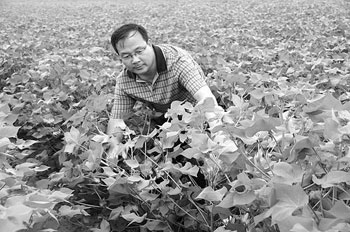
Dong Hezhong in a cotton field.
At the Shandong Academy of Agricultural Sciences there is a scientist who spends every day in the company of cotton. From the Yellow River basin to the inland northwest, from southwestern Shandong to northwestern Shandong, his figure has been left everywhere across the boundless cotton fields. He is Dong Hezhong, director of the Cotton Research Center of the Shandong Academy of Agricultural Sciences, a cotton expert who has won 16 national and provincial/ministerial science and technology achievement awards, including 4 second prizes of the National Science and Technology Progress Award.
Recently, a reporter met him at the Shandong Academy of Agricultural Sciences.
Dong Hezhong, who has watched over cotton fields for more than 20 years, has a very simple idea: to contribute more to China's cotton industry. "As an agricultural science and technology worker, on the one hand I should produce more new technologies and new achievements, and on the other hand I should offer more good suggestions to the country's decision-making departments."
Planting cotton happily
Yu Shuxun, a famous Chinese cotton expert and academician of the Chinese Academy of Engineering, once proposed letting cotton farmers "plant cotton happily," and this is also one of Dong Hezhong's wishes.
Cotton is an important cash crop in China, but planting cotton is a "drudgery." In recent years, with the transfer of rural labor and the rapid rise in labor costs, the traditional intensive cotton planting method no longer meets production needs and has seriously constrained the sustainable development of cotton production. Therefore, achieving light, simple, convenient, cost-saving, efficiency-increasing and happy cotton planting has become an inevitable requirement for the development of the cotton industry. To achieve this goal, corresponding scientific and technological support is first needed.
In order to break through the difficulties, Dong Hezhong has long fought on the front line of cotton cultivation and breeding, pouring almost all his efforts into cotton scientific research. Hard work pays off: the "light and simplified cotton cultivation technology" researched and established by the innovation team he leads has provided strong scientific and technological support for happy cotton planting.
For a long time, China's cotton planting was decentralized, with each household operating independently, and the large-scale mechanized and intelligent operations of the West did not suit China's national conditions, so the only option was to take an agricultural technology path with Chinese characteristics. Based on actual conditions and production needs, Dong Hezhong's team focused on strengthening research on key technologies such as precision sowing, simplified pruning and one-time fertilization. Around 2010, breakthroughs were first achieved in the planting and management stages, and a light and simplified cultivation technology was researched and established with key measures including precision sowing to reduce or eliminate thinning and final singling of seedlings, rational close planting combined with chemical regulation to achieve simplified pruning, and controlled-release fertilizer combined with quick-acting fertilizer to achieve one-time fertilization. On the premise of ensuring that cotton yield per unit area did not decrease or even increased slightly, labor use was reduced by more than 40%.
Take sowing as an example. In the past, cotton was always sown in large amounts or sufficient amounts, requiring 8-10 jin of seed per mu. One jin of seed contains about 5,000 grains, and if 50,000 grains emerge at a rate of 70%, that is more than 30,000 seedlings, but only 3,000-4,000 seedlings are needed in the field. Therefore, repeated thinning, spacing and final singling of seedlings were needed, which was labor-intensive, time-consuming and also wasted seed. After adopting precision sowing, only 2-3 jin of seed is needed, and with only slight adjustment when releasing seedlings, steps such as thinning, spacing and final singling of seedlings can be reduced or eliminated, greatly reducing the workload and also saving seed.
"Light and simplified cotton cultivation technology is a practical technology built on scientific research and practice. To make it easier for farmers to accept, we carried out scientific 'packaging' and 'popularization' treatment, making it an easy-to-understand, easy-to-operate 'foolproof' technology. When teaching the technology, we only need to tell farmers the general principle and a rough range, and they can carry out planting operations within that range. It is about letting farmers understand it and master it easily," Dong Hezhong said.
To achieve truly light, simple and happy cotton planting, full-process mechanized cotton planting must be implemented. Therefore, Dong Hezhong has recently focused mainly on researching full-process mechanized cotton production technology.
The full-process mechanized cotton planting technology of developed cotton-planting countries such as the United States and Australia is already very mature, and it has also been promoted and applied on a relatively large scale in China's northwest inland cotton region (**). However, due to differences in production and ecological conditions and planting methods, Shandong cannot completely copy the existing cotton mechanized production technology of foreign countries and **. For this reason, the Shandong Cotton Research Center carried out research on full-process mechanized cotton production technology, focusing on strengthening research on key technologies such as breeding of machine-harvested cotton varieties, rational close planting, chemical regulation, and defoliation and ripening acceleration.
"We established machine-harvested cotton agronomic technology based on precision sowing and concentrated boll setting as the core content, replacing manual harvesting with mechanical harvesting, basically achieving full-process mechanization of cotton production, promoting the organic integration of agricultural machinery and agronomy, and reducing cotton planting labor from about 25 workers in the past to about 6."
In order to promote the new technology, Dong Hezhong often needs to go to the grassroots. Every year he organizes more than 20 technical training sessions of various kinds, many of them in the fields, and even at night. "At night, in the village party secretary's courtyard, we set up a screen, just like showing a film in the past. We can gather 40 to 50 people. I speak for 1 hour and leave 1 hour for questions. The effect is very good."
"Some of the questions raised by farmers are ones I have never encountered, and these questions may become the subject of our next research project." One of Dong Hezhong's projects that won the second prize of the National Science and Technology Progress Award was "Creation and Application of a High-Yield Cotton Cultivation Technology System for Coastal Saline-Alkali Land." The proposal of the project came precisely from farmers' questions, and the methods for solving the problems came from the fields.
From the field, to the field
Planting cotton in saline-alkali land in coastal areas faces many difficulties, such as difficulty in establishing seedlings, poor maturity uniformity, low fertilizer efficiency and high labor demand. In response to these difficulties, Dong Hezhong and his colleagues carried out research and achieved remarkable results.
"Planting cotton in saline-alkali land means planting cotton in furrows. In fact, the source of this technology was not invented by me, but by farmers," Dong Hezhong said frankly.
15 years ago, Dong Hezhong went to saline-alkali land in Dongying to inspect cotton growth and found that cotton seedlings in saline-alkali land emerged unevenly. "Most saline-alkali cotton fields are uneven, causing uneven salt distribution, with salt patches everywhere. Whenever cotton encounters a salt patch, it dies, resulting in very serious missing seedlings and broken rows in saline-alkali cotton fields. Farmers were very troubled by this, and every time I gave a lecture, farmers raised this issue and hoped to have it solved," Dong Hezhong recalled.
But he accidentally discovered that farmers had casually scattered seeds in the irrigation ditch beside the field, and as a result the cotton in the ditch had uniform, complete and strong seedlings. Dong Hezhong immediately took soil samples from the irrigation ditch and the field ridges, and analysis found that the salt content was lowest in the central area of the ditch and highest at the highest point on the ridge. Salt concentration decreased from ridge to ditch and from top to bottom. Dong Hezhong found that the secret lay in salt moving with water. "Salt in the field dissolves into soil water. Salt moves with water. The higher the place, the greater the water evaporation. After the water evaporates, the salt remains in the soil, causing the phenomenon of salt climbing to higher places."
Dong Hezhong's team also invented a grafting and root-splitting method, accurately simulating the differential distribution of salt in the root zone indoors, and revealed the mechanism of differential salt distribution from different levels of physiology and molecular biology. On this basis, they designed a furrow-and-bed film-mulching planting technology that can induce differential salt distribution in the root zone in the field and promote cotton seedling establishment, and developed supporting machinery. Thus, the physiology, ecology and cultivation technology of cotton in coastal saline-alkali land emerged. Dong Hezhong's team proposed the theory that differential salt distribution in the root zone promotes cotton seedling establishment, and created new technologies such as furrow-and-bed film-mulching planting, pre-film-mulching cultivation, late spring sowing of short-season cotton, and positioned drip irrigation to induce differential salt distribution in the root zone and achieve seedling preservation and yield increase, achieving full seedling establishment in one sowing on saline-alkali land with a salt content below 0.7%.