Giant salamander prices fell from over a thousand yuan per jin to just over a hundred yuan; how can the industry escape its predicament?
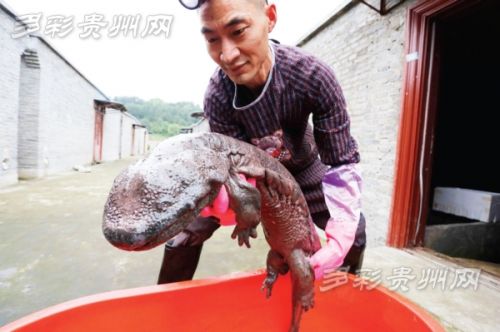
Four years ago, one giant salamander sold for 1,500 yuan per jin. Now, it is only just over a hundred yuan per jin.
Recently, a tourist ate a meal of giant salamander at an ordinary restaurant in Guilin, priced at 1,500 yuan per jin. One giant salamander weighing 3.3 jin came to nearly 5,000 yuan in total, which the media dubbed a "sky-high price giant salamander."
Four years ago, a giant salamander selling for 1,500 yuan per jin was not considered unusual; because of its "sky-high price," that was once one of its most attention-grabbing labels.
Tang Jie, station chief of the technology extension station at the Animal Husbandry and Aquaculture Development Promotion Center of Guiding County, Qiannan Prefecture, told reporters that in 2012, when Guiding's giant salamanders were at their most popular, the price reached 2,000 yuan per jin. Four years on, in Yanxia Township of Guiding County, known as "China's Home of the Giant Salamander," the retail price of one jin of giant salamander has fallen to around 200 yuan.
From the beginning of 2016 to April 18, counting the peak sales season during Spring Festival, Su Zhilong, a farmer in Matatun Village, Yanxia Township, Changming Town, Guiding County, had only closed his fifth giant salamander deal of the year -- 3 giant salamanders, 20 jin in total, at only 100 yuan per jin.
Lan Hongming, the "leader" of Guizhou's giant salamander industry and general manager of Guizhou Jinjiang Giant Salamander Technology Co., Ltd., which has a 20-year breeding history, works in an office in the Kempinski building in Guiyang. Outside his office all is bustling and prosperous, yet his situation is full of crisis.
He told reporters, "Right now is a difficult period for the giant salamander."
Qu Jiyong holds his giant salamander noodles in his hands.
The Beginning
Building a domestication and breeding base
Yanxia Township in Guiding County has abundant giant salamander resources. The arrival of Guizhou Jinjiang Giant Salamander Technology Co., Ltd. marked the beginning of the area's giant salamander "glory days."
In 2004, Guiding County brought in Guizhou Jinjiang Giant Salamander Technology Co., Ltd. and built the largest wild giant salamander domestication and breeding base in the Southwest region in Yanxia Township. In 2006, the title of "China's Home of the Giant Salamander" gave Guiding County more confidence in domesticating and breeding giant salamanders.
Three years later, Jinjiang succeeded in artificially breeding giant salamanders, and Guiding County decided to support the giant salamander industry locally.
"A single fry cost 980 yuan. For the villagers, that was a big investment, and not many dared to raise them," Tang Jie said. "In the end, it was the township's leading officials who took the lead, and that's what lit this 'fire.'"
Zou Yong, director of the Yanxia branch of the Guiding County Rural Credit Cooperative Union, told reporters, "In the years when 'giant salamander' loans were at their peak, every trip to Yanxia Township meant visiting more than 20 farmers in one go."
Qu Jiyong, chairman of the Yanxia Giant Salamander Imitative-Ecological Breeding Farmers' Professional Cooperative and general manager of Guiding County Qianmeng Agricultural Technology Co., Ltd., was one of the earlier joiners of the "giant salamander" poverty-alleviation ranks.
In 2008, while still working in Shenzhen, he had already been through 8 failed ventures, including growing bamboo shoots, figs and cherries, and was several tens of thousands of yuan in debt. Determined to start a business, he heard the news, returned home from Shenzhen, borrowed money from family and took out a credit union loan, scraping together 40,000 yuan to buy 40 fry.
The fry he bought were placed in a plastic tub 3 m long and 1.5 m wide, set behind the house.
Some were even less particular: some farmers simply put them in a basin and stuck it under the bed.
Three years later, Qu Jiyong's small fry had grown to around 4 jin each. At the time the fish price was about 1,500 yuan per jin, and Qu Jiyong sold all 40 fish. In one turn, the original 40,000 yuan became 200,000 yuan.
An overview of Guiding's deep-processed giant salamander products.
Glory
A small Western-style house for every household
From 2008 to 2012 was the "peak period" for Guiding's giant salamanders. Qu Jiyong said, "Raise two giant salamanders and you can become a household with 10,000 yuan."
In 2007, Guiding County mobilized 49 farming households in Yanxia Township, who together raised 980 giant salamanders. In the following years, both figures increased year by year.
The growing scale attracted consumers from all over the country. Especially as the plaque of "China's Home of the Giant Salamander" was settled in Guiding County, and the fame spread by "group promotion," customers from within and outside the province came in an endless stream.
Qu Jiyong's phone almost became a hotline, receiving consultation calls from all over the country every day. When he got orders from Beijing and Shanghai, Qu Jiyong packed the giant salamanders in foam boxes, added ice and shipped them out; for orders within the province, once the goods were ordered in the morning, Qu Jiyong would stay at home, and in the afternoon Mercedes-Benz and BMW cars would drive over from Guiding county town and Guiyang to pick up the goods.
Qu Jiyong said that before everyone started raising giant salamanders, Yanxia Township was still a poor place where "girls from other villages would not even marry into it."
In the file photos provided by the Animal Husbandry and Aquaculture Development Promotion Center of Guiding County, before 2008 in Yanxia Township, tile-roofed houses lined both sides of the road, along with quite a few dilapidated huts and thatched sheds.
But after entering the "giant salamander era," in almost only 3 years, every household lived in a modern small Western-style house, and all kinds of cars were parked on the open ground in front of their doors.
When he first started his business, Qu Jiyong only drove a minivan. Now what sits at home is a brand-new sedan.
To better breed giant salamanders, many large farming households in Guiding County built imitative-ecological giant salamander breeding farms.
The Turning Point
Market prices fall several times in a row
In 2010, Qu Jiyong set his mind on expanding the scale.
Qu Jiyong borrowed 150,000 yuan from the rural credit union, rented a piece of land in Yanxia with a good ecological environment, and built an imitative-ecological breeding farm. This imitative-ecological breeding farm drew on the experience Qu Jiyong had gained from inspections in Shaanxi and Sichuan, and fully simulated the living environment of wild giant salamanders. After two years of exploration, the survival rate of the giant salamanders Qu Jiyong bred had reached over 90%.
Because the breeding technology had matured, the price of giant salamander fry also dropped from the initial 980 yuan each to 300 yuan each.
In 2012, still the "peak period" for giant salamanders, Qu Jiyong had already written in his QQ space: "Maybe in a few more years, everyone will be able to eat giant salamander."
His premonition was not wrong.
In 2013, the market price of giant salamanders fell to 500 to 800 yuan per jin; in 2014, the price fell again, to around 300 yuan.
In 2015, buying a 5-jin giant salamander on the market cost only about 1,000 yuan, at 200 yuan per jin.
In 4 years, the unit price of giant salamanders fell from 2,000 yuan per jin to 200 yuan per jin, catching the farmers who had rushed in unprepared, and everyone went from jubilation to "deep anxiety" in an instant.
While the market price was still 200 yuan per jin, some farmers sold off the giant salamanders they had at the low price of 180 yuan per jin, packed their bags and once again left home to work.
Predicament
165,000 giant salamanders awaiting sale