Making a fortune from honeysuckle farming, and raising ecological fish too
Feeding the fish
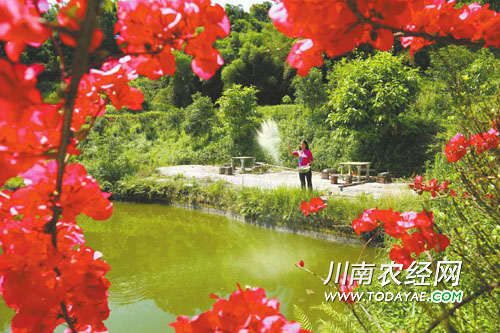
In May, in Fangshi Village, Liugeng Town, Jiang'an County, Yibin City, more than 2,000 honeysuckle plants were in full bloom, in tender yellow and pinkish white, giving off a delicate fragrance and delighting the eye.
In the honeysuckle base, the honeysuckles were blooming beautifully, in tender yellow and pinkish white that delighted the eye; on closer look, the flowers were at different stages of bloom and their colors also varied. Each flower has two blossoms on one stem, with two stamens reaching out, in pairs, inseparable, like mandarin ducks dancing together.
"Honeysuckle starts blooming one after another from the end of April, with the flowering period from April to June. Tourists from Yibin, Luzhou and Leshan all come here, drawn by its fame, first to enjoy the fun of picking honeysuckle for free, and second to taste authentic farm dishes such as douhua, free-range chicken and ecological fish," said Zhang Quan, head of the honeysuckle base. He said the farm will next introduce about 5,000 more honeysuckle plants and build this place into the largest honeysuckle viewing base in Jiang'an.
Zhang Quan explained that in the honeysuckle base, dozens of free-range chickens are kept, and these chickens feed on coarse grains, vegetable leaves, honeysuckle and so on. He mixes honeysuckle with soybeans, corn, millet, rapeseed meal and so on in a certain ratio to use as raw material for feeding the fish, and is currently applying for an ecological organic fish brand.
"In 2010, with the help of the Jiang'an County Science and Technology Bureau, I began introducing and planting honeysuckle. At that time the price of honeysuckle was 200 yuan to 300 yuan per jin, the economic returns were quite good, the flowers bloomed well too, and we were too busy to pick them all. At that time I planted about 5 mu, with income of roughly 10,000 yuan," Zhang Quan said. By 2013, many places had introduced honeysuckle cultivation, the market gradually began to saturate, and so the price of honeysuckle fell to 40 yuan to 80 yuan per jin. After the economic returns of honeysuckle declined, he had a sudden idea: honeysuckle is a medicinal herb, and the grass carp fry in the pond are prone to diseases such as enteritis; could feeding honeysuckle to the fish strengthen the fry's ability to resist disease? After he fed the fish with fish feed mixed with honeysuckle, the effect turned out to be especially good, not only reducing the cost of buying fish medicine, but also improving the ecological quality and raising the quality of the fish, so the economic returns of the adult fish were higher.
"Every year from May to October is the high-incidence period for fish diseases, but by mixing honeysuckle into the fish feed in a certain ratio, the disease control effect reached 99%." Zhang Quan explained that the fish he raises are never fed compound feed, so the fish quality is guaranteed; breeding costs increase, and the market price is also twice the price of ordinary fish quality. Although the fish Zhang Quan raises are relatively expensive, they have already been accepted by residents, and sales are relatively good. Next he will negotiate with supermarkets to sell fish in supermarkets.
At the same time, Zhang Quan sells fry to farmers, and after the farmers raise the fish to maturity they sell them back to Zhang Quan. Zhang Quan first sends the fish to Chengdu for testing, and only if indicators such as heavy metals do not exceed the standard will he buy them. Zhang Quan raises these purchased fish in his own breeding area and feeds them with grain, and only after a 12-month conversion period will he sell them.