Raising forest frogs in vineyards, farmers become partners
+
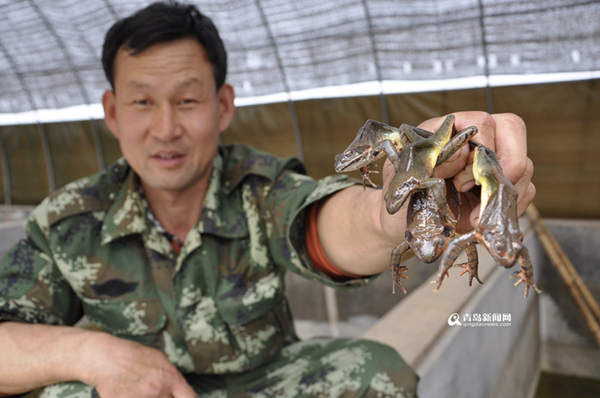
Walking into Houtun Village, Jiaobei Subdistrict, Jiaozhou City, modern breeding greenhouses stand out prominently. Inside the greenhouses, tens of thousands of forest frogs are making deafening calls, as if bringing people to the edge of a pond after a summer rain. Jin Guomu, secretary of the Houtun Village Party branch, told reporters that forest frog breeding is a village-enterprise cooperation poverty alleviation project explored by Jiaobei Subdistrict, which began operating last year. Forest frog breeding has transformed local villagers from impoverished households into "makers," with incomes rising sharply.
Starting in the second half of 2015, Houtun Village, Jiaobei Subdistrict, Jiaozhou City, built a 3,000 sq m forest frog breeding greenhouse, trying out a cooperation model of "enterprises raise frogs, villagers raise insects." Although the project has been operating for less than a year, results have already begun to show. Villagers participating in the project now have a fixed monthly income and have become "partners."
Forest frogs have become a famous delicacy on people's dining tables because of their delicious taste and rich nutrition. They became a tribute item during the Ming and Qing dynasties and were listed among the imperial court's "Eight Treasures." At present, the economic value of forest frogs is considerable. According to reports, the market price of adult forest frogs can reach 180 yuan/jin, and demand exceeds supply. In "Compendium of Materia Medica," the forest frog is called "Shanha," also known as Hashima or snow frog, mainly produced in the Changbai Mountain area of Northeast China. The dried substance of the female frog's placenta is called "snow frog oil," with a market price as high as 5,000 yuan/jin. It has the effects of tonifying deficiency and moistening the lungs, and strengthening the body. Since ancient times, it has been praised among the people as a world-renowned nourishing treasure on par with the Three Treasures of Northeast China. It has been widely used by people for thousands of years, and its pharmacological effects have long been known.
On May 11, reporters saw at the Houtun Village forest frog breeding base that the entire breeding greenhouse is an independent ecological system. Grapevines are planted inside the greenhouse, and among the trees are dozens of cement pools, with groups of tadpoles swimming in the pools. "In about a month, these tiny tadpoles will become forest frogs," introduced Manager Lin, head of the greenhouse. The vineyard is the forest frogs' home and "canteen." With some supplemental artificial feeding, the forest frogs have no shortage of food or drink.
The entire breeding base currently has more than 50,000 forest frogs. Their food is mainly insects. In addition to insects naturally reproducing in the vineyard, they mainly rely on artificial feeding.
Manager Zhang, the person in charge on the enterprise side, introduced that technicians specially bred a kind of yellow mealworm, which forest frogs like very much. Because forest frogs have an extremely large demand for yellow mealworms, the enterprise reached cooperation with local villagers, and the yellow mealworms are mainly incubated by villagers and supplied to the breeding base. In other words, in addition to participating in forest frog breeding, villagers can also supply yellow mealworms.
How much money can be made by breeding yellow mealworms? Jin Guomu, secretary of the Houtun Village Party branch, did the math for reporters: yellow mealworms take only 100 days from egg to adult. The cost of one jin of yellow mealworms is 2 yuan, and the market price of adults is 5 yuan. The company purchases at a protective price of 5 yuan/jin. Calculating on the basis of each household breeding 500 jin, the average monthly income is 2,500 yuan, and the net profit is 1,500 yuan.
In addition, there is also income from insect feces. Each jin of adult insects produces 2 jin of feces. Calculated at a purchase price of 0.3 yuan per jin of insect feces, this can bring people another 1,800 yuan in benefits. "Because this is a poverty alleviation project, we give priority to impoverished households for production," Jin Guomu said.
Since Houtun Village introduced the forest frog breeding project, local villagers' incomes have risen sharply. Jin Guomu introduced that in the past, villagers' income mainly depended on growing grain, and the income was very limited. Once they encountered illness or had to pay for their children's schooling, it was hard to cope. Therefore, there were quite a few impoverished households in the village. Now that the project has landed, villagers have become makers, incomes have increased, and enthusiasm has also been stimulated. The village's appearance is expected to change rapidly.
"We plan to expand the project next and develop tourism," Ma Jinxiu, secretary of the Jiaobei Subdistrict Party Committee, told reporters. Because specialty fruit planting in Jiaobei Subdistrict has always been an important industry, the forest frog industry can develop together with the fruit industry. Whether it is village-enterprise cooperation or the coexistence of frogs and fruit, it is well worth promoting. Next, Jiaobei Subdistrict will expand the scale of forest frog breeding according to specific circumstances, so that more villagers can increase their incomes.
"Through experiments, we found that raising forest frogs in vineyards does not hold back either side, and it builds a relatively balanced ecosystem. Next, we will gradually expand the variety of fruits and at the same time let more villagers participate in the project, organically combining fruit planting, forest frog breeding, and eco-tourism to create a classic case of poverty alleviation," Jin Guomu said.