Lianzhou returnee from abroad uses drones to focus on pest and disease control
Original title: "Flying" operations boost agricultural development
Lianzhou talent Huang Shan returns home to found a technology company, focusing on the development and application of agricultural plant protection drones
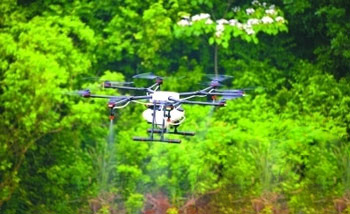
Drone
Staff are debugging the drone.
Huang Shan
As long as altitude, flight path and other parameters are set, the drone will fly on its own and carry out spraying operations, without even needing manual control.
On the hill covered with fragrant camphor trees in Xiaoxiao'an Village, Chaotian, Longping Town, Lianzhou City, a white drone rides the wind, spraying atomized pesticide along a predetermined route. In just 5 minutes, it completed spraying more than 4 mu of woodland, drawing repeated praise from Wu Weibing, chairman of the Lianzhou City Hongsen Fragrant Camphor Professional Cooperative.
"The work a drone does in 5 minutes is equivalent to a worker's whole day's workload," Wu Weibing said. The drone is not only fast, but also sprays precisely, and it avoids the safety hazards of manual operations. "From now on, I'll choose Mr. Huang's drone service for my 300 mu of land."
The Mr. Huang he referred to is named Huang Shan, a native of Xiahuan, Fengyang, Lianzhou, and only 30 years old this year. After returning from his studies in Canada in 2008, he worked successively at Shenzhen Airlines and Guangzhou Baiyun International Airport, obtaining release authorization for Boeing 737 and Airbus A320 aircraft.
Driven by his obsession with mechanical design and invention, and seeing the advantages and potential of drone applications in agriculture, Huang Shan resolutely gave up his high-paying airport job in 2015 and returned to Qingyuan to found Qingyuan City Jujin Technology Co., Ltd.
"This time back in Lianzhou, the main purpose is to demonstrate drone spraying operations for pest and disease control. The results are good, and the growers are very satisfied," Huang Shan told reporters. The company focuses on the development and application of agricultural plant protection drones, and plans to train and build a professional, certified plant protection flight team to provide modern services for hometown agricultural production and pest and disease control.
Spraying 1 mu of land in 1 minute
"I didn't expect it to be so fast! With traditional manual work, a worker normally sprays only 4 mu of land per day, but the drone completed it in less than 5 minutes."
The transition between spring and summer is a period of vigorous plant growth. As temperatures gradually rise in May, pests and diseases begin to enter a period of high incidence. However, the traditional tool farmers use to spray pesticide - the manual backpack sprayer - has many difficult-to-overcome problems: high labor costs, long operation time, low work efficiency, low pesticide utilization rate...
Especially in the hilly areas of Lianzhou with relatively steep slopes, farmers face greater difficulty in spraying pesticide, high labor intensity, and long working hours, which greatly affects production and planting. How to effectively prevent and control pests and diseases? This is a problem troubling many farmers in Lianzhou.
"This fragrant camphor grove covers about 300 mu, and in June this year it will enter the period of high incidence of pests and diseases. Because pest outbreaks happen very quickly, we often need to finish spraying pesticide within 1 or 2 days. Once delayed, these camphor leaves will be eaten up by pests, causing serious losses." Wu Weibing, chairman of the Lianzhou City Hongsen Fragrant Camphor Professional Cooperative, explained that fragrant camphor is a high-efficiency agriculture and forestry industry built by the cooperative using Lianzhou's unique climate environment.
However, as large numbers of rural laborers move to cities for work, the labor force engaged in agricultural production in rural areas continues to shrink, which naturally drives up the labor cost of agricultural production. Wu Weibing said it is now very difficult to hire workers, and labor costs are also high. "Based on past experience, we need to finish pesticide spraying within 1 day. Then, calculating at an efficiency of 4 mu per person per day, we would need to hire 80 workers to operate at the same time in order to finish spraying more than 300 mu of land within 1 day. In that case, we would very likely face the dilemma of being unable to hire people and excessively high labor costs."
This is not an isolated case. In the townships of Longping Town, Xingzi Town, Xijiang Town, Dalubian Town and other mountainous areas of Lianzhou, due to the terrain, farming is mainly based on mountain land. Yet pest and disease control for peach trees, pear trees, camphor trees and other trees is a task with tight timing, urgent demands, and high difficulty.
So how can pesticide spraying be completed efficiently and quickly? Huang Shan, general manager of Qingyuan City Jujin Technology Co., Ltd., recently made a special trip back to his hometown with a drone to conduct a demonstration.
The mountain slope exceeds 45 degrees, making manual operations quite difficult. But a white drone took off steadily, spraying pesticide back and forth evenly over the mountain land, and soon completed the spraying task for the designated plot.
"I didn't expect it to be so fast! With traditional manual work, a worker normally sprays only 4 mu of land per day, but this drone completed it in less than 5 minutes." Wu Weibing was very satisfied with the drone's operational results.
The key to drone development lies in the economic value generated by high efficiency. "The spraying efficiency of our drone can reach 1 mu of land per minute, which can greatly save labor time and reduce labor intensity," Huang Shan introduced.
Wu Weibing deeply agreed with this. "Now we only need to purchase drone services, and we can easily achieve the ideal effect of pest and disease control."
Operations unaffected by terrain
As long as altitude, flight path and other parameters are set, the drone will fly on its own and carry out spraying operations, without even needing manual control, and can implement group prevention and group control in a short time, adapting to large-area, sudden pest and disease control
With the accelerated advancement of rural land transfer, there are more and more professional cooperatives, family farms, and large growers in Lianzhou, and the demand for pest and disease control is growing. Traditional backpack sprayers are difficult to adapt to the needs of large-area, sudden pest and disease control. Drones can provide a completely modern solution to the above problems.