Pear industry technology system helps pear farmers' lives undergo earth-shaking changes
Original title: The spring breeze urges "pear blossoms to bloom"
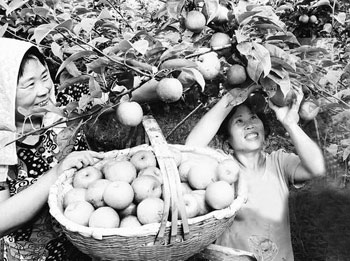
Picking pears. Image source: Baidu Images
The cultivation history of pears is very long; recorded history alone spans more than 3,000 years, making it a fruit with distinctive character and cultural heritage.
As the world's largest pear-producing country, China's total pear area reaches 1.11 million hectares, with total output reaching 17.3 million tonnes, accounting for 62.9% of the world's total pear area and 68.6% of total output respectively.
"China's pear industry shows characteristics of very wide distribution, many domestic varieties, huge output, and relatively low prices." Professor Zhang Shaoling, chief scientist of the Modern Agriculture (Pear) Industry Technology System and director of the Pear Engineering Technology Research Centre at Nanjing Agricultural University, said in an interview with a China Science Daily reporter that with the establishment of the national pear industry technology system, the pear industry has already undergone earth-shaking changes.
Extensive industry practices lead to low export prices
Pears are China's third-largest fruit tree, with area and output second only to apples and citrus. However, China's pear planting area and output rank first in the world. China is the world's largest pear producer; to put it figuratively, for every 10 pears produced in the world, 7 come from China.
Pears are widely distributed in China, from south to north, and are cultivated in all regions except Hainan Province.
"Pears have a very important characteristic: about 85% of the pear varieties cultivated in China are our own traditional local varieties, or varieties we have bred ourselves, and the proportion of domestic varieties being cultivated is growing higher and higher." Zhang Shaoling introduced, "This is currently a major advantage of China's pear industry."
In recent years, China's annual pear export volume has been about 400,000 tonnes, ranking first in the world in export volume. The main export destinations are Southeast Asian countries such as Malaysia and Indonesia, and neighbouring countries such as Russia; a small amount is also exported to some developed countries.
"However, the price of China's exported pears is not high, somewhat lower than the world average price." Zhang Shaoling said this is because the quality of the pears is slightly poorer, pear cultivation is relatively extensive, the overall production level is relatively low, and thus competitiveness in the international market is weaker.
Pears have wide adaptability and many types, showing the characteristics of "three regions and four points." The "three regions" are the North China white pear region, the Northwest white pear region, and the middle and lower Yangtze River sand pear region. The "four points" refer to distinctive pear regions, including Liaoning Nanguo pear, Yunnan red-skinned pear, **Korla fragrant pear, and Jiaodong Western pear.
Scientific and technological progress is outstanding
Facing the complex domestic pear industry situation, after several years of system implementation, "overall scientific and technological progress has been relatively great." Zhang Shaoling summarised.
First, in recent years the pear industry has basically achieved steady and relatively rapid development. The overall situation is that the pear area has increased by nearly 1 million mu, and output has increased by about 2 million tonnes. Total output has increased and risen steadily. Per-unit yield is higher than in the past, and high-quality fruit and good fruit varieties have increased considerably.
Through the construction and operation of the pear industry technology system, the promotion and application of new pear varieties and new technologies have been driven in 105 demonstration counties (districts) across 19 provinces (municipalities and autonomous regions) nationwide, and 207 high-level standard demonstration orchards have been established, with an area of about 66,000 mu, and a radiating promotion area of more than 5 million mu.
Especially in light and simplified production technology, the transformation of labour-saving, efficient, light and simplified efficient cultivation models has played a great leading role, promoting the development of labour-saving and efficient cultivation models. This is very suitable for the development trend of modern orchards.
Compared with traditional pollination operations, the liquid pollination technology developed by Zhang Shaoling's research group can increase pollination efficiency by 36 times. "For example, artificial pollination in a one-mu pear orchard requires 1.5 workers for a whole day, whereas with the liquid pollination method, 1 person can complete the same workload in one hour. Especially within the flowering period of less than a week, it can save even more labour and improve efficiency." Zhang Shaoling said.
In recent years, Dongzhitianmu Agricultural Ecological Park, which has long-term technical cooperation with Nanjing Agricultural University, has also enjoyed the enormous benefits brought by science and technology.
"Nanjing Agricultural University is the technical support for our pear orchard." Ren Bomin, head of Dongzhitianmu Agricultural Ecological Park, said with emotion in an interview with a China Science Daily reporter that cooperation with universities has solved enterprises' technical worries.
According to him, help and support in cultivation management, variety improvement and other technical aspects enable the orchard to produce high-quality pears. "An ordinary pear orchard reaching 3,000 jin per mu is already very good; we can basically reach a yield of about 4,500 jin per mu. Not only is the yield higher, the quality is also better, and the market price is therefore more considerable."
Among them, there is also one technology that Zhang Shaoling finds very meaningful: "That is, we have solved the industry problem of a high proportion of 'male pears' (persistent-calyx fruit) in pear varieties such as **Korla fragrant pear."
On the market, "female pears" (deciduous-calyx fruit) are more expensive than "male pears" (persistent-calyx fruit), and are also better in taste, flesh texture, sugar content and so on. "After about three years of experiments, my research team and I developed a 'formula', and it has now been promoted in the main production areas of **Korla fragrant pear. As long as our 'prescription' is used during the flowering period, more than 90% of the fruit can be 'female pears'." Zhang Shaoling said.
A long and heavy road ahead
Now, the overall domestic research level on pears has entered the international advanced ranks, and some fields are already in a leading position internationally. However, the overall industry level still lags behind developed countries.
"This is because many of China's achievements and technologies have a low conversion rate and low popularisation rate in the production process." Zhang Shaoling pointed out.
In recent years, the construction of the national pear industry technology system has brought new opportunities for the rapid improvement of China's pear industry level. Under the stable support of the system, a nationwide pear research network has been gradually established and improved, forming an expert team covering the pear industry chain, including 21 position scientists and 21 comprehensive experiment station directors, distributed across 19 major producing provinces (municipalities and regions) nationwide. Each position expert or experiment station director is equipped with a team of about 5 people, jointly forming a research team and talent echelon of more than 200 pear researchers spanning old, middle-aged and young generations.
"The construction of the system has achieved full coverage of every link and every stage of the entire industry chain." Zhou Yingheng of Nanjing Agricultural University, director of the Pear System's Storage, Processing and Industrial Economics Research Office, said in an interview with a China Science Daily reporter that the industrial economics position also plays an important role.
In Zhou Yingheng's view, the construction and implementation of the system has greatly improved China's scientific research system. "This kind of innovation is very forward-looking and very meaningful." Their work focuses mainly on collecting data at the comprehensive demonstration county and farmer levels, and tracking changes in pear industry production, costs and sales prices. Through basic data collection and observation point surveys, they gain a more systematic understanding of industry trends. In the future, the system will continue to track the varieties, quantities and prices of China's 7 major pear cultivars, 10 major producing-area wholesale markets and 11 major consumption-area wholesale markets.
Overall, "during the '12th Five-Year Plan' period, under the stable support of the industry system, we achieved relatively outstanding results, with remarkable industrial technological innovation, and some mature technologies were widely applied." Zhang Shaoling said. "In addition, we still need to carry out some applied basic research, with the focus still on developing new technologies, so as to make various technical reserves for industry development."