After 10 years, he finally grew his "fruit of wealth" as he had wished
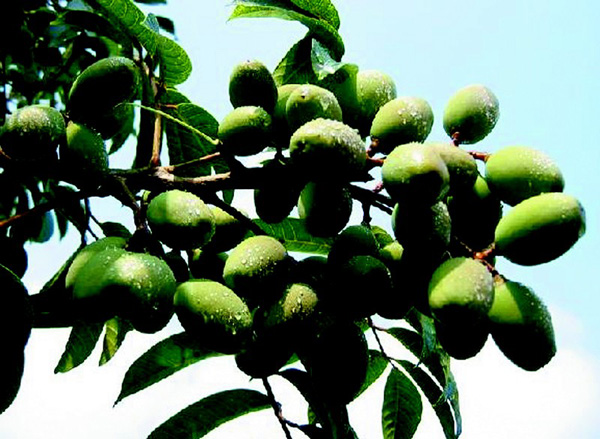
Fang Dong inspects the growth of the olive trees.
Ten years ago, he took an unusual path and planted olive trees. Not only did he become an olive tree expert, he also registered an agricultural development company and set out on a golden road to wealth. His goal is not only to grow olive trees, but also to extend into processing and produce Shiyan's own olive oil. He is Fang Dong, deputy general manager of Jilanyuan (Hubei) Agricultural Development Co., Ltd.
The work unit was restructured, and he decided to change careers and grow olive trees
Fang Dong, 48 this year, is from Fang County and originally worked at a work unit in the urban area of Shiyan. In 2002, Fang Dong's mother went to the hospital because of high blood pressure. The doctor told Fang Dong that since his mother had this illness, it was best for her to eat olive oil. Fang Dong grew up in the countryside and knew sesame oil, peanut oil and rapeseed oil, but had never heard of olive oil. For his mother's health, Fang Dong asked around about where olive oil was sold. Later he heard that a shop on Liulin Road specialized in selling olive oil, at 200 yuan per jin!
At the time, Fang Dong's monthly salary was only a little over 200 yuan. "What kind of oil is this? One jin costs as much as my monthly salary!" Fang Dong was astonished.
After Fang Dong's mother ate olive oil, her symptoms indeed eased. From then on, Fang Dong began to pay attention to olive oil. Through newspapers and magazines, Fang Dong learned that olive oil is the oil pressed from the fruit of the olive tree, hailed in the West as "liquid gold," with many benefits such as promoting blood circulation, improving digestive system function, beauty care, and preventing cardiovascular and cerebrovascular diseases. It is highly popular in European and American countries.
In 2003, the work unit was restructured, and Fang Dong faced the question of where to go from there. Having learned about the benefits and market value of olive oil, Fang Dong began to wonder whether he could do something with olive trees.
The first thing Fang Dong considered was whether Shiyan was suitable for growing olive trees. He learned that our city had planted olive trees in the 1960s and 1970s, but they were abandoned because they did not produce considerable economic value, and some of those olive trees were hidden in the mountain forests, unknown to anyone.
Fang Dong had never seen an olive tree. After learning that there was a remaining olive tree on Liuyan Mountain, he went out of his way to look for it, and in the end he really found it. Fang Dong found that although this olive tree had weathered decades of wind and rain, it was full of vitality. People who understood the habits of olive trees told Fang Dong that the low-mountain river valleys below 600 m elevation in Shiyan were relatively suitable for planting olive trees, and that even in extreme weather they usually would not die from freezing or drought. Fang Dong also once went to Yunyang District, where olive trees had been planted, to investigate, and found many neglected olive trees standing in farmers' fields. Since they had been planted for decades and could still grow so well without anyone tending them, that showed olive trees could be planted in Shiyan.
Starting in 2003, Fang Dong spent more than two years investigating and studying the olive tree project. After reaching a positive conclusion, Fang Dong decided to plant olive trees on a large scale.
Investing a million yuan, Liupi built an olive tree base
In 2006, Fang Dong set up an olive tree base in Liupi Town, Yunyang District, with an area of 50 mu, and the first batch of saplings was purchased from Longnan, Gansu. After that, Fang Dong said goodbye to the bustle of the city, eating and living at the base, busy every day with farming work such as planting seedlings and hoeing weeds.
Everything is hard at the beginning. Although he had correctly judged that growing olive trees had "money prospects," only when he truly threw himself into this line did Fang Dong discover that difficulties were everywhere. First, although before planting Fang Dong had gone out to learn planting techniques, in actual practice he still encountered all kinds of problems: when pruning the trees, the branches were not pruned well and the trees were pruned to death; when spraying herbicide, the weeds were fine but the trees were ruined. Fang Dong learned while working and gradually figured things out. In the end, he actually obtained the national horticulture second-level technician certification.
In addition, growing olive trees faced a severe test: large investment and slow results. If olive trees were planted well, they would not bear fruit until several years later; if planted poorly, they might struggle to bear fruit for many years. Before they bore fruit, Fang Dong could only keep pouring money into them. In just a few short years, he "sank" more than 1 million yuan into the base. From 2006 to 2011, Fang Dong basically saw only investment and no output.
Finally seeing returns, the olive fruit became the "fruit of wealth"
After all, Fang Dong was a laid-off worker and could not continue investing. When he was caught in a dilemma, Fang Dong fortunately met a benefactor. In 2011, he became acquainted with a Taiwanese businessperson investing in the mainland. The Taiwanese businessperson was very optimistic about Fang Dong's olive oil project and decided to inject 10 million yuan. That same year, Fang Dong contracted 500 mu of land in Shujiagou, Liupi Town, Yunyang District. Subsequently, Jilanyuan (Hubei) Agricultural Development Co., Ltd. was successfully registered, and Fang Dong became deputy general manager.
After several years of planting, the olive tree seedlings Fang Dong had planted back then grew into a forest, and in 2015 they bore fruit on a large scale. Once an olive tree bears fruit, each tree is a "small oil field," bearing fruit year after year without stop, and Fang Dong smiled.
In recent years, Fang Dong has adopted methods such as providing technology as equity to cooperate with others in building multiple olive tree bases in Danjiangkou City, Yunyang District and other places. In addition, he has introduced and planted more than 20 olive tree sapling varieties, bringing the number of sapling varieties to more than 30, and cooperates with some farmers by selling saplings. Because the olive tree saplings he sells are cultivated locally, they are better adapted to the local climate and soil, and the survival rate after planting is much higher than that of saplings purchased from elsewhere, so they are deeply welcomed by farmers.
In 2015, Fang Dong also trial-produced olive oil from the harvested olive fruit, successfully producing 5 tons of olive oil. Before these oils even went on the market for sale, they were snapped up by relatives and friends. Some people even sought him out by reputation to ask to buy some, but because there was no stock, he could only repeatedly apologize.
Deep development, Shiyan-produced olive oil expected to hit the market
Not long ago, a reporter, having heard of him, came to Liupi Jilanyuan (Hubei) Agricultural Development Co., Ltd., where Fang Dong was busy among the trees. Behind him, row after row of olive trees were blooming. Fang Dong told the reporter that olive trees harvest fruit every November, and this year's harvest should be good. At the base, the reporter also saw some olive branches drying in the shade. Fang Dong proudly told the reporter: "The olive tree is a treasure from head to toe; even the olive leaves are useful, and pharmaceutical factories buy them to make medicine."
The reporter learned that at this year's National "Two Sessions," Xue Liang, a member of the National Committee of the Chinese People's Political Consultative Conference, and 6 other members submitted the "Proposal on Accelerating the Development of the Olive Industry." In the proposal, accelerating the development of the olive industry was placed in an important position for raising the incomes of farmers in poor areas.
Statistics show that in 2014 China imported 42,000 tons of olive oil, and it is expected that by 2020, at an annual net increase of 10,000 tons, it will reach 100,000 tons.
Olive trees are continuously bringing returns to Fang Dong's company, but Fang Dong's future plans are not limited to this. Jilanyuan (Hubei) Agricultural Development Co., Ltd. has already acquired land to build a factory and ordered a set of Italian-made cold-pressed olive oil equipment production line. It is expected that by the end of this year, this production line will begin operating and produce Shiyan's olive oil.
After experiencing hardship and adversity, the olive trees have brought Fang Dong ever greater returns, and he has already set out on the golden road to wealth. He believes that olive trees grown in the Shiyan area, with its good mountains, good water and good ecology, will certainly produce even higher-quality olive oil.