Farmed pufferfish may soon be allowed on the table, wild live fish still banned
Original title: Pufferfish are poisonous
"Eating pufferfish is illegal" may become history
Three ministries and commissions plan conditional lifting of the ban
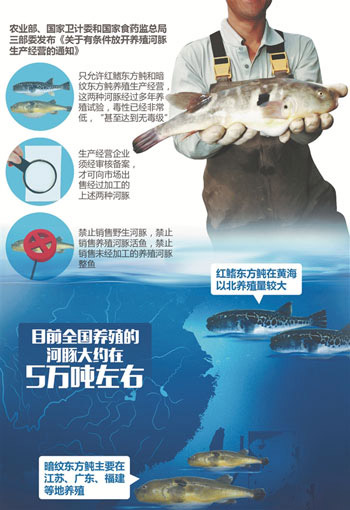
Illustrated explanation of the "Notice on Conditionally Lifting Restrictions on the Production and Operation of Farmed Pufferfish"
The Ministry of Agriculture, the National Health and Family Planning Commission and the State Food and Drug Administration, three ministries and commissions, recently commissioned relevant units to hold a hearing on the draft jointly issued document "Notice on Conditionally Lifting Restrictions on the Production and Operation of Farmed Pufferfish", and the safe consumption of pufferfish may be legalized in our country. The China Fisheries Association has publicly stated that our country will conditionally lift restrictions on the production and operation of farmed pufferfish, and "eating pufferfish is illegal" may soon become history.
Why conditionally lift the restrictions?
Since ancient times, our country has had the well-known saying, "Wild rice shoots cover the ground and reed buds are short; it is precisely when pufferfish are about to swim upstream." In real life, although pufferfish are cute in appearance, they are extremely harmful. "A dozen or so seconds can paralyze the nerves, and a dozen or so minutes can kill a person." In 2015, there were at least 7 publicly reported pufferfish poisoning incidents nationwide. The toxin in pufferfish is not only enough to kill a person, but there is currently no antidote for this toxin anywhere in the world. Over the past 26 years, pufferfish have always been excluded from legal ingredients. But many restaurants across the country still cook and sell this dish, whether openly or covertly.
In April this year, the Ministry of Agriculture, the National Health and Family Planning Commission and the State Food and Drug Administration, three ministries and commissions, issued the "Notice on Conditionally Lifting Restrictions on the Production and Operation of Farmed Pufferfish", but there are strict rules on the varieties allowed on the market; it is not a full opening of the market. At the same time, it also stipulates: "It is prohibited to sell wild pufferfish, prohibited to sell live farmed pufferfish, and prohibited to sell unprocessed whole farmed pufferfish."
A person in charge of the China Fisheries Association said that allowing pufferfish to enter the market circulation sector is subject to multiple conditions. First, in terms of species, there are more than 40 common pufferfish species along our country's coast, but only redfin pufferfish (Takifugu rubripes) and obscure pufferfish (Takifugu obscurus) are allowed for breeding and production operations. The reason is that after many years of breeding trials, the toxicity of these two pufferfish species has become very low, "even reaching a non-toxic level." In addition, production and operation enterprises must pass review and filing before they can sell the above two processed pufferfish species to the market. In other words, what can legally circulate on the market cannot be live pufferfish or unprocessed whole pufferfish, and wild pufferfish are explicitly prohibited from being sold.
Industry insiders introduced that redfin pufferfish are bred in relatively large quantities north of the Yellow Sea, while obscure pufferfish are mainly bred in Jiangsu, Guangdong, Fujian and other places. At present, the country's farmed pufferfish total about 50,000 tons. Xu Quan, secretary-general of the Pufferfish Professional Committee of the Jiangsu Province Catering Industry Association, said that because the market has long remained closed, those who raise pufferfish cannot sell pufferfish, but instead export them abroad. Japan and South Korea are very shrewd; they know it is not easy to sell domestically, so they drive down the price very low, which greatly hurts fishermen's enthusiasm for farming.
How can ordinary people eat with confidence?
It is understood that redfin pufferfish and obscure pufferfish, as the two varieties with the largest domestic export volume, have a very high market share in Japan and South Korea. For example, redfin pufferfish reaches 20 USD/kg in the Japanese market. Japanese people make pufferfish into fresh, refreshing sashimi, and many Chinese diners make a special point of eating it when they go to Japan. To ensure safety, Japanese chefs who cook pufferfish must undergo strict training and obtain a nationally recognized practitioner qualification certificate. Then, once the domestic pufferfish market opens, how can we ensure the safety of us diners?
Xu Quan believes, first, pufferfish cooks must undergo professional training, work with certificates, and operate under signage. During processing, they must handle it according to the control procedures. Second, relevant enterprises operating pufferfish must establish specialty stores; it does not mean that any enterprise can sell it in the future.
The reporter learned that enterprises that breed pufferfish and process pufferfish must pass expert assessment organized by the China Fisheries Association and the China Aquatic Products Processing and Marketing Alliance, and be filed and publicly announced with the Ministry of Agriculture, before they can obtain production and operation permission.
Over the past 26 years, pufferfish have not been completely banned. The desire to "risk death to eat pufferfish" has also given rise to various underground pufferfish markets that "play edge balls," and has also gradually pushed pufferfish breeding and consumption toward safer methods, and in this process has also driven changes in relevant regulations. Cai Ping, executive president of the Jiangsu Provincial Branch of the "Asian Pufferfish Culture Research Association" in Yangzhong City, Jiangsu, said that in 1998, after a document was issued by the Law and Supervision Department of the former Ministry of Health, Gong Qingli, a fisheries professor at Ocean University of China, opened a "Qingli Pufferfish Hotel" in Taiping Bay, Qingdao, Shandong, equivalent to a pilot institution exploring safe methods for eating pufferfish. After that, some areas in Liaoning also successively set up similar institutions. Cai Ping said that Yangzhong has a series of standards for making pufferfish. For example, after the pufferfish is prepared, the chef first tastes it once, then after 10 minutes the server tastes it once, and only after 20 minutes with no problems can it be served to guests at the table. He also said that over the past 10-plus years, Yangzhong City has had no cases of accidents caused by pufferfish cooked in restaurants, with only two cases of poisoning caused by outsiders eating discarded pufferfish roe and internal organs.
Only after farmed pufferfish have been processed, packaged, clearly labeled and made traceable by processing enterprises according to certain steps can they enter domestic market circulation. According to information released on the official website of the China Fisheries Association, the Ministry of Agriculture's "Notice on Carrying Out the Filing Work for Farmed Pufferfish Source Bases" states that pufferfish must be labeled and identified according to relevant regulations, and the label should include: provincial-level administrative region code, farmed pufferfish source base code, breeding pond code, capture time, identification sequence number, etc. "In other words, pufferfish sold in the future can be traced back to which fish pond they came from." Xu Quan said the entire process must be traceable. This includes which stage and which level, including the transportation of the fish, to the slaughterhouse, and finally packaging, all of which must be traceable. (CNR)