Why was Xinyi flooded? El Niño is hard to blame
Original headline: A once-in-200-year event, 540,000 people affected
Why did Xinyi, Guangdong become a "rain nest"
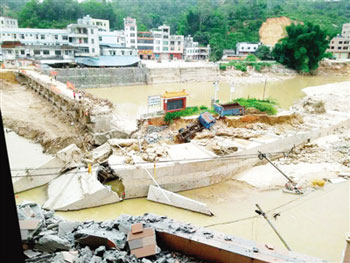
On May 23, the floodwaters receded in Xinyi City, Maoming, Guangdong, leaving behind bridges washed away by the floods and village buildings toppled by mountain torrents and mudslides. Photo by Sun Jiuwan
On the evening of May 20, the reporter drove back to Guangzhou from Zhanjiang. On the highway, it started as a light drizzle, then the rain grew heavier and heavier; by the time we passed through the Maoming section, it was pouring rain, and the view out the car window was like a curtain of water.
Only later did we learn that we had run into a once-in-200-year extreme heavy rainfall. When the reporter arrived in Guangzhou in the early morning, there was basically no rain in Guangzhou. The next day, we learned that on that day the whole city of Maoming had experienced a round of localized torrential rain from north to south, with extreme torrential rain in the urban area of Xinyi and Beijie Town. From 00:00 on the 20th to 14:00 on the 20th, rainfall recorded in the urban area of Xinyi and its subordinate Beijie Town, Jindong Town, Chidong Town and many other places all exceeded 240 mm, and rainfall in Dingbao Town, Xinyi City reached as high as 298.2 mm.
On the 19th, the reporter was in Zhanjiang, which borders Maoming, and had only experienced "apricot blossom rain that moistens the clothes"; who would have expected that just over a hundred kilometers away, there would be torrential rain, fierce winds and a vast expanse of water. In Xinyi City, Maoming, 540,000 people in 131 villages (communities) were affected, 8 died, 4 were missing, and direct economic losses exceeded 500 million yuan. The reporter learned during interviews in Xinyi that in this disaster, Xinyi City dispatched a total of 15 assault boats and relocated 51,420 people.
On May 23, when the interview staff of Science and Technology Daily rushed to Xinyi City, Maoming again, the sun was once more blazing high. The floodwaters had receded, and in the reporter's lens, all that remained were bridges washed away by the floods and village buildings toppled by mountain torrents and mudslides.
According to staff of the local meteorological department, the main causes of the severe flood disaster in Xinyi were, first, its special geographical location, and second, rare extreme heavy rainfall. Because Xinyi is located among the towering ridges of the Yunkai Mountains, one of Guangdong's three major mountain ranges, and is a rainstorm center of Guangdong, under the onslaught of heavy rainfall it is extremely prone to flash floods that rise and fall rapidly. In particular, the urban area of Xinyi is surrounded by mountains on all sides; under the continuous onslaught of heavy rainfall with 6-hour rainfall exceeding both extreme values and exceeding a once-in-200-year event, surrounding floodwaters concentrated and converged in the urban area, causing severe waterlogging and serious disaster.
The interview staff dispatched by Science and Technology Daily went directly to Beijie Town, Xinyi City, the worst-hit area in this extreme heavy rainfall natural disaster. Although the rainstorm had passed, the rainstorm and flash floods had left the town devastated. All 35 villages (communities) in the town were affected to varying degrees, among which the disasters in Liangdong, Luohan, Liuyun, Changwangdong, Beijie and other villages were relatively severe.
As of 20:00 on May 21, the affected population in the whole town was more than 88,000; the affected crop area was 15,700 mu, and 21,169 livestock and poultry were washed away or missing; 278 houses collapsed, including 20 households with total collapse; 92 roads were cut off, and 11,032 meters of roads were damaged by water; 24 bridges were damaged; 967 landslides occurred; 141 places and 25,590 meters of embankments were damaged, 158 breaches and 4,228 meters of embankments occurred, 221 slope dams were washed away, and 448 water conservancy irrigation facilities were damaged; 5 hydropower stations were damaged, and electricity and communications were completely cut off; direct economic losses were about more than 230 million yuan.
Changwangdong Bridge is the main passage connecting Changwangdong Village with the town. Since it was built in 1984, although it was reinforced twice, it was cut in half by the floods in this extreme heavy rainfall natural disaster. The houses of villager brothers Pan Qingwei and Pan Qingquan, closely connected to the bridgehead, were washed away. At present, more than 10 people from the two brothers' families are living in two tents set up in an abandoned chicken farm. The brothers have been worrying all along, not knowing how long such days will last.
Science and Technology Daily reporters specially interviewed the Guangdong Climate Center for this and learned that it was all "caused by El Niño"! Cheng Zhengquan, chief forecaster of the Guangdong Provincial Meteorological Observatory, introduced that this heavy precipitation showed in its spatial distribution the characteristics of "two rain belts in the north and south, and one rain nest in the west." The rainstorm belt in the north was located in the Shaoguan-Qingyuan-Zhaoqing area, the rainstorm belt in the south was located in the coastal area between Shanwei and Yangjiang, and a local extreme torrential rain nest appeared in the Maoming Xinyi area.
Experts from the center said that although the super El Niño event is expected to end in May, its impact will continue, and the probability of extreme weather in Guangdong Province in the future remains relatively high.
Wu Hongyu, chief expert of the Guangdong Climate Center, introduced that under the influence of the super El Niño event, Guangdong Province's climate has been obviously abnormal since the beginning of this year, showing three major characteristics: "significantly above-normal precipitation, abnormally early start of the flood season, and frequent severe convective weather."
El Niño mainly refers to the phenomenon of abnormally sustained warming of sea surface temperatures in the tropical eastern and central Pacific Ocean. La Niña is exactly the opposite of El Niño; La Niña refers to the phenomenon of abnormally sustained cooling of sea surface temperatures in the eastern and central equatorial Pacific. After an extremely strong El Niño phenomenon occurs, the probability of turning to La Niña is relatively high.
The reporter learned from the Guangdong Provincial Headquarters for Flood Control and Drought Relief that after this El Niño event ends, La Niña may appear in July. Because this year's climate background is similar to that of 1998, the probability of basin-wide floods in Guangdong has increased. The Xijiang River and Beijiang River may experience once-in-10-year to once-in-20-year floods, and local small basins in Shaoguan, Qingyuan and other cities may experience once-in-50-year extreme floods, accompanied by relatively severe localized urban waterlogging and flash flood geological disasters.
The meteorological department cautioned that under the alternating influence of the super El Niño phenomenon and La Niña phenomenon, the probability of extreme weather such as rainstorm floods and high-temperature drought is relatively high; in addition, tropical cyclones making landfall in southern China this year may also have the characteristics of fewer in number and stronger in intensity. The main pattern is flooding first and drought later: precipitation in the early flood season will be above normal, and precipitation in the late flood season will be below normal, and this phase is very obvious. Therefore, with precipitation abnormally high in the early period, we must pay attention to preventing landslides, mudslides, geological disasters and severe convective weather. In the late flood season, we must again pay attention to preventing drought.
At the disaster relief site in Xinyi, the reporter saw relief workers braving the scorching sun and hurrying to carry out cleanup work in the disaster areas. In the hardest-hit towns of Beijie Town, Jindong Town and others, dozens of excavators were mobilized to carry out post-disaster production recovery work.
"El Niño" has left, and it is unknown when "La Niña" will arrive unexpectedly. Since it cannot be stopped, then the only choice is to do the homework of disaster prevention as fully as possible as early as possible, and minimize the losses from future disasters. (Correspondent Sun Jiuwan, Qian Congbo; our reporter Zuo Chaosheng; Science and Technology Daily, Guangzhou, May 23)