Factory-farmed shad hit the market at 200 yuan each
Original headline: 200 yuan each! The nearly extinct shad has "come back"
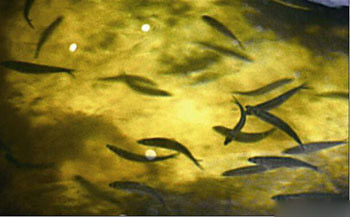
"Factory farming" succeeds in Jingjiang
The shad, ranked first among the "Three Freshwater Delicacies of the Yangtze," is truly a rare treat, with the best flavor coming from the lower reaches of the Yangtze. Unfortunately, since the 1980s, wild Yangtze shad have been nearly extinct. Recently, news came from Jingjiang that after a year of trials by local "post-85" young man Shen Lian, "factory farming" of shad has recently succeeded, and 2,000 plump, lively shad are beginning to reach citizens' dining tables.
Large-scale farming
American shad "swim" to Jingjiang
In two cement tanks more than 10 m long at the Jingjiang Sea Love Aquaculture Base, thousands of shad swim in circles in schools. These fish are quite interesting: they move in unified rhythm, either all clockwise or all counterclockwise, never stopping or resting. When affected by outside sounds, they immediately churn rapidly with a splashing sound and leap out of the water.
"Shad are fish that never rest, swimming day and night, and are called the 'perpetual motion machines of the water.'" Base owner Shen Lian explained that shad have fragile digestive systems and very short intestines, so they need to search for plankton while constantly moving and cannot stop for a moment.
In 2012, Shen Lian returned after being discharged from the military and went into the aquatic products business, mainly dealing in mid- to high-end seafood. Due to factors such as overfishing and deterioration of the ecological environment, shad resources declined sharply, with production decreasing year by year and individuals becoming severely smaller, while market demand only increased, even reaching the awkward situation of having demand but no supply.
"Shad have such a market. If I could farm them myself, wouldn't that be a good thing?" Shen Lian immediately took action. He learned that American shad and Yangtze shad are "close kin," living in similar environments and at similar latitudes, and the two are also extremely close in appearance and taste. In recent years they have been introduced into China as a substitute for Yangtze shad, and farming in Guangzhou and other places has already reached considerable scale.
In March last year, under the guidance of the agriculture department, Shen Lian invested more than 1 million yuan to introduce 5,000 American shad fry from Guangzhou and began artificial farming.
Naturally delicate
5,000 fry yield 2,000 adult fish
Shen Lian's shad farming base is located in Shandong Village, Gushan Town, Jingjiang, tucked away in a secluded corner and normally closed to outside visitors. It is not that these fish are unwelcome, but because shad are too delicate: the slightest disturbance may make them turn belly-up and attempt suicide, so they must be kept in a place seldom visited by people.
"Keepers must work gently and softly at the tank edge. If shad are startled, they may crash headfirst into the tank wall and die on the spot." When he first started farming, Shen Lian brought in 5,000 fry, and by the time they arrived in Jingjiang only 4,000 of the 5,000 remained. One summer during thunder and rain, 500 turned belly-up. During the cold wave in January this year, another 500 shad could not withstand the low temperatures and floated to the surface. Now, about 2,000 shad remain at the base.
When the shad were young, Shen Lian and the keepers hardly ever slept through the night. Fortunately, they have now passed the critical period of farming. Shen Lian said these treasures are extremely difficult to "wait on." The farm uses circulating deep-well water, and temperature controllers are installed in the greenhouse to keep the water temperature between 15°C and 25°C. Overfeeding risks killing them by overeating, so they can only be fed small meals frequently. During the day they must be fed once every one or two hours. Shad scales are very soft, so the nets used at the base to lift the fish are also custom-made, using especially soft gauze to minimize harm to the fish.
A hefty price tag
200 yuan each and in short supply
Once lifted from the water, the shad can only be described as stunning: a sleek spindle-shaped body, covered in scales that gleam brightly. Because shad swim constantly, they burn a great deal of fat. Compared with ordinary fish, shad are much more athletic and contain large amounts of unsaturated fatty acids. Their scales in particular contain very high levels of phospholipids. Therefore, shad are eaten without removing the scales.
What many gourmets care about is that wild shad excel in fresh, tender flavor, so how exactly does this artificially bred shad taste? Will its flavor fall far short and lose the freshness that shad should have? Shen Lian introduced that the water quality required for the base's tanks is extremely high, meeting direct drinking water standards. It is precisely in this special environment that the shad grow, with tender meat that is even more delicate in taste than wild shad.
At present, the 2,000 fish at the Sea Love Aquaculture Base have gradually matured, with the largest already reaching 2 jin. The base's shad are not sold by weight but by the fish, at 200 yuan each, and are still in short supply. Each time they are harvested, these shad are bought up by high-end restaurants in surrounding areas before they even have a chance to reach the market.
In just over a month, the base will welcome another 20,000 shad fry. Shen Lian said that next the base will also explore and practice artificial breeding of shad, striving to make farmed shad cheaper and cheaper and bring them to more ordinary people's dining tables.
2 million fry released into urban waters
On the morning of May 20, the Municipal Agriculture Commission Fisheries Administration Detachment and the Hailing District Fisheries Administration Brigade held an aquatic organism stock enhancement and release activity at the Wanghailou Wharf on Fengcheng River, Yinfeng River, and waters near Taishan Park. That day, a total of 2 million summer fry of carp and silver crucian carp were released. This was also the largest number of fry released into inland rivers in our city in past years. More than 50 representatives of Taizhou fishermen, netizens, angling enthusiasts, and fisheries administration staff participated in the fry release activity.
Carrying out fishery resource stock enhancement and release activities is an important measure in ecological civilization construction. It plays an important role in giving full play to aquatic organisms in curbing water eutrophication and restoring and improving the ecological environment of waters, and will play a positive role in promoting the building of a beautiful homeland where fish and water are in harmony and humans and nature coexist harmoniously.
It is reported that there are currently an estimated more than 100,000 angling enthusiasts in our city, and they are often active along the Fengcheng River, Fenghuang River, Nanguan River, and the banks of the Yinjiang River. That day, relevant heads of the Municipal Angling Association also participated in the release activity, calling on all angling enthusiasts to "keep the big and release the small" while fishing, and to develop the good habit of protecting the water resource environment and fishing in a civilized manner.
It is reported that around June 20, our city will again release 1.5 million fry into urban waters and 7 million fry into the Yangtze River. (Reporter Sun Fengjuan)