PhDs plant strawberries on the plateau, bringing sci-tech poverty alleviation to Tibetan and Qiang villages
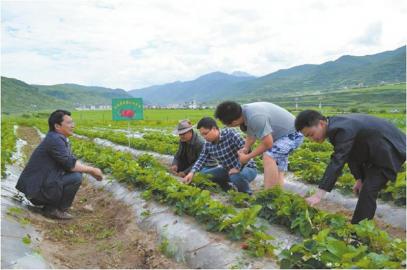
Hanpan Village in Shuijing Township, Songpan County, has successfully introduced summer-autumn strawberries.
The sci-tech poverty alleviation team from Southwest University of Science and Technology uses professional expertise to guide farmers in increasing their income
On the grasslands of Chuanzhusi, a tourist attraction, what blooms is not only gesang flowers but also the strawberries brought by horticulture PhD Zhang Meng.
Zhang Meng is the head of the sci-tech poverty alleviation team at the School of Life Science and Engineering, Southwest University of Science and Technology. In 2012, when Zhang Meng went to Songpan for a temporary post, he saw that the local area had vast land, yet the local people were worrying about how to increase their income. From that time on, Zhang Meng conceived the idea of using professional knowledge to help the local people, and afterward there was no stopping him.
Zhang Meng, Ding Jiangang, Peng Ling, Ma Jinshan, Xiong Shuangli and 16 others voluntarily formed a sci-tech poverty alleviation team. This poverty alleviation team, composed of teachers from across majors and disciplines including animal science, agronomy, horticulture, food science, pharmacy and business administration, uses their rest time to travel among Tibetan and Qiang villages, using their professional knowledge to help the local people get rich and increase their income.
PhD takes temporary post in Tibetan village: using temperature differences to grow off-season strawberries
Using professional knowledge to help ordinary people increase their income was still Zhang Meng's idea when he went to Songpan for his temporary post.
That was in early July 2012, when the provincial Party committee and provincial government selected cadres to take temporary posts in the "three regions," and Southwest University of Science and Technology was designated to provide targeted assistance to Songpan County. "Our school is closely connected with agriculture, and the university ultimately decided that our school would carry out the assistance."
Zhang Meng was selected to serve as deputy director of the Songpan County Government Office. "Songpan covers more than 8,000 sq km, yet its total population is only more than 70,000." Zhang Meng said the local per capita land occupancy is especially large, but this arable land had not been put to good use.
After visiting the townships below, Zhang Meng conceived the idea of benefiting the local people. After repeated investigations, he decided to lead the people of Chuanzhusi Town in growing strawberries. "Strawberries are widely grown in flat areas and are very easy for people to accept."
Speaking of strawberry cultivation, Zhang Meng did some calculations for the reporter. Chuanzhusi has an altitude of about 3,000 m, and the local temperature is lower than in plain areas, which brings opportunities for strawberry cultivation. "The local strawberry ripening period is from June to August, which exactly fills the gap in China's year-round strawberry supply. When strawberries in plain areas are out of season, local strawberries are just coming onto the market, and at the same time the low local temperature also makes them easy to store." Zhang Meng said, moreover, when the strawberries ripen it coincides with Songpan's peak tourist season, so they can be picked by visitors themselves and sold nearby, and can also be transported by air to all parts of the country. "Starting cultivation that very year let the local people see the 'money prospects.'"
Today, with the assistance of the sci-tech poverty alleviation team, Songpan has carried out many specialty planting and breeding projects.
Improving tea processing in Qiang villages increases the resources available to tea farmers
Peng Ling is a teacher at the School of Life Science and Engineering of Southwest University of Science and Technology. When the reporter met Teacher Peng, she had just finished teaching international students and had not yet had time to take off her white work clothes.
"Pingwu has a long history of tea cultivation, and its tea contains no heavy metals, making it a truly green product in today's tea industry." Peng Ling said that although there are relatively good tea resources, the utilization rate is not high. "Local tea farmers mostly pick spring tea, while summer and autumn tea is wasted for nothing."
After Peng Ling took students to Doukou Town in Pingwu to learn about this situation, she decided to help tea deep-processing enterprises carry out technical improvements and help the enterprises introduce black tea production lines. "After spring tea, although the tea leaves are no longer tender, they can still undergo fermentation and deep processing." Peng Ling said, "It can be said that the whole tea leaf is a treasure. Besides making black tea, old tea leaves can also be made into tea powder, used for brewing alcohol, making noodles and baking food."
With Peng Ling's support, the Pingwu Doukou tea processing factory not only produced black tea using the introduced black tea production line, but tea powder was also put to reasonable use. At the same time, Peng Ling also helped the enterprise with product packaging and certification through the certification system. Tea farmers also benefited from it. "Turning formerly discarded old tea leaves from waste into treasure also increased the enthusiasm of tea farmers." Peng Ling said that in 2014, Doukou collected 700 jin more of dry tea during the summer and autumn seasons, and products such as tea powder, fine tea powder and tea beverages made from tea by-products were also successively put on the market.
Although they encountered difficulties in the process of sci-tech poverty alleviation, this did not stop them from moving forward. Pingtong Town in Pingwu County has a very large plum orchard, but because the plums are too sour, fruit farmers' enthusiasm for planting was affected. Peng Ling and her poverty alleviation team set their sights here again, helping fruit farmers carry out technical improvements and helping enterprises add deep-processing techniques.
Expanding the poverty alleviation team so that farming households become science-and-technology-oriented farmers
Ma Jinshan, one of the members of the poverty alleviation team, said that in recent years the school has chosen rural areas as locations for student practice. The professional advantages of the school's wheat breeding team, bamboo resource research and utilization team, plant protection and cultivation expert team, modern horticulture team, and animal nutrition and reproduction team have long been stationed in rural areas such as Mianyang, Deyang, Suining and Luzhou for guidance, regularly and at fixed locations popularizing professional knowledge and providing assistance to farmers.
Ma Jinshan told the reporter that from 2014 to 2016, 13 team members, including PhDs and professors, had been selected as sci-tech personnel to carry out sci-tech assistance work in poor and remote areas, through a "one project, one model" assistance approach in food processing, livestock breeding, horticultural fruit and vegetable cultivation and processing, Chinese medicinal herb cultivation and processing, and edible fungus cultivation.
At the same time, team members made full use of methods such as "farmers attending university," "knowledge updating for agricultural technicians," and "cultivation of new-type professional farmers" to carry out more than 10,000 person-times of agricultural technician training, agricultural science lectures, advanced agricultural technology promotion, and "field-side" production practice guidance for farmers in Deyang City, Beichuan County, Heishui County, Songpan County, Zitong County and other places, providing efficient intellectual support for agricultural transformation and development.