Poor Village in Qingshen County, Sichuan Gets Rich by Raising Chickens
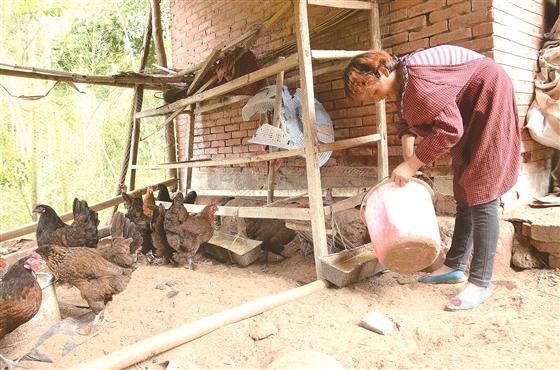
A farmer is feeding the chickens.
Free-range native chickens kept around the villagers' homes.
Huangyingling Village, Hebazi Town, Qingshen County, is dominated by deep hills and mountainous terrain, with less than 1 mu of arable land per capita. For a long time, most of the young and middle-aged adults in the village chose to seek work elsewhere, leaving behind mostly the elderly, women and children, and much of the land lay abandoned. It was a municipal-level poverty-stricken village.
Although it had no locational advantages, thanks to its sound ecological environment, the town was rated a "National-Level Ecological Township" in 2014. At present, Huangyingling Village is also working to become a "Provincial Model Village with a Beautiful Environment."
"We cannot sit with a golden rice bowl and beg for food," said Ren Fuhua, secretary of the village Party branch. To this end, the village brought in e-commerce to develop ecological chicken farming, and provided the village's idle chicken farm to the business owner as a brooding room, solving the problems of water and electricity for the brooding room. Not only did the village develop, but the villagers' lives also improved day by day.
Raising Chickens While Staying Behind
Villagers Escape Poverty and Increase Their Incomes
Recently, a reporter saw in Huangyingling Village that nearly ten thousand native chicken chicks were foraging in the brooding room and growing well. Workers were carefully tending these little creatures. The person in charge of the brooding room said these chicks carried the villagers' dream of escaping poverty and becoming prosperous.
In the woods around the home of Wang Cuirong, a villager in Group 2 of the village, more than a hundred native chickens with bright plumage ran quickly home at their owner's call. Wang Cuirong and her husband Fan Junhua are two elderly people who stayed behind. Last year, Fan Junhua could not go out to work because of illness. Encouraged by village officials, Wang Cuirong joined the ranks of those raising ecological laying hens. She and her husband raised one hundred native chickens, and in a year they made a net profit of more than 10,000 yuan, successfully shedding the "poverty hat." "This year, my husband recovered and went out to work again, and I have gained experience in raising chickens. Now both of us can earn money, and our days will get better and better," Wang Cuirong said happily.
"Last year the village raised a total of 3,000 dual-purpose ecological chickens for both eggs and meat under the trees. Five households have already escaped poverty through chicken farming, and many villagers who stayed behind have also increased their incomes by raising chickens," Ren Fuhua said.
E-Commerce Joins In
Ecological Eggs Sell Well in Many Places
"Ninety percent of the eggs now produced in Huangyingling Village are sold online to all parts of the country." Wu Yongzhi, head of an ecological native chicken e-commerce brand based in the village, said in introduction that today's consumers all pay attention to safety and health, so ecological, green and pollution-free native chicken eggs are naturally popular. It was precisely because he favored Huangyingling Village's superior geographical environment - vast land with few people, many mountains and dense forests, and natural freedom from pollution - that he decided to build the breeding base here.
In the "Native Egg Acceptance Contract" signed between Wu Yongzhi and the villagers, the business owner set strict requirements for ecological laying hen breeding, such as feeding only corn, grain chaff, bean cake and the like, and strictly prohibiting compound feed, drugs and additives; and a stocking density of 45-60 birds per mu of forest and wasteland.
At the same time, Wu Yongzhi also made irregular spot checks at farmers' homes, and every native egg that passed inspection would be labeled with the name of the breeder, so that customers could return or exchange eggs if they received substandard ones. "This is to ensure product quality, so that this industry can go further and better."
In addition to running the e-commerce platform he was familiar with, Wu Yongzhi also established cooperative relationships with several well-known agricultural product sellers, "so that after breeding volume increases, the sales of ecological agricultural products can be guaranteed through multiple channels."
Government and Business Step Up
Villagers Take a "Reassurance Pill"
"We also developed broiler chicken farming before, but the farmers all failed to make money, and their enthusiasm was greatly dampened," Ren Fuhua said. At first, no one was willing to raise chickens again. To boost everyone's enthusiasm, the town and village decided to use industrial support funds to give farmers raising dual-purpose ecological chickens for both eggs and meat under the trees a subsidy of 5 yuan per chicken. This year, in conjunction with the county and town poverty alleviation work, the subsidy amount will also be appropriately increased for poor farming households.
With the subsidy, many villagers were tempted. But breeding technology had always been a worry for the villagers. "In the early stage, we carried out unified epidemic prevention and feeding. The native chickens were sold to farmers only after they reached about two jin, giving a higher survival rate and solving the early-stage risk problem," Wu Yongzhi said. "For later-stage feeding technology, we all provide unified guidance and regular epidemic prevention, greatly reducing the difficulty of farming for the households." In addition, the village also trained young farmers as technicians specifically responsible for solving technical problems in chicken farming in the village. At the same time, the village strengthened its ties with the county agriculture and animal husbandry department, regularly and irregularly inviting livestock experts into the village for training.
To further protect the interests of farming households, the village also established a cooperative and signed a buyback contract with the e-commerce business, setting a floor price. With these safeguard measures, the farming households felt secure. This year, the whole village has already booked 6,000 chicken chicks.
Short Commentary
Targeted Poverty Alleviation and Escape from Poverty: Learn to Make Good Use of "Internet Plus"
Targeted poverty alleviation and targeted escape from poverty require not only precise identification of and assistance to the poor population, but also precise analysis and treatment of the poverty problem. Finding the right root cause and prescribing the right remedy is the key to targeted poverty alleviation and escape from poverty. Just as in Huangyingling Village, Hebazi Town, it identified its own advantages, took local conditions into account, and developed ecological farming. Relying only on traditional methods yields little effect; one must learn to make good use of "Internet Plus" and give full play to the role of the internet in helping poor areas escape poverty.
In targeted poverty alleviation and targeted escape from poverty, one must learn to make good use of "Internet Plus." It is necessary to clarify the "poverty baseline," carry out precise identification, establish relevant files, connect with resources from all sides, and update the situation in real time. In particular, targeted assistance measures should be adopted for individual poor households, and smooth information flow allows the leaders of poverty alleviation to provide more targeted and efficient services. At the same time, through online sales, the problem of distinctive agricultural products in poor areas being "kept in the boudoir unknown to others" can be effectively solved; by making distinctive industries bigger and stronger, and through the radiating and driving effect of "leading industries," poor people can be helped to prosper, so that leading industries truly play a "leading role"; and by cultivating e-commerce talent, villagers can be encouraged by example to "get online," open shops and escape poverty.
As "Internet Plus" rises to a national strategy, "Internet Plus" has become an important lever for poor areas to escape poverty. In my view, implementing "Internet Plus" well is like giving poverty alleviation wings, stimulating the enthusiasm of those being helped, and with everyone participating, they can truly embark on the broad road of "escaping poverty and becoming prosperous."