How to adjust the planting structure? A large-scale summer planting farmer talks with you
Original topic: In Shandong Province, after the wheat harvest in previous years, corn was planted as a matter of course --
What to plant this summer? Everyone needs to think it over
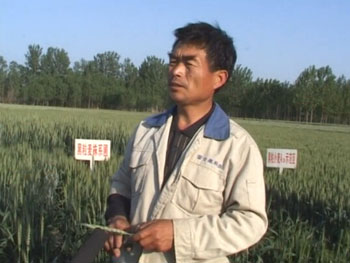
Large-scale grain grower Guo Yubao (video screenshot: People's Television)
Affected by factors such as the consecutive years of increases in corn planting area and output and the impact of imports of substitute products, corn is currently in a phase of supply exceeding demand, making it the focus of this round of planting structure adjustment. In adjusting the corn structure, the corn planting area in non-advantageous regions should be appropriately reduced to ease inventory pressure, while at the same time consolidating and enhancing production capacity in advantageous regions, working hard to improve the structure and raise quality and efficiency, and safeguarding farmers' planting income. What impact has this direction of adjustment brought? How are localities responding? Please see the frontline investigation sent by our newspaper's reporter.
-- The Editor
A few days ago, in Lilouzhai Village, Pulianji Township, Cao County, Heze City, Shandong Province, large-scale grain grower Guo Yubao stood in front of his own wheat field, thinking not only about this year's wheat yield but also making plans for summer planting: "Despite the low price, corn still has to be planted. After all, one mu of corn can produce more than 1,300 jin of grain, so the yield is guaranteed. However, I plan to interplant peanuts in 30 mu of summer corn and also introduce some black corn for trials."
Guo Yubao's grain fields are high-yield and stable-yield fields, so corn output is guaranteed and the pressure is relatively smaller. At Yuanfeng Family Farm in Nanshahe Township, Tengzhou City, farm owner Liu Yufeng has more calculations to make: "Our area is semi-hilly, the land is relatively poor, and irrigation conditions are not good either. Corn output is only about 800 jin per mu. To prepare for summer planting, I have been in contact with livestock farms all this year, planning to plant silage corn, and I have also set aside a small amount of land to plant sweet potatoes, peanuts and millet to see how the income turns out."
Affected by falling corn prices and national regulatory policies, in the face of the upcoming summer planting, whether on high-yield fields or low-yield fields, Shandong's grain farmers are all carefully making plans.
Advantageous regions raise production capacity and tap deeper into yield-increasing potential
Juye County in Heze City is a major national grain-producing county, and its grain production level ranks among the top in the country. Li Peixian, deputy director of the county's Agriculture Bureau, introduced that according to earlier surveys, the household income of grain farmers who plant on a household-by-household basis mainly comes from off-farm work, and most still choose to continue planting corn because "they are used to planting it, it is all done with machinery, and it will not delay going out to work." By contrast, most new-type operating entities such as large-scale grain growers, family farms and cooperatives have some new plans, including "raising planting standards and increasing per-unit yield; connecting with livestock farms to plant silage corn; developing rotation of corn with peanuts or soybeans," and so on.
"Our overall approach is to strengthen grain production capacity building, further improve field infrastructure, promote practical technologies, raise the level of corn planting, and thereby increase grain farmers' returns. At the same time, we encourage grain farmers to experiment boldly and explore multiple ways to increase income," Li Peixian said.
In Dongming County, another major grain-producing county in Heze City, Ma Guoxing, chairman of Maifeng Grain Planting Professional Cooperative, introduced that the cooperative currently has more than 1,800 member households and operates 26,000 mu of land. "The main approach is still to continue strengthening technical measures, tap deeper into the potential for raising per-unit yield, and at the same time explore the development of deep processing of corn. Now, the high-quality flour, selenium-enriched noodles and other products processed from wheat by our cooperative have achieved substantial value-added processing. Next, I plan to replicate this model in corn," Ma Guoxing said.
A relevant person in charge of the Tengzhou City Agriculture Bureau introduced that advantageous corn-producing regions still need to maintain their area, with the focus on raising production capacity; non-advantageous regions should focus on reduction, encouraging farmers to boldly explore new planting models.
Non-advantageous regions need reduction, but how to do it still remains to be explored
As a non-advantageous corn-producing region, what should Nanshahe Township do in the face of planting structure adjustment? "Reduction is necessary, but how to reduce still needs exploration," said Fang Yong, deputy township head. "After all, this is the first year, and we cannot push forcefully. For the time being, we still need to play the role of advisers and service providers."
It is understood that Shandong Province has issued the "Implementation Plan for Advancing the 'Grain-to-Feed' Pilot to Promote the Development of the Grass and Livestock Industry," which clearly calls for developing demonstration plots of dedicated silage corn and demonstration bases of high-quality forage grass (alfalfa), among others. This is a very good opportunity for new-type operating entities such as grain cooperatives and family farms. Ma Guoxing said: "Our cooperative has the planting scale, and recently we have been actively connecting with large livestock farms, striving to achieve contract planting."
In addition, planting specialty crops such as black corn and waxy corn is also a way out. Guo Yubao has been planting black wheat for more than 20 years, and this year he also plans to start planting black corn. "Although the yield of black wheat is a bit lower, only eight or nine hundred jin per mu, the price is high, and it can sell for more than two yuan per jin. I hope black corn can be the same."
Developing intensive and deep processing of corn is also a way out. The reporter learned that the Ministry of Agriculture's survey team of one hundred townships and ten thousand households is conducting research in Shandong, and one important part of it is investigating the situation of intensive and deep processing of corn and future development trends.
Corn-peanut rotation eases the conflict over land between grain and oil crops
Not long ago, the Shandong Academy of Agricultural Sciences held an on-site promotion meeting for wide-strip intercropping of peanuts and corn in Songlumiao Village, Niji Street, Cao County. Song Xiaoyin, chairman of the Dishengjin Planting Professional Cooperative in Songlumiao Village, introduced that this was already the third consecutive year that wide-strip intercropping of peanuts and corn had been tested and demonstrated here. "The results have always been very good. Basically, corn output does not decrease, and more than 300 jin of peanuts can be harvested in addition," Song Xiaoyin said.
Zhang Zheng, director of the Scientific Research Division of the Shandong Academy of Agricultural Sciences, introduced that in developing intercropping of corn and peanuts, high-fertility plots are suitable for the "corn:peanut = 2:4 model," while medium-fertility plots are suitable for the "corn:peanut = 3:4 model"; the density is 4,000 corn plants per mu and 6,400-7,600 peanut hills per mu. In this way, the border effect of corn can be fully utilized, ensuring that corn yield per mu remains stable at more than 1,000 jin, while at the same time increasing peanut output by 300 jin, achieving stable grain and increased oil, and easing the conflict over land between grain and oil crops. At the same time, rotation between gramineous crops and leguminous crops also helps improve soil and reduce diseases.
Good plots can develop rotation and intercropping, but what about poor plots? Planting sweet potatoes after harvesting wheat is a good choice. "In recent years, the fresh-eating sweet potato market has been very good, especially for some good varieties, which can sell for seventy or eighty cents per jin. I have asked around, and although planting summer sweet potatoes has a bit lower yield, some varieties can reach four or five thousand jin per mu, and the price is not low either, so this is much more cost-effective than planting corn," a large-scale grain grower in Shanting District, Zaozhuang City, told the reporter. (Our newspaper's reporter Lyu Bingbing)