Special-purpose corn sells well, variety structure adjustment trends toward specialization
Original title: See how corn varieties become specialized and capable
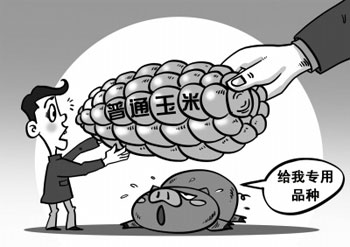
Online illustration: Give me specialized varieties. Illustration: Wu Di
For the past two weeks, from Beijing to Anyang in Henan, to Handan in Hebei, and then to Qinhuangdao, Jiang Wei, general manager of Beijing Youzhong Youzai Technology Service Co., Ltd., has been busy negotiating contracts and signing orders. His purchase and sales business for the high-starch special-purpose corn Nongda 372 and the food-specific starch special-purpose variety Xianda Nuo 001 is in full swing.
At a time when grain corn prices and sales are sluggish, why do special-purpose varieties like these still hold firm prices and smooth sales channels?
As Zhao Jiuran, director of the Corn Research Center of the Beijing Academy of Agriculture and Forestry Sciences, explains, corn is mainly divided by harvest product and use into grain corn, fresh-eating corn and silage corn. To adapt to the upgrading of consumption structure, varieties for various uses are also undergoing corresponding adjustments, subdividing all-purpose varieties into specialized ones. Specialized "special-purpose" varieties increase farmers' returns and bring convenience to enterprises.
Grain corn:
High-starch crop with great energy
At the critical juncture of planting structure adjustment, dealers do not know what to sell and farmers do not know what to plant. Just as he was worrying, Wang Song of the Feiyue Farmers' Grain Planting Professional Cooperative in Anyang, Henan, heard from a friend that the grain corn Xianda Nuo 001 performed well in the Huang-Huai-Hai summer sowing areas such as Hebei and Shandong, with a per-mu yield reaching 650 kg to 700 kg, and that it was contract planting, so there was no need to worry about sales. "After gathering some large land contractors to talk with Youzhong Youzai, the large contractors all expressed hope to plant it," Wang Song said.
This year, Jiang Wei signed contracts for tens of thousands of mu of Xianda Nuo 001 with large growers. Where were these tens of thousands of mu sold, and at what price? "Xianda Nuo 001 is a special-purpose corn variety that can be processed into high-end starch, with a starch content of about 74%." Jiang Wei told the reporter, "Because the high-amylopectin starch it contains is a raw material for food-grade modified starch, this corn variety's price is 'firm'; the purchase price per ton can be about 200 yuan higher than ordinary corn."
Due to corn overcapacity, more and more deep-processing enterprises such as corn starch producers have also fallen into the dilemma of overcapacity. "But good special-purpose varieties are still very 'in demand'." Jiang Wei showed great confidence in this. "As the domestic enterprise with the largest export volume of starch and derivatives, Lihua Starch is currently establishing stable, sustainable-development and green-food corn planting bases in China. What we recommend is the high-yield, high-starch special-purpose corn Nongda 372, whose starch content is as high as over 75.5%."
Jiang Wei's trip to Qinhuangdao this time was to discuss cooperation matters with Lihua Starch. "The food and beverages produced by many domestic and international enterprises cannot do without starch and derivatives. We can screen out varieties with a high starch ratio for processing enterprises, increase the starch extraction rate and thereby reduce production costs; we have stable planting bases, with whole-process monitoring from planting to harvest, improving the safety of food and beverage use," Jiang Wei said.
Zhao Jiuran has always positioned grain corn as a high-starch energy-type crop. From this perspective, both Xianda Nuo 001 and Nongda 372 fit this characteristic.
Fresh-eating corn:
Year-round supply, waiting for a good price
When it comes to fresh-eating corn, one cannot fail to mention Jingkenuo 2000. "There are more than a million people across the country who became rich because of Jingkenuo 2000." Zhao Jiuran spoke highly of this white waxy corn variety, which has been promoted for 10 years in various planting regions across the country, occupies half of the domestic fresh-eating corn area, and was the first to pass variety approval abroad.
In 2003, Yu Shilong, a farmer from Yingshan Village, Ying'ebu Town, Tonghua County, Jilin Province, was laid off from a pharmaceutical factory. That same year, through a friend's introduction, he met Zhao Jiuran and trial-planted a few mu of Jingkenuo 2000. What he did not expect was that this variety had good quality and large ears, and for fresh eating the purchase yield could reach 1.5 tons per mu. At the same time, compared with field corn, fresh-eating corn can be quickly frozen and processed after harvest, allowing year-round supply and the ability to wait for a good price. So in the following years, Yu Shilong increased the planting area year by year, until 2007 when he planted more than 10,000 mu, and this has continued to the present. "At present, my more than 10,000 mu base has been recognized as a 'National Fresh-eating Corn Export Demonstration Safety Base,' which means the fresh-eating corn we grow all meets export standards, and 40% to 50% of the products are exported to South Korea," Yu Shilong said.
"Because of Jingkenuo 2000, I began engaging in corn processing and started my own enterprise." Today's Yu Shilong is general manager of Tonghua Aohe Food Co., Ltd., and can be described as one of the biggest beneficiaries of Jingkenuo 2000. "At present, our quick-frozen fresh-eating corn holdings in Northeast China should be the largest. Every year from August to mid-October is the fresh-eating corn harvest season, and the quick-freezing processing machines are all running at full capacity. It peaks in early September, when more than 280 cartloads can be received in a day, each cart carrying more than 1 ton, with a processing volume of 30,000 ears."
Between Yu Shilong and growers in Yingshan Village and Shantou Village of Ying'ebu Town, as well as Yimushu Village of Sankeyushu Town and other places, the form adopted is order-based purchasing. "Every year farmers scramble to place orders." To ease the difficulty of villagers selling grain, Yu Shilong also took in some new growers to plant fresh-eating corn this year. "Farmers are very enthusiastic about planting fresh-eating corn. We now drive more than 1,200 farming households each year, increasing income by 300 yuan to 500 yuan per mu compared with field corn."
Silage corn:
Cooperative-enterprise alliance makes variety promotion easier
Silage corn sowing has just ended, and Wanbei Animal Husbandry Development Co., Ltd. in Shawan County, Tacheng Prefecture, ** Uyghur Autonomous Region, planted 5,000 mu of Yu Silage 23 again this year. The company raises 5,000 beef cattle. In addition to its own 10,000 mu silage corn planting base, it also signs purchase orders with cooperatives within a 10-kilometer radius around the cattle farm. General manager Zhao Hongjiang said: "One mu can produce about 6 tons of silage corn, and the price is 3 mao per kilogram, so farmers can earn 1,800 yuan per mu. The company uniformly provides farmers with seed, medicine, fertilizer, management and harvesting."
"We have planted this variety for 3 years. Its growth period suits our area, and its protein content is also very high," Zhao Hongjiang said.
Yu Silage 23 is a variety bred by Henan Dajingjiu. "China's silage corn variety breeding has reached the world's advanced level." Ding Guangsheng, chairman of Henan Province Dajingjiu Seed Industry Co., Ltd., believes that the lack of guaranteed sales channels is the crux of the difficulty in promoting silage corn: "We should achieve integration of 'planting-raising-selling,' adopt a combination of planting and raising, and order-based production."
On the evening of May 18, when the reporter interviewed Zhao Hongjiang, he was in his office facing a computer preparing materials for the founding ceremony of the "Shawan County Modern Animal Husbandry Collectivized Development Cooperative-Enterprise Alliance." "It will be established in another 10 days, and both enterprises and cooperatives are highly enthusiastic."
"With orders, farmers feel at ease planting silage corn. Back in February we had already signed orders with farmers," Zhao Hongjiang said. "After the alliance is established, there will be corresponding enterprises in links such as plant improved-variety breeding, forage supply, finished cattle trading, deep processing of beef and mutton, and product brand building, developing circular animal husbandry, so farmers have more guarantees when planting silage corn." (Staff reporters Miao Yi and Li Guolong)