Rice grown as tall as Yao Ming, a self-taught expert figures out a clever trick
Original headline: Xianning self-taught expert who has watched over the field ridges his whole life is skilled at growing both rice and rapeseed (photo)
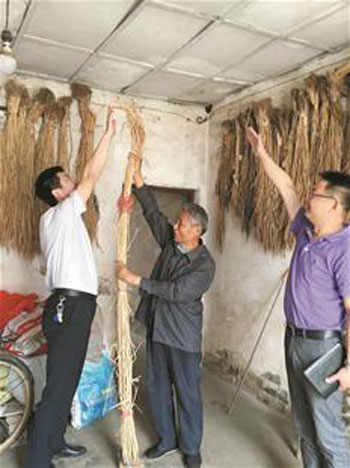
The rice stood a head taller than a person
Counting seeds one by one
Having watched over the field ridges his whole life, Yin Puhe of Henggou Town in Xianning has always insisted on doing experiments in his own fields, becoming a widely known self-taught expert. He grew rice as tall as Yao Ming, and the rapeseed he cultivated was tall and large; planting problems that even some agricultural technicians found puzzling were always figured out by him.
Counting seeds one by one
The desk by the window is the brightest spot in the whole house, and it is also where 78-year-old Yin Puhe spends the most time besides the farmland.
At 10 a.m. on May 18, in Qunli Village, Henggouqiao Town, Xianning City, in a white single-story house right next to National Highway 107, Yin Puhe was picking rapeseed from an iron dustpan at his desk. Glancing down over the top of his glasses at the Chutian Metropolis Daily reporter who had come in, he gave a slight nod as a greeting, but his hands did not stop. While picking rapeseed the size of millet grains into a paper cup, he counted aloud.
"I had just reached the crucial point, and if I'm interrupted I have to start over." After finishing the count, he poured the rapeseed from the paper cup into the tray balance beside him, slowly adjusted the weights, and finally got a weighing result of 6 grams. This is the weight of 1000 rapeseeds, commonly known as the thousand-grain weight, used to evaluate seed quality. "My rapeseed is a bit larger, 2 grams heavier than ordinary rapeseed." Perhaps these 2 grams seem insignificant, but when planted over a large area, the increased yield is a considerable figure.
To obtain this result, Yin Puhe had started the simple and tedious counting at 8 a.m.
This was a sample he selected from the rapeseed he had grown himself; first he counted how many branches there were, then from the branches he selected more than 30 pods, and he had to record clearly, one by one, how many seeds were in each pod. Round rapeseeds are too small and roll easily, so wearing reading glasses, he had to concentrate fully as he counted them one by one. "Science cannot tolerate the slightest carelessness; all of this will affect the harvest."
His home is practically like a small agricultural research institute: bundles of dry yellow rice ears hang neatly from the roof beams, each bundle labeled with the planting time, stalk length, ear length, and the number of grains per ear; packets of rice seeds are placed on the wooden shelves, and stacks of neatly arranged newspapers, periodicals, and books almost pile up to the ceiling.
"I now subscribe to 30 newspapers and 9 magazines, and I spend two or three hours every day reading newspapers and books." This newspaper-subscribing habit has lasted for decades, and he spends more than a thousand yuan on it every year.
Rice as tall as Yao Ming
After a lifetime of growing rice, he had also once grown something unusual.
Yin Puhe took down from the wall a bundle of rice specimens placed horizontally. This clump of already withered and yellowed rice seemed ordinary enough, but when held upright on the ground by hand, it showed its difference: he, 1.6 meters tall, stretched out his arm and still could not reach the tip of the ear. Several people nearby became interested and took turns standing beside the rice to compare heights.
Taking out a meter stick to measure, from the root to the top tip, the entire clump of rice specimen was fully 2.26 meters long. "The same height as Yao Ming." The people around burst into exclamations of surprise. Yin Puhe smiled confidently: "We all grow rice; I dare to compare heights with Teacher Yuan Longping's rice."
This was the rice Old Yin grew 3 years ago.
In 2010, Old Yin saw a report in Rural New Newspaper. The report was about farmer Li Xiangying of Xinzhou, who had bred "tall-stalk rice," with a plant height of 1.55 meters; standing in the field, the rice plants rose above his neck, and the ears were 28 cm long, with about 250 grains per ear. "Back then, it was not as tall as what I grew." At that time, Old Yin's observation notes clearly recorded that for the previous two years he had been cultivating a "super tall, large, and thick new-type rice." In 2009, this rice had already reached 1.7 meters tall, with ears 45 cm long and about 500 grains per ear. This report encouraged Old Yin: this yield was not bad; under local growing conditions, could an even taller rice be grown?
What he adopted was not the hybridization method, but rather finding tall, large, and thick mutant plants from the rice, and then selecting even taller and thicker ones from the mutants to save seed and trial-plant. In 2012 he finally obtained one super-tall rice plant, and after saving its seed, the next year he grew more than one hundred clumps of the new-type "super-tall rice," that is, this rice as tall as Yao Ming.
That year, standing in this "rice forest" much taller than a person, Yin Puhe had complained that spraying pesticide while looking up was inconvenient, and also felt lucky that these rice stalks had not suffered too much wind and rain and lodged, so they were protected until they headed. "I tended it just like an ordinary rice field, without adding anything special." However, the rice yield was not high; the ears were only 30 cm long, with only about 300 grains per ear.
From a cultivation standpoint, this rice as tall as Yao Ming is not suitable for promotion. "If used for sightseeing, it would indeed make a fine landscape. And with such long stalks, returning them to the field can also save fertilizer." After saving seeds, Old Yin did not plant it again the next year, leaving only one clump as a specimen.
Self-taught expert specializes in diagnosing crop diseases
Having dealt with the land all his life, Yin Puhe became a self-taught expert.
In 1957, Yin Puhe began to be exposed to scientific farming. He was sent by the brigade cooperative to Xiaogan Agricultural School to study, where he encountered knowledge such as improved seeds, new fertilizers, and field water and fertilizer management. "In the era of taking grain as the key link, increasing yield was important work." He gradually became fascinated with cultivating high-yield rice and had at his own expense successively gone to rice research institutes in 10 provinces and cities including Hunan and Zhejiang to learn from experts. "There is no disease Old Yin cannot diagnose." The villagers firmly believed in this old farmer with only an elementary school education; 59 years of planting experience had let him see all kinds of problems, and he could basically identify pests and diseases at a glance.
Last year, villager Xiong Dafu found that the seedlings in his rice field were withering, and neither fertilizing nor spraying pesticide worked. An agricultural technician from the town agricultural technology station rushed over, and after examining the seedlings, asking about the situation, and checking the water quality, could not find the cause; the senior agronomist he brought took out materials to compare, and still there was no result. After walking around the edge of the field several times, Yin Puhe advised him to apply some fertilizer and look again in a few days.
A week later, the seedlings recovered their vitality.
Under Xiong Dahe's repeated questioning, Yin Puhe explained the whole story. It turned out that while inspecting along the field ridge, he found the weeds were wilting, which was the effect after herbicide had been used, but the weeds had not died, showing that the potency had not been reached. "Rainwater containing herbicide flowed into the field, so the seedlings also turned yellow and withered." He recalled that there had been a rainstorm a few days earlier.
Another time, seedlings in a villager's field died over a large area, and poisoning by a nearby farmer was suspected. "That patch of dead seedlings was in the middle of the field." Yin Puhe ruled out the possibility of poisoning, since after all it would be more convenient to poison around the field ridge; after carefully examining the scorched yellow marks on the seedlings and recalling the lightning and thunder of the previous few days, he judged the cause of death to be lightning strike, averting a dispute.