A Saigon banana grower went abroad to learn from others and achieved great success growing them back home
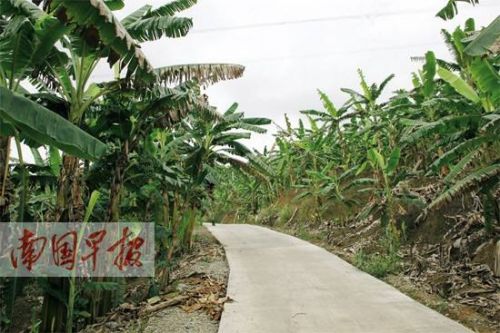
The Saigon bananas grown by Wei Shanghua.
Wei Shanghua applied for and registered a trademark for the Saigon bananas he grows.
Wei Shanghua, of Yanlaisi Tun in the resettlement site of Pingban Town, Longlin Various Ethnic Autonomous County, is seen by the villagers as a farmer who “neglects his proper work.” While everyone else took their resettlement money and rushed to build houses or go out to work, he took his money and went “traveling around the world,” and often headed into the city to scout things out. Now, Wei Shanghua has “returned from his studies,” and the Saigon bananas he grows sell well in many places, with buyers from several big supermarkets rushing over to snap them up……
During a recent interview, Wei Shanghua was once again getting ready to attend an e-commerce training session organized by the government; he plans to make another big profit in online sales.
1、The “returnee farmer” found a path to prosperity
The people of Yanlaisi Tun became connected with Saigon bananas because of a “returnee farmer” in the village, Wei Shanghua.
Wei Shanghua is a reservoir resettler from the Tianshengqiao Power Station and is 56 years old this year. A few years ago, he and 25 other households relocated to Yanlaisi Tun near the county seat. When they first arrived, people went out to work or built houses and bought land, but Wei Shanghua, carrying several hundred thousand yuan in savings, went in 2008 to Southeast Asia and even to some countries along the Indian Ocean to study agriculture.
In the course of a year, he went to Vietnam, Laos, Cambodia, and Myanmar, and even reached Bangladesh and India. “I just wanted to see which country grows which crop well, and then consider whether it could be introduced to our village.” Later, he also went to cities such as Nanning, Guangzhou, and Shenzhen, visiting big supermarkets and browsing vegetable markets. Through his investigations, he found that city people are quite particular about what they eat, especially green, environmentally friendly agricultural products, which sell extremely well.
Having traveled to many places, Wei Shanghua broadened his horizons and his thinking became clearer. After returning home, he decided to grow Saigon bananas. “This kind of banana is grown quite a lot in Vietnam and Thailand, and its yield is fairly stable.” Most importantly, Wei Shanghua found that the conditions needed for Saigon bananas to grow can basically be met in Longlin.
2、Cleverly using the internet to open up the market
He acted as soon as he decided. At first, Wei Shanghua planted only a small amount. When he saw the fruit setting, Wei Shanghua was very happy. He set up a stall by the roadside and sold them in the county seat, but although the price was the same as local bananas, he could only sell a few hundred jin a day. Later, he contacted buyers in Guangzhou, Shenzhen, and other places, but they said, your bananas are good in quality, but your planting is not at scale and the output is too small; it is not worth coming all that way for such a small amount of goods.
So Wei Shanghua decided to expand the scale of planting. He hired people to help and in 3 years expanded the planting area to 53 hectares, and he also urged the other villagers in the village to plant together. But at first, few people dared to follow suit.
Wei Shanghua did not hesitate and decided to be the first to eat the crab. After two years of cultivation, the 53 hectares of Saigon bananas bore fruit one after another, yielding 2 million kg.
The bananas had a bumper harvest, and then the problem came. If all these bananas were sold locally, there simply was not such a large consumer market.
Just when people were worried, Wei Shanghua became busy; he was on the phone constantly every day, and before long, buyers from out of town came swarming in and snapped up all the bananas, and even the little “stock” he had kept at home to eat was carried off.
People watched enviously as Wei Shanghua counted out a big stack of payment, and only then did they realize that the information he had posted online had done the trick.
Seeing that Wei Shanghua had made money, the number of people growing Saigon bananas immediately increased, and people came to his home one after another to learn from him.
Now, the planting area centered on Yanlaisi Tun alone grows more than 200 hectares of Saigon bananas, and the county's total planting area has reached 2,000 hectares.
3、Planning to rely on e-commerce to seek new business opportunities
With the Saigon banana harvest in full swing, Wei Shanghua had new plans. Last year on “May 1st,” he flew to Shandong, a major agricultural province, to study modern agricultural management models. After seeing the apple industry in Yantai, he was deeply impressed, and his thinking became even clearer.
“To be a good farmer, the key is to know what city people want and what you can provide.” Using the internet to solve the problem of product sales was only the first step in Wei Shanghua's plan. Last summer, he sent the Saigon bananas he grew to the testing laboratory of the State Food and Drug Administration, and after obtaining a test result showing no pesticide residue, he applied to the Trademark Office of the State Administration for Industry and Commerce for a registered trademark.
“Since registering the trademark, our Longlin Saigon bananas have been sold to big supermarkets in Guangzhou and Shenzhen.” Speaking of this, Wei Shanghua looked very proud.
To develop the Saigon banana planting industry, the local government also gave strong support. The agriculture department held technical training classes, while the commerce and postal departments jointly held e-commerce training in villages to relieve the villagers' worries. Now, Saigon banana planting has set many villagers in Longlin on the path to prosperity.
“Wei Shanghua, an e-commerce training class will be held in the town on Monday, you should go and attend.” On May 13, during the reporter's interview, Liu Jun, Party secretary of Pingban Town, came to deliver the notice and invited him in person, and Wei Shanghua readily agreed.
“Wholesaling to buyers, the price is 3.6 yuan per kg, while selling retail online, it can fetch more than 10 yuan per kg.” Wei Shanghua said that the e-commerce sales experiment he began at the end of last year showed him even broader prospects.
It is understood that banana growers in Longlin are planning to rely on cooperatives to build a cold storage facility to extend the freshness period of Saigon bananas by one month before selling them, so that supply will be more stable and prices will also rise.