Native chicken farming helps an old farmer become a chicken-raising expert and get on the road to prosperity
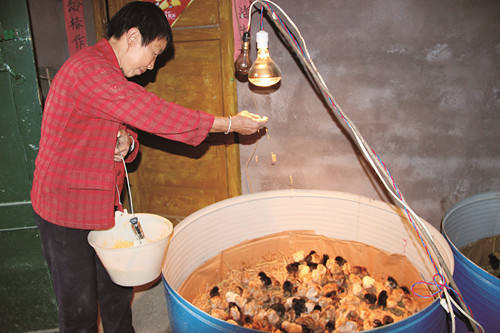
Wang Fuying feeding the chicks
In Group 8, Puzi Village, Xinglong Town, 62-year-old impoverished resident Wang Fuying keeps more than 600 chickens at home. In a very short time she mastered a wealth of chicken-raising knowledge and lifted herself out of poverty through her own two hands, making her the "chicken-raising expert" envied by everyone in the village.
Changing the approach: raising chickens under the trees has many benefits
Puzi Village is not far from town, about a twenty-minute drive. Among the farming households on the mountain, most people raise cattle in addition to farming. As more and more farmers raised cattle, Wang Fuying changed her approach and tried learning the techniques to raise chickens.
The first idea of raising chickens dates back to early 2015. Once, when she and her son Zhan Zhaoxu were talking, the topic of raising native chickens came up, and the mother and son hit it off immediately, deciding to raise chickens to change their impoverished life and take off the "hat" of poverty.
Soon afterward, Wang Fuying's family invested more than 4,000 yuan to buy more than 400 chicks to raise.
She fenced off several mu of woods in front of her house as a space for the chickens to move around. "When raising chickens under the trees, the grass and insects in the woods become natural feed for the native chickens, greatly reducing costs. In addition, chicken manure is also excellent organic fertilizer.
"I use all the corn to feed the chickens." Wang Fuying told the reporter that she has more than three mu of cornfield. She used to make a living by selling corn, but after she started raising chickens, she no longer sold any of the corn.
Last October, Wang Fuying sold the first batch of more than 200 chickens, earning nearly 20,000 yuan. In March this year, Wang Fuying bought another 350 chicks, and it is expected that by August she can sell more than 200 more chickens.
A setback in chicken raising: summing up and figuring out experience
"Observe, listen, look -- observe changes in the color of the chicken manure, listen for anything unusual in the chickens' throats, and see whether the combs have turned purple, whether the feathers are ruffled, and whether their spirits are normal..." When talking about her chicken-raising experience, Wang Fuying spoke fluently and with a serious expression. Who could have imagined that when Wang Fuying first started raising chickens, she suffered repeated setbacks.
Being diligent alone is not enough; raising chickens also depends on technique. "Don't think it comes easily to me now. When I first started raising chickens, it was terribly frustrating. I thought raising chickens was very simple, that I just had to put the chicks in a fenced-off place and raise them. Only later did I discover that there is a great deal of knowledge in raising chickens, and that you also have to carefully think over better breeding methods according to the actual situation." Wang Fuying told the reporter that because she had not understood the chickens' habits at first and thought she could just build any chicken coop, the more than 400 chicks, being afraid of the cold, all crowded together, and more than 100 chicks were trampled to death, which was a great pity.
Misfortunes never come singly. Just as the family was lamenting the loss of the chicks, the roosters in the coop caught avian influenza, and nearly 200 died in just one or two days. The total loss added up to more than 10,000 yuan.
Because of the initial lack of chicken-raising techniques and experience, a large number of chickens died, and for a time Wang Fuying lost confidence in raising chickens. But more than 10,000 yuan had already been invested in the chicken-raising site, facilities, and so on, so how could she just withdraw? Learning from her painful experience, she went to the town animal husbandry station to consult technical staff, and at the same time searched online and studied breeding techniques. Through constant deliberation, Wang Fuying's chicken-raising skills became richer day by day.
"Chickens are much like people; they also catch colds and sneeze." Wang Fuying told the reporter that treating a chicken's cold also has its finer points. Whenever the weather changes drastically, she gives them preventive injections or cold medicine to prevent illness.
Not long ago, Wang Fuying had just bought 400 chicks. She took the reporter to check on the chicks' growth and told the reporter that temperature control is very important, and the indoor temperature must be kept above 35°C. "Keep them warm and remove dampness, keep the chicken shed ventilated, and also clean up the chicks' droppings in time..." Over the course of a year, Wang Fuying's chickens never had any major problems again.
Tasting success: expanding the scale and making money
As her experience continued to grow, Wang Fuying's chicken farm also grew from the initial more than 400 to its current scale of 700, and the survival rate of the chicks is above 95%. In just one short year, she transformed from an old farmer into a chicken-raising expert. Even nearby villagers come to her door to ask for advice on chicken-raising techniques, and she always imparts her chicken-raising experience without reservation.
Because these are native chickens raised freely on the hillside, compared with caged broiler chickens on the market, the native chicken meat is more delicious, more nutritious, and free of pollution, making it very popular with consumers. Not only do many people from town come to her home to buy them, but when there is demand at the farmers' market in the county seat, they also place orders with her.
"Sales are pretty good right now. According to the current market, native chickens sell for about 32 yuan per kilogram, and generally they can be sold after reaching 2.5 kilograms, so one native chicken can sell for seventy or eighty yuan." Wang Fuying said that as sales of native chickens continue to increase, she plans to keep expanding the scale and strive to develop to a farming scale of 1,000 chickens.