Open-field vegetable crop rotation puts an old farmer on the road to prosperity
This year, Wu Kaiming, a villager from Group 2 of Sifang Village, Xiangyi Town, Weiyuan County, Neijiang, is approaching sixty. His son and daughter-in-law both work away from home and earn decent wages, yet Wu Kaiming is not one to "settle down." Seeing others make money growing greenhouse vegetables made him envious, but at the vegetable market he noticed that people who are truly particular about food prefer to buy open-field vegetables. That is because open-field vegetables get plenty of sunlight and need fewer pesticides; they are not force-grown and taste better, and diners feel safer eating them. So he decided to grow open-field vegetables.
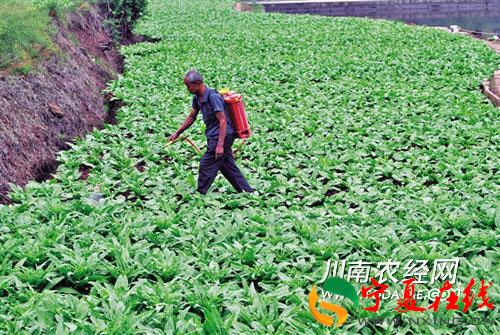
Working in the lettuce field
At first he grew bok choy, radishes, cabbage and the like. But the vegetables grew slowly, and whenever his crop was ready for harvest, a large volume of the same vegetables happened to hit the market at the same time, so the returns were low. After studying vegetables, he felt that celtuce (stem lettuce) was highly adaptable, could be grown all year round, suffered few pests and diseases, and was popular with people. So starting in 2013, he chose celtuce as his main crop.
But how can you make money growing celtuce? First, a large volume hitting the market certainly means poor prices, so when nearby villagers or greenhouse growers sow their celtuce, he does not rush; he sows a week later, and only when others' sales peak is nearly over does his crop reach the market, avoiding low prices from oversupply. Second, after every season's harvest, he treats the ground once or twice with chemicals, carrying out pest and disease control before transplanting. Third, he changes the seedbed plot every season to reduce infection from pests and diseases remaining in the soil. During the growing period, he focuses on early treatment to reduce pesticide use. For every one or two seasons of celtuce he grows, he carries out one round of rotation, planting a season of cauliflower or cabbage or other vegetables with a short growing period or high value, which also effectively reduces the harm of pests and diseases; in choosing varieties, he always picks those with strong disease resistance and good yield and quality.
Besides all this, Wu Kaiming has another advantage: his land sits right beside a large irrigation pond, so water is convenient, and especially in times of drought, while others' vegetables suffer reduced yields, his still achieve steady yields and steady income.
"Even though my model does not yield as much as the greenhouse model, people today are good at judging vegetables -- many can tell whether the quality is good and whether a lot of pesticides were used, so even though my vegetables are priced more than 10% higher than greenhouse vegetables, people still prefer to buy mine. In a year, I earn more than twenty thousand yuan just from growing vegetables." Wu Kaiming says that in doing things you must be good at thinking, observe more and study diligently, so that even traditional agriculture can be "farmed" into money.