Adding Coarse Grains to Noodles, Bridged by Technological Transformation
Original title: Achievement Transformation: Making "New Tricks" out of the "Old Three Staples"
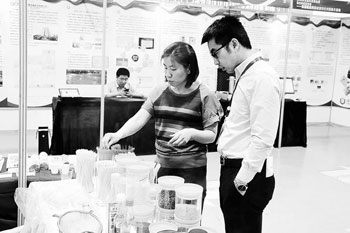
Staff members introduce coarse grain dried noodles to representatives attending the exhibition. Photo by Shi Yonghao
"I didn't expect to be so busy today. The materials we brought were all taken away within half an hour, and our business cards were gone too." Zhou Qiangbing from the Electromechanical Technology Research Institute of the Chinese Academy of Agricultural Mechanization Sciences told a reporter from China Science Daily that this was the first time he had seen such a lively scene.
From May 17 to 18, the 2016 Grain Science and Technology Activity Week and the First Grain Science and Technology Achievement Transformation Matchmaking and Promotion Event were held at Wuhan Polytechnic University, attracting nearly 700 organizations and more than 1,500 participants.
Behind the bustling scene is the urgent need for matchmaking and cooperation among science and technology, talent teams and industry in the grain sector. Science and technology are the greatest potential and the fundamental way to firmly hold the rice bowl of the Chinese people. Technological transformation is the "bull's nose" of scientific and technological work. Against the backdrop of implementing the strategy of "invigorating grain through science and technology," promoting the transformation of scientific and technological achievements is of great significance to the transformation and upgrading of the grain industry, increasing the added value of grain and oil processed products, and advancing supply-side structural reform.
"This event is precisely to meet the requirements of supply-side structural reform, do a good job in popularizing scientific and technological knowledge and achievements, realize the 'three matchmakings' of grain scientific and technological achievements, talent teams and research institutions with grain enterprises, and truly give the grain industry economy the wings of science and technology, so that this traditional industry can soar." Xu Ming, deputy director of the National Food and Strategic Reserves Administration, said at the opening ceremony.
Market-Led Innovation Products Add Value to Grain Processing
Noodles are an ordinary traditional staple food on Chinese dining tables. At the First Grain Science and Technology Achievement Transformation Matchmaking and Promotion Event, the reporter found that coarse grain and bean dried noodles developed by the Academy of National Food and Strategic Reserves Administration and produced by Hunan Grain Group Yuxiang Food Co., Ltd. enjoyed extremely high popularity.
Why "coarse grains and beans + dried noodles"? Tan Bin, a researcher at the Academy of National Food and Strategic Reserves Administration, told a reporter from China Science Daily that in recent years, chronic diseases have been highly prevalent among Chinese residents, and ordinary people have paid more attention to and pursued nutritious and healthy diets, which has provided great development space for coarse grain products. However, coarse grains and beans are mostly consumed in the form of raw grain, and "not knowing how to prepare them" is an awkward problem coarse grains face when they reach ordinary people's dining tables.
"Our idea is to use bulk traditional staple foods as the carrier and develop coarse grains into staple foods." It was precisely after seeing such market demand that Tan Bin and his team put forward the research approach and carried out research.
However, adding coarse grains to ordinary noodles is not easy.
Generally speaking, when the amount of coarse grain and bean raw materials added exceeds 5%, the taste of the noodles is affected; when the amount added exceeds 10%, the noodles are difficult to roll and shape. Tan Bin led his team to develop the "processing technology for nutritious and healthy dried noodles with high coarse grain and bean content." Through technologies such as physical modification, moderate particle size control and premixed flour preparation, they solved the bottleneck problem that high-content coarse grain and bean raw materials are difficult to apply to traditional staple dried noodles. It is understood that, without adding other additives, the application of this technology can produce dried noodles with more than 60% coarse grain and bean raw materials.
At present, a series of high-coarse-grain-and-bean dried noodles produced using this technology have been launched in Beijing, Shanghai, Guangzhou and other places, with enthusiastic market response. A search by the reporter on an e-commerce platform found that the selling price of this product is three times higher than that of ordinary dried noodles of the same weight.
"China's grain and oil processing enterprises are currently in a stage of meager and thin profits, and the grain processing industry is facing transformation and upgrading. To realize industrial upgrading, there must be new support points and economic growth points." Tan Bin said that although related technological transformation and achievement industrialization have only recently started, there should be great room for development in the future.
Technological Upgrading and Efficient Transformation Extend the Industrial Chain
Broken rice is the main by-product resource produced during rice processing, accounting for about 10%-15% of the total amount of paddy. Apart from defective appearance, a relatively high impurity rate and an impact on eating texture, the main components, protein and starch content of broken rice do not change.
It is understood that China's total annual broken rice volume reaches 11 million to 12 million tons, but most of it is treated as feed, with very low added value. How can broken rice resources be fully utilized? The research team at the National Engineering Laboratory for Grain Fermentation Technology and Technology of Jiangnan University carried out research on deep processing of broken rice.
The researchers used new biochemical separation methods to separate the effective components in broken rice, and then utilized them respectively as rice starch, rice starch sugar and rice protein according to their properties and characteristics.
Compared with directly selling it as feed, deep processing of broken rice extends the rice processing industrial chain, improves the utilization rate of grain resources, and greatly increases the added value of the rice industry.
Among these, rice protein is a high-nutrition, low-allergenicity high-quality plant protein, commonly used as a nutritional supplement and widely applied in the food industry.
"We utilize the protein residue produced during the production of starch sugar and, using patented technology, produce food-grade rice protein with a purity of more than 80%." Chen Zhengxing, a professor at the School of Food Science and Technology of Jiangnan University, said in an interview.
Through deep processing, food-grade rice protein has been extracted from feed-grade rice residue, and its economic value has also become much higher. "The price as feed is several thousand yuan per ton, but the export price of rice protein can reach 25,000 yuan per ton, a fivefold increase in price." Chen Zhengxing revealed that the research team has currently carried out matchmaking and transformation of technological achievements with enterprises such as Wuxi Jinnong Biotechnology Co., Ltd., and different types of rice protein powder have already come onto the market, bringing enterprises good economic benefits.
Transformation of Grain Science and Technology Achievements Promotes Supply-Side Reform
Deep processing of broken rice is a successful case of deep processing and efficient transformation, but overall, China's rice processing industry has a utilization rate of only 1:1.3 for rice resources, far below the international advanced level of 1:4 to 1:5. In general, the technical content is not high and the added value is relatively low.
The field of corn deep processing also faces the same crux. On May 18, Yue Guojun, an academician of the Chinese Academy of Engineering, mentioned in the science popularization lecture of the Grain Grand Lecture Hall at this event that China currently has fewer than 1,000 corn processing products, while the United States already has about 3,500 corn processing products. "In China, high-value-added products are still in the early stage of growth, with great room for growth." Yue Guojun said.
To change the current situation of China's grain industry, it is necessary to rely on "invigorating grain through science and technology," and the transfer and transformation of scientific and technological achievements is the key among this. "If the grain industry is to truly shoulder the important mission of safeguarding national food security, it must implement the strategy of 'invigorating grain through science and technology.' If grain enterprises want to become stronger and larger, they must place science and technology in a prominent position, make up for shortcomings and catch up." Xu Ming, deputy director of the National Food and Strategic Reserves Administration, said at the opening ceremony of this event.
The "joining hands" between Henan Huangguo Grain Co., Ltd. (hereinafter referred to as Huangguo Grain) and the research team of the School of Food Science and Engineering of Wuhan Polytechnic University is one of the typical production cases in which research institutions efficiently transform scientific and technological achievements and enterprises use science and technology to become stronger and larger. In response to market feedback that general glutinous rice flour lacks specificity while demand is increasingly becoming specialized, Huangguo Grain and Wuhan Polytechnic University cooperated to carry out research on value-added comprehensive utilization technology of glutinous rice flour. Around glutinous rice flour processing research and development, they applied for multiple technology invention patents and shared the achievements.