Microbial fermentation of forage for sheep can improve meat quality
Original title: Duowei Animal Husbandry's path of straw-based farming for poverty alleviation
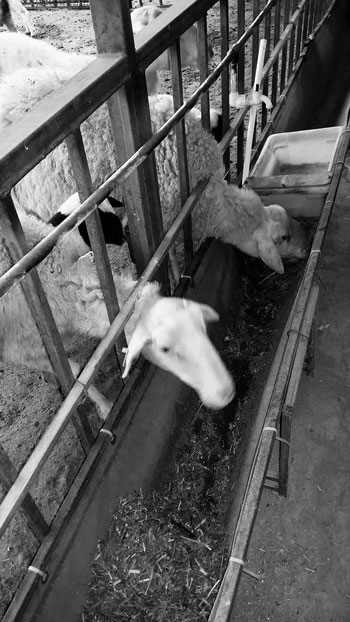
Sheep are eating straw feed treated with a multifunctional compound microbial agent fermentation technology. Photo by Wang Hui
"On one hand, the problem of straw burning is very serious every year; on the other hand, good straw treatment technologies cannot be promoted." Recently, Li Yutang, honorary director of the Grassland System Professional Committee of the Systems Engineering Society of China, told a China Science Daily reporter with some regret.
Li Yutang has been involved in raising livestock with straw for more than thirty years. As an official who oversaw animal husbandry and grassland affairs at the Ministry of Agriculture for many years, he is very familiar with the problems in this field.
What Li Yutang recommends is the research achievement of the team led by Zhu Baocheng, a professor at Hebei Agricultural University - the technology of fermenting straw forage with a multifunctional compound microbial agent.
"If I had not found Teacher Zhu Baocheng's technology that turns straw waste into a valuable resource, I would not have gone into sheep farming." In Wuxiang, Shanxi, Kang Shaozhen, general manager of Shanxi Duowei Animal Husbandry Co., Ltd., told a China Science Daily reporter.
Kang Shaozhen found Zhu Baocheng's articles online and, with recommendations from local Academy of Agricultural Sciences experts, got in touch with Zhu Baocheng. "Sheep farming must use straw because the cost is low. Shanxi has very little land, and basic farmland is subject to the national red line requirement, so growing grass to raise sheep is unrealistic."
Zhu Baocheng is currently mainly cooperating with the National Animal Husbandry Station of the Ministry of Agriculture on pilot work for straw fermented forage and cattle and sheep feeding technology. Last year, they treated about 50,000 tons of straw with this technology. However, in Li Yutang's view, this is still a very small number.
A key technology that helps the transformation and upgrading of animal husbandry
Li Yutang explained that microbial fermentation of straw replaces ammoniated straw, which has been used for a long time, and this is not only a matter of efficiency and benefits but also involves food safety. Straw ammoniation requires adding the chemical substance urea, and the cow's rumen can only absorb part of it. On one hand, this affects livestock quality; on the other hand, the excrement also has an adverse impact on the environment. Recent research results from the Chinese Academy of Sciences show that due to the addition of chemical additives to livestock and poultry feed, heavy metal pollution is present in livestock and poultry manure in North China.
"Feed for animal husbandry still has problems, let alone residues brought by things like Sudan Red and clenbuterol." Li Yutang warned.
Zhu Baocheng's technology also requires adding a little urea, but the difference is that this only creates conditions for the growth of fermentation bacteria. It is completely converted into organic protein, with no residue, causing a qualitative change, and it has nothing to do with ammoniation technology.
"Feed quality is very important to the development of animal husbandry." Li Yutang explained that foreign countries are rich in pasture, and cattle and sheep eat natural pasture, so the quality is high and the nutrition is good, while we mostly use formula feed, which has low yield and poor quality. Foreign milk has high profits and is also cheaper than ours. China's animal husbandry has high breeding costs, feeding the old three items of fishmeal, soybean meal and corn, and now additives as well, while fishmeal and soybean meal mostly rely on imports.
"To transform and upgrade our animal husbandry, the technology of Zhu Baocheng's team is very important. Grassland vegetation in pastoral areas is severely damaged, while growing grass in agricultural areas also raises concerns about competing with grain for land. But at the same time, the country has 700 to 800 million tons of straw resources each year, most of which is not utilized and instead becomes a pollution source because of burning."
The technology of Zhu Baocheng's team is not ordinary microbial storage. It converts crude protein into true protein, a qualitative change, and can even match the protein nutrition level of a very good forage - alfalfa.
Li Yutang believes that once the feed foundation is laid well, the problems that need to be improved in sheep and cattle farming, such as standardization, slaughter rate and reproduction rate, can all be solved, and it also helps prevent and control disease. With good feed, livestock are strong and there is less disease. These are patterns summarized from many years of practice.
The exploration of Duowei Animal Husbandry Company
Entering Shanxi Duowei Animal Husbandry Company's breeding park with nearly 5,000 breeding sheep, green trees provide shade and grass grows lushly. In front of each row of sheep sheds there is a certain activity area. Dozens of lively lambs jump and skip among the flock. A faint fresh fragrance of forage fills the air, with none of the odor often felt at ordinary breeding sites.
The breeding park is clean and tidy. The sheep manure is cleared away in time every day and, as a very good organic fertilizer, is in short supply nearby at 50 yuan per cubic meter.
Mutton is a food beneficial to health. Kang Shaozhen, who once taught in a middle school and has gone through multiple ventures, approached this from the perspective of food safety. In the north, a shortage of grass in winter is common. In the past, straw and other materials were fermented with lactic acid bacteria mainly to keep the straw from spoiling and make it edible, but it could hardly be called nutritious. Straw treated with Zhu Baocheng's technology has high nutritional value and high protein content, and the fermentation process also produces a large amount of organic acids, so the utilization rate is high and palatability is good. Sheep like to eat it, and generally 99% can be utilized, greatly saving breeding costs. In the past, usually 50% of straw feed could not be utilized, resulting in too much loss.
"It is too important for the flock to have good feed." Kang Shaozhen has experienced that with straw forage fermented using microbial technology, the quality of mutton clearly improves. With this technology now, sheep can eat good feed at any time throughout the year. This fermented forage accounts for at least 70% of the forage, with dry matter such as peanut vines added as well to reduce the moisture and acidity of the feed.
Kang Shaozhen has realized that enterprises definitely need the support of science and technology to be more confident.
In Li Yutang's view, food safety is a big problem, but relying on government regulation has limited strength, and it also depends on conscientious scientists and entrepreneurs to push it forward.
Kang Shaozhen's current approach is to first provide fermented forage to the ordinary people raising sheep, and the ordinary people return fresh straw to him the following year. Two tons of fresh straw are exchanged for one ton of fermented forage. Ordinary people are afraid of spending money, but they have straw resources and labor.
In Fengzhou Town, Chengjiagou Village, Wuxiang County, Shanxi, Li Jing's father-in-law has tended sheep for half his life. Li Jing worked in the city for a period after graduating from university, then felt agriculture was good and returned to the countryside to raise sheep. "Fermented forage is indispensable. Sheep must eat grass."
Li Jing's idea is, "Boss Kang's big company leads our medium-sized company, and we medium-sized ones then lead the small ones." Issues such as disease and nutrition are all solved through Duowei Animal Husbandry. As farmers below, this also saves worry.
For Li Jing, selling breeding sheep is more valuable than selling meat sheep. When small traders come to buy sheep, she has experienced that "only with large scale do you have bargaining power, otherwise the price is pressed very low."
Li Jing has already talked with several nearby farming households and persuaded them to raise sheep together. This winter, she can provide breeding sheep to seven or eight households. There are farming conditions here and plenty of cultivated land, and households usually have straw and basic feed corn. If a household raises twenty or thirty sheep, it does not require much cost.
At Cheng Huanmei's home in Mayizhan Village, Yongquan Township, the family farms more than twenty mu of land, mainly growing corn, sorghum and millet. This year the state began banning grazing and no longer allows free-range herding, although some households still graze sheep on their own hillsides. Using fermented forage from Duowei Animal Husbandry Company is a better choice for them.
The specific approach of Duowei Animal Husbandry Company in developing the breeding industry is: upstream talent training, breeding sheep reproduction and supply; midstream model promotion and technical services; downstream meat sheep recovery, processing and sales.
The forage processing base and breeding sheep base have already been built. Duowei Animal Husbandry is waiting for the slaughtering and food processing base to be completed, which will fully complete the company's industrial chain.
Confidence in poverty alleviation