How agricultural IoT solutions form an informationized closed loop
Original title: Internet Plus Agriculture: Breaking Down Regional Barriers
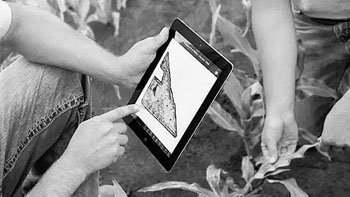
Internet agriculture (Image source: Baidu Images)
Recently, eight departments - the Ministry of Agriculture, the National Development and Reform Commission, the Cyberspace Administration of China, the Ministry of Science and Technology, the Ministry of Commerce, the General Administration of Quality Supervision, Inspection and Quarantine, the State Food and Drug Administration, and the State Forestry Administration - jointly issued the "Three-Year Action Plan for Implementing 'Internet Plus' Modern Agriculture" (hereinafter referred to as the "Plan").
The "Plan" sets out the overall goals for the next 3 years: by 2018, obvious progress will have been made in bringing agriculture online and making it data-driven, efficient management and convenient services will be basically achieved, intelligent production and networked operations will reach a new level, the urban-rural "digital divide" will be further narrowed, a sound situation of mass entrepreneurship and innovation will basically take shape, and strong support will be provided for a marked improvement in the level of agricultural modernization.
Since the reform and opening up, China's economy has developed rapidly, accumulating abundant material conditions and a technological foundation for agricultural modernization. With the emergence of the "Internet Plus" action plan, the internet wave has swept through every field and is also changing the model of agricultural development. "Internet Plus" modern agriculture is slowly gathering strength.
The reporter learned during interviews that at present, China's "Internet Plus" modern agriculture has a certain foundation in the fields of production, operation, services and management, but there are still practical problems such as unbalanced regional development, non-sharing of data between regions and relatively large spatial differences. At the same time, it faces major challenges including weak agricultural informatization infrastructure, insufficient research and development of information technology products, a sustainable development model that has not yet taken shape, and a development environment that needs to be further strengthened.
Development has a "lighthouse"
In accordance with the deployment requirements of the "Guiding Opinions of the State Council on Actively Promoting the 'Internet Plus' Action", the "Plan" closely centers on the goals and tasks of advancing modern agriculture and the structural reform of the agricultural supply side, focuses on promoting the deep integration of modern information technology into all links of agricultural production, operation, management and services as well as all fields of the rural economy and society, advances the online and data-driven transformation of agriculture, vigorously develops smart agriculture, strengthens institutional and mechanism innovation, and comprehensively raises the level of agricultural informatization.
"Such an action plan is a reference for local areas, equivalent to a 'lighthouse' guiding us forward," said Ke Nan, deputy director of the Information Center of the Chongqing Municipal Agriculture Commission, in an interview with a reporter from China Science Daily.
In the view of Wang Xiuhui, deputy general manager of the Smart Agriculture Business Division of Beijing Paide Weiye Technology Development Co., Ltd., who has worked on agricultural informatization for nearly a decade, this "Plan" is also a new major opportunity for agricultural development.
In the view of experts, the introduction of the "Plan" at this stage will play a very positive and effective role in alleviating resource and environmental constraints, adjusting the production structure, and improving quality and efficiency. The guidance of the three-year action plan can enable the coordinated and efficient development of production, operation, management and services in "Internet Plus" modern agriculture, continue to consolidate the foundation for stable agricultural development, and stabilize the continuously improving situation in rural areas.
Regional information barriers await breakthrough
For "Internet Plus" modern agriculture, especially the "Internet Plus" production field, this involves more the aspect of agricultural IoT, such as field planting IoT, protected horticulture IoT, livestock and poultry farming IoT, aquaculture IoT and so on.
"The main role of agricultural IoT is monitoring and decision-making," said Li Hongjun, associate researcher at the Agricultural Resources Research Center of the Institute of Genetics and Developmental Biology, Chinese Academy of Sciences, in an interview with a reporter from China Science Daily.
He emphasized that China's farmland has particularly large spatial and regional differences, and agricultural IoT should be fully combined with land transfer, reducing the "one household at a time" pattern, transferring land to large-scale operators, achieving scaled operation, and reducing spatial differences, so that IoT monitoring is representative.
The top-level design of IoT is precisely to achieve big data sharing. "All regions need to share information and break down regional information barriers in order to form big data benefits and give play to the role of IoT applications," Li Hongjun said. For example, for pests, diseases and animal epidemics, if IoT information is shared on a large scale, big data mining can be better achieved, and many regional problems can be identified, such as the location, scale and direction of spread of agricultural epidemics.
In his view, IoT decision-making is not universally applicable and should take into account regional particularities and differences. In particular, the formulation of decisions should involve individualized development and should be combined with local characteristics.
For example, Chongqing has a special topography and landform of shallow hills plus medium and deep hills. "This requires finding IoT production and application models suitable for Chongqing's hilly areas," Ke Nan said. How to use IoT technology to monitor Chongqing's special topography and landform is precisely the direction they are truly researching. To this end, Chongqing built ten new demonstration sites this year, covering chicken farming, pig farming, vegetables, fruit and so on.
Experts point out that data contains enormous value, and the larger the amount of data, the higher the value of the data. The value of agricultural big data exists in every link of agricultural production and circulation, and will greatly change the operating system and model of modern agriculture.
With the support of big data, agricultural production becomes more precise and intelligent, agricultural product circulation becomes more orderly, agricultural management decision-making becomes more scientific, agricultural information services become flexible and convenient, and rural information consumption is enhanced. In the future, agricultural big data will play an enormously huge role in genetic engineering, precision agriculture, environmental monitoring and control, agricultural product quality and safety, agricultural and rural informatization services, agricultural insurance and other aspects.
Some regions are leading the way
After development in recent years, China's "Internet Plus" modern agriculture has gained a fairly good foundation. Some regions have taken the lead and explored their own paths of development.
Tianjin is one of the 3 national agricultural IoT regional pilot engineering pilot zones designated by the Ministry of Agriculture.
Since the Tianjin agricultural IoT regional pilot project was launched in April 2013, with the joint promotion of the Ministry of Agriculture, the Chinese Academy of Sciences and the municipal agriculture commission, it has now achieved remarkable results in five aspects: improving platform functions, deepening demonstration applications, building a standards system, carrying out independent innovation, and advancing e-commerce. It has become a powerful measure for promoting the rapid upgrading of modern urban agriculture.
According to research materials provided by Wang Wensheng, deputy director of the Agricultural Information Institute of the Chinese Academy of Agricultural Sciences, Ningxia's agricultural informatization has developed rapidly in recent years, mainly relying on the Ningxia Agricultural IoT Engineering Technology Research Center established by the Ningxia government in 2012.
In 2016, the Ningxia agricultural IoT demonstration project, the construction of the Ningxia agricultural product quality and safety traceability and supervision system, and other projects have now been fully launched in Ningxia.
In addition, in "Internet Plus" modern agriculture, the Heilongjiang reclamation area has mainly carried out field planting production, agricultural e-commerce, precision agricultural machinery operations and so on. It has achieved automatic control of temperature and humidity in rice seedling greenhouses, automatic rolling and ventilation of curtains, and can query temperature and humidity and control curtain rolling and ventilation through mobile phones.
According to Wang Xiuhui, Paide Weiye has long been committed to agricultural and rural informatization construction, and has carried out the construction of smart agriculture integrating government supervision, production management and information services in various parts of the country. It has carried out agricultural and rural informatization construction integrating "Internet Plus" modern agricultural production, operation, management and services, achieving phased results with remarkable application effects, and has become a typical local model.