The integration of mechanization technology in the rapeseed industry urgently needs to be expanded and strengthened
Original title: Technology integration sounds the clarion call for structural adjustment of the rapeseed industry
Experts call for the rapid establishment of a protected zone for double-low quality rapeseed in the Yangtze River Basin
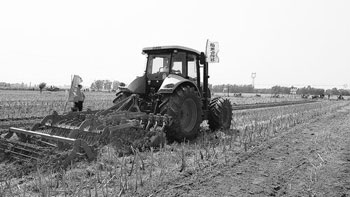
Multifunctional deep tillage machine operating on site. Photo by Lu Wei
On May 13, at the dryland rapeseed demonstration site in Fenlu Town, Huangmei County, Hubei, a crowd gathered. In the demonstration field, various modern agricultural machinery and equipment were lined up in a row.
At a command on site, 6 large combine harvesters started simultaneously and completed the harvesting, threshing and bagging of rapeseed in just a few minutes. Immediately afterward, several multifunctional deep tillage machines took the stage. The remaining half-meter-high rapeseed straw was instantly pulverized, and the compacted rapeseed field was turned into soft, loose cultivated soil. Then came the mechanical precision seeder, which orderly sowed dark brown cotton seeds into the newly tilled field...
"This is an exciting moment." Chen Mengshan, Party Secretary of the Chinese Academy of Agricultural Sciences, who was observing on site, said happily that this means China's rapeseed industry has finally shaken off the traditional farming model and moved toward full mechanization and modernization, and now has the foundation to participate in international competition.
The most difficult year for the rapeseed industry
Currently, for the rapeseed industry, confidence is more precious than gold. In 2015, affected by domestic policies and the international market, the domestic rapeseed purchase price fell sharply, from 5.1 yuan per kg to 3.5 yuan. Planting benefits declined, many rapeseed farmers suffered serious losses, and pessimism bred.
"This year will be the most difficult year for the rapeseed industry." Chen Mengshan pointed out that the information coming from major domestic production areas was all negative: purchase prices fell, rapeseed output fell, planting area fell, and farmers' enthusiasm fell. What followed was an increase in inventories and an increase in foreign imports. The rapeseed industry once again entered a critical period of development.
The same problem also occurred before 2008. Due to low production efficiency, the national rapeseed planting area declined continuously, and rapeseed output fell for consecutive years. On January 9, 2008, the Ministry of Agriculture held the launch ceremony of the national oilseed production revitalization plan in Huangmei County, Hubei. After that, domestic rapeseed production successively achieved increased output and income.
In rapeseed circles, there is a saying: "To see the world's rapeseed, look to China; to see China's rapeseed, look to Hubei." And Huangmei, Hubei, inadvertently became the birthplace of two revitalizations of China's rapeseed industry.
Regarding this, researcher Wang Hanzhong, Vice President of the Chinese Academy of Agricultural Sciences and Chief Scientist of the National Rapeseed Industry Technology System, has a deeper understanding. He said that from 2008 to now, we relied on price incentives and policy stimulation to usher in the revitalization of the rapeseed industry through a high-input, high-output approach; now the situation we face is more severe, and the second revitalization of the rapeseed industry must rely on technological innovation and innovation-driven development, taking the path of green and efficient development.
Advancing agricultural supply-side reform
Exploring technological model innovation on the supply side and transforming "high input, high output" into "improving the output efficiency per unit of input" has become an effective way to revitalize the rapeseed industry.
How to solve the problem? Chen Mengshan believes that in the past we emphasized intensive cultivation and breakthroughs in individual technologies, but paid insufficient attention to the degree of mechanization in the rapeseed industry and to the systemic integration of technologies.
In response to these problems, the Chinese Academy of Agricultural Sciences launched the "Rapeseed Green Yield and Efficiency Enhancement Technology Integration and Demonstration Project" starting in 2013. The project is led by the Oil Crops Research Institute of the Chinese Academy of Agricultural Sciences, together with multiple advantageous units, focusing on the integration and demonstration promotion of green yield- and efficiency-enhancing technologies under mechanized conditions in rotation systems such as "rapeseed-rice," "rapeseed-corn," and "cotton-rapeseed."
At present, the project team has successively developed 9 core key technologies and integrated and assembled them in Huangmei County, Hubei, establishing a new fully mechanized "rapeseed-cotton" and "rapeseed-soybean" rotation technology model, and has established a 10,000-mu demonstration base in Fenlu Town, Huangmei County.
According to researcher Zhang Xuekun, Deputy Director of the Oil Crops Research Institute of the Chinese Academy of Agricultural Sciences, compared with the previous mechanized segmented harvesting technology model, the research team introduced rapeseed chemical desiccation technology and achieved mechanical combine harvesting, reducing costs by 100 yuan, about one quarter of the cost, and significantly doubling harvesting efficiency.
According to reports, since 2013, relevant domestic demonstration bases have reported good news continuously, and rapeseed production costs have continued to decline. In 2013, the demonstration base in Yunmeng County, Hubei, took the lead in reducing costs, from the traditional more than 5 yuan per kg to 2.9 yuan; in 2014, the demonstration base in Gong'an County, Hubei, fell again to 2.3 yuan; in 2015, the demonstration base in Xiangyang, Hubei, successfully fell to 2.0 yuan; in 2016, the demonstration base in Huangmei County, Hubei, hit a new low, reaching 1.75 yuan per kg.
"The field production cost in major international rapeseed exporting countries is roughly 1.5 yuan to 2 yuan per kg, which means we already have the ability to participate in international competition." Chen Mengshan said.
Urgent need to establish a national protected zone
How can rapeseed farmers regain confidence? Chen Mengshan believes that the more difficult the times, the more we must realize that the strategic position of the rapeseed industry cannot be shaken.
Data show that currently China's rapeseed planting area is about 110 million mu year-round, and rapeseed oil accounts for more than 55% of the oil output from domestically produced oilseed crops. It is the largest source of domestically produced edible vegetable oil and occupies a core position in the strategy of safeguarding the nation's edible oil supply security.
In 2015 alone, the summer-harvested rapeseed output in the main production areas of the Yangtze River Basin reached 13.88 million tons, accounting for 90% of the national total. Chen Mengshan believes that accelerating the establishment of a protected zone for double-low quality rapeseed in the Yangtze River Basin and deepening the structural adjustment of the rapeseed industry is both necessary and feasible.
As a major rapeseed province, Hubei's total rapeseed output has ranked first in the country for 19 consecutive years. In April 2016, Hubei took the lead domestically in launching the construction of a protected zone and issued the "Guiding Opinions on Building a Protected Zone for Double-Low Quality Rapeseed" (hereinafter referred to as the "Opinions").
According to the requirements of the "Opinions," Hubei's rapeseed protected zone will focus on the main production areas in the Yangtze River and Han River basins, mainly including 35 key counties and cities with rapeseed planting areas of more than 200,000 mu, such as Jianli, Wuxue, and Tianmen. At the same time, it strives to achieve by 2020, in key regions, "double-low varieties, full mechanization, diversified functions, socialized services, standardized processing, and high-quality branding" for the rapeseed industry, driving the province's double-low quality rapeseed production capacity to stabilize at around 2.5 million tons.
"Hubei Province's approach shows strong strategic vision. Next, we will accelerate the construction of the protected zone for double-low quality rapeseed in the Yangtze River Basin, further enhance the overall competitiveness of China's rapeseed industry, and safeguard the security of China's edible oil industry." Chen Mengshan said. (Our reporter Lu Wei, correspondents Yu Bo and Zou Shiqiao)