Wan Gang: Scientific and technological innovation is the core of achieving comprehensive innovation
Original title: Wan Gang: Achieving comprehensive innovation with scientific and technological innovation as the core
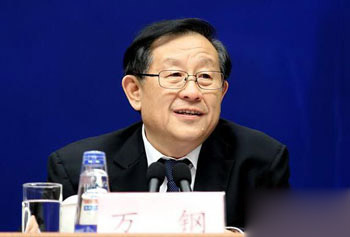
The State Council Information Office held a press conference on the situation of the "Outline of the National Innovation-Driven Development Strategy" (hereinafter referred to as the "Outline"), and Wan Gang, Minister of Science and Technology, introduced the relevant situation. (Network illustration: China.com)
"The 'Outline of the National Innovation-Driven Development Strategy' (hereinafter referred to as the 'Outline') clarifies the goals, directions and key tasks of innovation-driven development for the next 30-plus years. It is a programmatic document for advancing innovation work in the new era, an action guide for building an innovative country, and has very great practical significance and far-reaching historical significance," said Wan Gang, Vice Chairman of the National Committee of the Chinese People's Political Consultative Conference and Minister of Science and Technology, at a press conference held by the State Council Information Office on the 23rd.
Wan Gang introduced that under the leadership of the National Leading Group for Science and Technology System Reform, the Ministry of Science and Technology, together with more than 20 departments, spent two years carrying out top-level design for innovation-driven development, organizing special research and domestic and international investigations, completing the mid-term evaluation of the medium- and long-term science and technology development plan outline and the major national science and technology programs, and the forecasting of future technologies in 12 major fields, and held more than 20 symposiums to listen to suggestions from localities, enterprises, universities, research institutes and experts from all sides. On the basis of broad consensus and the pooling of wisdom from all sides, the "Outline" was researched and drafted, and was reviewed and approved after many rounds of study and discussion by the Party Central Committee and the State Council.
How should the innovation-driven development strategy be implemented? How can the innovation vitality of the whole society be stimulated? How should the reform of science and technology program management proceed? At the press conference that day, Wan Gang gave a detailed interpretation of the hot issues in the "Outline" that the public is concerned about.
Four aspects of the transformation toward innovation-driven development
Without belaboring the background, Wan Gang went straight to the main content of the "Outline." The "Outline" proposes that the implementation of the innovation-driven development strategy should be laid out in accordance with "adhering to the two-wheel drive, building one system, and promoting six transformations." Wan Gang explained that the "two-wheel drive" means scientific and technological innovation and institutional and mechanism innovation, the two wheels, generating force in sync; "one system" means building a national innovation system; and the "six transformations" means achieving fundamental transformations in development mode, development factors, industrial division of labor, innovation capacity, resource allocation, and innovation groups.
In response to a reporter's question about how to understand the transformation of "development factors," Wan Gang said that factor-driven development includes aspects such as resources, the environment, population and investment. He believes that after more than 30 years of rapid development, in the face of higher demands for economic development, the demographic dividend is gradually disappearing, the contradictions of resource scarcity and environmental constraints are prominent, and the marginal effect of investment returns is diminishing. To transform these traditional factor-driven approaches, it is necessary to solve the problem of improving the quality and efficiency of economic development. This is precisely why innovation-driven development has become a national strategy.
"To achieve the transformation from factor-driven to innovation-driven development, the fundamental task is to achieve comprehensive innovation with scientific and technological innovation as the core. On the one hand, vigorously promote scientific and technological innovation, continuously improve independent innovation capacity, and increase the technological supply for industrial transformation; on the other hand, continuously deepen reform, improve the market environment, carry out institutional innovation, and promote scientific and technological innovation and business model innovation, which is the 'two-wheel drive,'" Wan Gang said.
Wan Gang analyzed that there are mainly four aspects to promoting the transformation toward innovation-driven development: improving the productivity of factors and solving the problems of quality and efficiency; breaking through the constraints of resources and the environment through new combinations of production factors; solving the problem of independent controllability through the improvement of key technologies, especially original innovation capacity; and mobilizing the vitality of innovation and entrepreneurship across the whole society to achieve new development.
The "Outline" proposes that major programs oriented toward 2020 and major science and technology projects and engineering projects oriented toward 2030 should form a systematic layout of successive tiers, and should be promptly adjusted and optimized on a rolling basis in accordance with new progress in international science and technology development and new demands of China's economic and social development.
"Some projects not mentioned among the major national science and technology projects do not mean 'not doing them.' Some projects are more suitable to be led by enterprises, and the government can provide inclusive support," Wan Gang stressed. He said that the important areas that need support in the future are basic research and frontier exploration, in order to increase original innovation capacity.
Multiple measures will be taken to stimulate the innovation vitality of the whole society
The "Outline" points out that it is necessary to build and improve innovation and entrepreneurship carriers, develop the maker economy, and create a vivid situation of mass entrepreneurship and innovation. In this regard, Wan Gang believes that promoting mass entrepreneurship and innovation is an important way to enhance new momentum for development and improve the quality and efficiency of development.
He said that under the guidance of the "Outline," the Ministry of Science and Technology will next promote the development of maker spaces toward specialized fields, serving the transformation and upgrading of the real economy. "We encourage and support leading backbone enterprises, research institutes and universities to use their resource advantages to open up services such as sales channels, component supply, testing services, and especially entrepreneurial mentors and roadshows for entrepreneurial teams, to serve young makers," Wan Gang said.
In addition, he stressed that it is necessary to continue accelerating the transformation of scientific and technological achievements to encourage scientific and technological personnel, especially researchers, to lead doctoral and master's students into entrepreneurial activities. "The 'Outline' has made arrangements for establishing an income distribution system oriented toward the value of knowledge," Wan Gang said, adding that this work is under study.
How to do it specifically? "First, it may be necessary to increase the proportion of stable income for scientific and technological personnel at all levels. At the same time, scientific and technological personnel should be able to obtain corresponding returns in the process of achievement transformation, so as to drive their enthusiasm. National and local governments at all levels should give scientific research personnel more autonomy in the use of scientific research funds," Wan Gang said, adding that there should be reasonable compensation for the creative labor they put in for this.
Rebuilding the science and technology program management system is progressing smoothly
The "Outline" proposes rebuilding the science and technology program management system, improving and optimizing the management process of national science and technology programs, building a national science and technology program management information system, and establishing a supervision and evaluation system covering the entire process. How is the reform of the science and technology program management system progressing at present?
Wan Gang introduced that this work is progressing smoothly. Among these, the inter-ministerial joint meeting, in which more than 30 departments participate, has been held 10 times, and has made arrangements for major matters such as the 13th Five-Year Plan for scientific and technological innovation, the deployment of major scientific research tasks, the organization and implementation of key research and development programs, the reform of major programs, the selection and restructuring of professional institutions, and the supervision and evaluation system. Through competitive selection of the best, 7 professional institutions were selected to undertake project management work. A full-process embedded supervision and management system is taking shape and playing a role. "We require traces to be left throughout the entire process, truly achieving the ability to appeal, query and trace," Wan Gang said.
At present, a new set of five categories of science and technology programs has basically taken shape. The key research and development program has taken the lead in launching 36 key special projects in fields such as information, oceans, space and national security. "We strive to accelerate the approval of projects and the appropriation of funds," Wan Gang said.
The management reform of the major national science and technology programs currently being implemented has already carried out pilots in four programs: broadband mobile communications, genetically modified organisms, new drug development, and infectious diseases, and will be fully implemented within the year in major programs that meet the conditions. For the technology innovation guidance program, those already launched include the national guidance fund for the transformation of scientific and technological achievements and the guidance fund for venture investment in emerging industries.