New zinc concept for agriculture helps increase yield and income, enviable
Original title: Using "zinc" agriculture to make the "flower of life" bloom
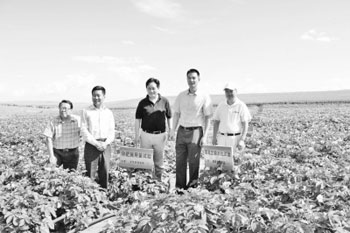
Experts inspect a zinc fertilization experimental field for potatoes in Inner Mongolia.
The trace element zinc is known as the "flower of life"; crops and the human body cannot do without it. To promote the new concept of "zinc agriculture, healthy living," since 2010 the National Agricultural Technology Extension Service Center, the International Zinc Association and Canada's Teck Resources have cooperated in a three-party partnership. Through implementing the zinc fertilizer demonstration and extension project, they are committed to building a zinc nutrition cycle chain of "zinc fertilizer - food - human body," letting this "flower of life" bloom beautifully in fields and on dining tables.
Problems force the pace:
Zinc fertilizer extension accelerates
Zinc is a trace element essential for human health and crop growth. Zinc deficiency leads to decreased human immunity, especially poor development in children. China's soils are severely deficient in zinc. According to test analysis in recent years, the area of zinc-deficient soil reaches about 60%, which is especially prominent in the arid and semi-arid regions of the north. To extend zinc fertilizer application technology, since 2010 the National Agricultural Technology Extension Service Center, the International Zinc Association and Canada's Teck Resources have cooperated in a three-party partnership to implement the zinc fertilizer demonstration and extension project, proposing the concept of "zinc agriculture, healthy living," and promoting scientific zinc fertilizer application technology through trial demonstrations, publicity and training, and guiding enterprises.
According to survey statistics from 26 provinces (autonomous regions and municipalities), in 2015 the national zinc fertilizer application area exceeded 100 million mu, an increase of more than 20% over the previous year, and zinc consumption reached 60,000 tons. According to trial demonstration data, applying zinc fertilizer increased grain crop yields by an average of more than 5%. In terms of zinc fertilizer application, zinc-containing nitrogen fertilizers and zinc-containing compound fertilizers increased relatively quickly; in terms of application methods, spraying and integrated water-fertilizer application increased relatively quickly.
Since 2012, scientific zinc fertilizer application has been written into the Ministry of Agriculture's technical guidance opinions on scientific fertilization of major crops. The recommended zinc fertilizer application rate for wheat, rice, corn, rapeseed, soybean, cotton, fruit trees and other crops is 1-2 kg per mu. Driven by the project, all provinces (autonomous regions and municipalities) also increased their efforts to promote scientific zinc application, and many places incorporated scientific zinc application into their crop fertilization guidance opinions.
Liu Shunan: Converting barren slopes to terraces yields more than 200 yuan extra per mu
Liu Shunan of Nailin Town, Harqin Banner, Chifeng City, Inner Mongolia, transferred 2,000 mu of barren sloping farmland in 2014 for large-scale operation, and after improvement all of it was built into terraces. Because the soil was turned over considerably, in the first year he invested a large amount of compound fertilizer and organic fertilizer, and also laid drip irrigation facilities, using integrated water-fertilizer application to topdress corn, but the corn yield still would not come up, which really stumped him.
In early 2015, technicians from the local soil and fertilizer station took soil samples from his plots for testing and found that the available zinc content in the soil was less than 0.3 mg/kg, making it a severely zinc-deficient plot, and recommended adding zinc fertilizer to the fertilizer formula. Following the guidance of the agricultural technicians, Liu Shunan added 0.5 kg of zinc fertilizer per mu in the base fertilizer, and also added zinc fertilizer in the later topdressing. By harvest time, corn yield increased by nearly 150 kg per mu, and income increased by more than 200 yuan per mu.
(Li Xiaolong, Inner Mongolia Soil Fertilizer and Water-Saving Agriculture Workstation)
Mei Jinxiang: Corn resists drought and disease and still yields steadily
"The dry spell this year has lasted too long, and I was worried the corn would lose yield. Fortunately I applied zinc fertilizer, and my corn grew 3 more leaves than other people's." Mei Jinxiang, a villager from Xiyan Village, Anyang Town, Yunyang District, Shiyan City, Hubei, recently said while holding the hand of Li Guangfu, head of the district soil and fertilizer station.
Starting in 2014, the district soil and fertilizer station carried out a zinc fertilizer pilot in the village. Mei Jinxiang tried setting aside just one mu of land and spread 1 kg of granular zinc fertilizer, and the autumn harvest was 110 kg more than other plots, a 22% increase. "The corn kernels grew all the way to the top, there was less disease and less pesticide use. This year with zinc fertilizer it could also resist drought." Station head Li explained that according to cultivated land fertility evaluation, more than 30% of plots in Yunyang District are severely zinc-deficient. With support from the provincial soil and fertilizer station, they began water-saving agriculture technology trial demonstrations in 2013, and have carried out demonstrations on more than 10,000 mu in sweet potato, rice and corn. Through guidance, the district's zinc application level has risen year by year, and crops' stress resistance, including drought resistance, cold resistance and disease resistance, has notably strengthened. (Hu Jinhong, Hubei Provincial Soil Fertilizer Workstation)
Zhao Wenping: Wheat yield increase drives surrounding large growers
Zhao Wenping is a large-scale farmer in Dongzhenzhuang Village, Ren County, Hebei, contracting 300 mu of land, mainly growing wheat and corn. He purchased tractors, seeders, rotary tillers and other machinery, achieving mechanization. He installed sprinkler irrigation, and the fertilization system achieved integrated water-fertilizer application. He has successively applied agricultural machinery deep loosening technology, the one-spray three-prevention technology, nitrogen fertilizer postponement technology, and corn late-stage topdressing technology, improving his farming level. Now the 300 mu of land is managed by him alone, yet nothing is delayed.
In 2014, Zhao Wenping began applying zinc fertilizer, first applying 1 kg per mu as wheat base fertilizer, and at harvest he harvested 35 jin more per mu than without application. When planting corn, he sprayed zinc fertilizer once at the seedling stage, and as a result the seedling stage yield increased by 52 jin compared with no application. Over the year, applying zinc fertilizer on just 300 mu increased grain output by 26,000 jin. Driven by his demonstration, several nearby large growers all began using zinc fertilizer. (Zhang Wenmin, Hebei Provincial Soil Fertilizer Workstation)
Technical support:
Trial demonstrations verify effects
To provide technical support for large-scale promotion and application, the National Agricultural Technology Extension Service Center formulates and issues the "Zinc Fertilizer Demonstration and Extension Plan" every year, carrying out scientific zinc fertilizer application promotion activities nationwide, and standardizing and requiring the trial demonstration crops, area, zinc application treatments, observation records, result analysis, data reporting and so on. In 2015, 22 demonstration sites were set up in 15 provinces (autonomous regions and municipalities), covering 8 crops, with a total demonstration area of nearly 10,000 mu.
According to the compilation and analysis of trial demonstration data, the effect of foliar spraying of zinc fulvate on tomato is better than integrated water-fertilizer application of zinc sulfate. The effect of foliar spraying of zinc fulvate on wheat is clearly better than integrated water-fertilizer application of zinc sulfate. Comparing the yield-increasing effects of different zinc fertilizer application technologies on corn, integrated water-fertilizer application of zinc sulfate is greater than foliar spraying of zinc fulvate, and foliar spraying of zinc fulvate is greater than basal application of zinc-containing compound fertilizer (or zinc-containing formula fertilizer). Under the condition of integrated water-fertilizer application of zinc sulfate monohydrate ZnSO4·H2O at 2 kg per mu, among various crops the yield-increasing effect is greatest for corn, followed by tomato, rice and wheat.
Industry keeps pace:
Active interaction in agricultural-enterprise cooperation
Applying zinc-containing fertilizer is an important route for zinc fertilizer extension. The National Agricultural Technology Extension Service Center focuses on guiding fertilizer enterprises to participate in the production of zinc-containing fertilizers. Large domestic enterprises such as Shandong Kingenta, Shenzhen Batian, Xindu Chemical and Shandong Chuangxin actively participate, developing zinc-containing fertilizer formulas and new fertilizer varieties. The 15 project provinces focused on contacting 73 fertilizer enterprises, developing a total of 63 zinc-containing fertilizer formulas over the year and recommending them to manufacturers.
Through organizing training seminars for fertilizer production enterprises, they promote zinc-containing formula fertilizers, compound fertilizers and water-soluble fertilizers, advance the production of zinc-containing fertilizers, and guide enterprises in scientific marketing of zinc-containing fertilizers. Dr. Fan Mingxian of the International Zinc Association attended the Second Liquid Fertilizer Industry Development Forum, with more than 300 representatives from relevant enterprises attending, training enterprise R&D and marketing personnel in zinc fertilizer and integrated water-fertilizer application technology. The water-saving division of the National Agricultural Technology Extension Service Center sent personnel to attend the "Third Medium and Trace Element Fertilizer Application and Development Seminar" and gave a special report on "Agricultural Zinc Deficiency and Scientific Application of Zinc Fertilizer."
Publicity and popularization:
Carrying out technical training at all levels
The National Agricultural Technology Extension Service Center successively organized two national technical trainings in Chifeng City, Inner Mongolia, and Dunhuang City, Gansu Province, training agricultural technology extension personnel in integrated water-fertilizer application and scientific zinc fertilizer application technologies. In 2015, it compiled and printed 5,000 copies each of the color leaflets "Scientific Zinc Fertilizer Application Technology for Citrus" and "Scientific Zinc Fertilizer Application Technology for Apple," and distributed them free of charge to major citrus and apple producing provinces such as Hubei, Hunan, Sichuan, Chongqing, Shandong and Shaanxi, to promote fruit growers' attention to zinc nutrition and zinc fertilizer application. In the same year, more than 60 provincial- and county-level on-site observation and technical discussion activities on zinc fertilizer application effects were organized in the 22 project demonstration areas. Through on-site observation during key crop growth periods, farmers were educated to strengthen their awareness of scientific zinc fertilizer application.