Livestock and poultry must pass four checks before they can be sold with a pollution-free certification
Original headline: Beijing: pollution-free livestock product certification ensures the "four checks"
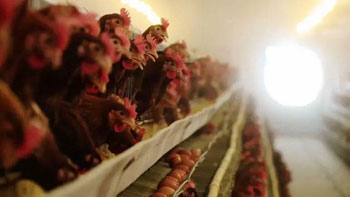
Laying hens at Lüdou Yukou Xinghe Breeding Co., Ltd. (web illustration: Qianlong.com)
Today, pollution-free livestock products have become the main force in Beijing's livestock market. The reporter learned from the Beijing Municipal Bureau of Agriculture that the city currently has 695,000 tons of pollution-free livestock products, accounting for 56% of the city's total livestock production.
How are these pollution-free eggs, pollution-free pork and other products on residents' dining tables produced?
Recently, the reporter visited Lüdou Yukou Xinghe Breeding Co., Ltd. in Daxingzhuang Town, Pinggu District, an eco-tourism area of Beijing. This is an enterprise producing pollution-free fresh eggs, covering 40 mu, with 5 modern chicken houses raising 50,000 laying hens and an annual production of 160 tons of pollution-free fresh eggs.
As soon as the reporter entered the gate of the farm, a display window came into view showing new technologies promoted by the Beijing Municipal Animal Husbandry Environmental Monitoring Station, including intelligent energy-saving lighting technology for laying hen houses, two-fluid spray disinfection technology and water-saving drinkers. Entering the management office, 7 standardized management display boards of uniform format came into view. These are management systems and operating procedures formulated under the guidance of the station based on the enterprise's production conditions, and are the "tightening spell" that ensures the production of safe, high-quality, pollution-free fresh eggs.
"We produce strictly in accordance with pollution-free production requirements, and the entire production process is recorded in detail, including the time, number and destination of laying hens introduced and culled, when the hens became ill, which medicines were used, and how dead diseased chickens were handled, so that the whole process of egg production can be traced," the company's person in charge told the reporter.
In one of the company's chicken houses, modern breeding technology impressed the reporter: 5 rows of cold cathode fluorescent lamps are distributed in parallel along the top of the house, forming an intelligent lighting system together with an intelligent controller installed at the door. It is reported that this technology can automatically adjust light intensity according to the different rearing stages of laying hens, effectively increasing the laying rate, saving electricity and reducing the intensity of rearing labor, while also reducing the incidence of disease among laying hens to a certain extent and cutting down the use of veterinary drugs.
A person in charge from the Beijing Municipal Animal Husbandry Environmental Monitoring Station told the reporter that there are 249 modern pollution-free livestock product production enterprises with standardized management like this in the suburbs of Beijing, but it is not easy for these enterprises to obtain pollution-free livestock product certification; they must ensure the "four checks."
The first check is base site selection. To ensure that farms are not affected by the outside world and that the breeding process does not affect the surrounding environment, pollution-free livestock product production bases must not only meet requirements for production scale, but must also be far from areas polluted by industrial "three wastes," agricultural waste and household garbage, as well as far from main highways and residential areas.
The second check is production management. Farms must formulate corresponding quality control measures and production operating procedures according to their own production conditions, and clarify the specific requirements of each production link for pollution-free livestock products, covering the entire breeding process including production, disinfection, immunization, epidemic prevention, diagnosis and treatment, feed and veterinary drug use, and harmless treatment, so as to ensure full-process quality traceability when problems are found.
The third check is infrastructure. The production of pollution-free livestock products has strict requirements for farm infrastructure. For example, a disinfection pool and personnel disinfection passage must be built at the base gate; the base's production and environmental facilities should be able to meet the production needs of the farm and the growth needs of livestock and poultry, and ensure that the environment inside the houses meets relevant standards; and manure and wastewater generated during breeding must undergo harmless treatment and resource utilization.
The fourth check is supervision. It is understood that pollution-free livestock product certification bodies regularly go to certified bases for supervision and inspection, supervising the bases' production processes in accordance with pollution-free production requirements. In addition, certification bodies also conduct random inspections of the environmental quality inside farm houses to promptly discover hidden dangers threatening livestock product safety in the breeding environment. (Reporter Lu Xiaochun)