Precision application can effectively control pesticide drift
Original title: More accurate targeting, controllable drift
"School-enterprise-government" jointly explore reduced-volume, efficiency-enhanced precision application technology
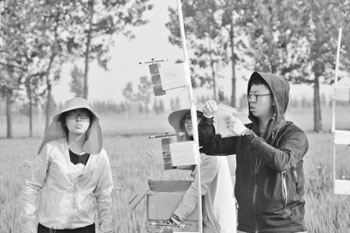
①Students from China Agricultural University collecting airborne pesticide drift at the test site.
②Experimenters inspecting precision application test equipment.
③Staff from the Linyi Plant Protection Station conducting on-site environmental monitoring.
Recently, China Agricultural University and the Linyi Plant Protection Station jointly carried out reduced-volume, efficiency-enhanced precision application test trials in Taiping Town, Linyi City, Shandong Province. China Agricultural University was responsible for application technology, the Linyi Plant Protection Station was responsible for crop pest and disease monitoring and pesticide selection, and Shandong Yongjia Power Co., Ltd. was responsible for providing efficient and precise self-propelled boom sprayer equipment. Together, "school, enterprise and government" advanced the integration of agricultural machinery and agronomy and explored a systematic precision application technical plan: selecting green, low-toxicity agents during the optimal control period and, through the use of precision application technology and efficient plant protection machinery, achieving the desired control effect.
The action to achieve zero growth in pesticide use requires both reduced volume and enhanced efficiency - reducing pesticide use while improving control effects - and this cannot be achieved without the use of precision application technology and efficient plant protection machinery. As the leading unit of the National Agricultural Self-Propelled Plant Protection Machinery Science and Technology Innovation Alliance, Shandong Yongjia Power Co., Ltd. has taken the initiative to shoulder the task of guiding farmers in the scientific use of plant protection machinery, control methods and technology. "As a special type of agricultural machinery, plant protection machinery is not the same as ordinary farm machinery. It is not a case of the greater the horsepower the better, the wider the spray boom the better, or the greater the spray volume the better. A qualified piece of plant protection machinery, besides being able to travel, more importantly must be able to apply pesticides precisely and achieve a good control effect," said Qi Peng, director of the company's precision application laboratory.
As people's awareness of protecting the ecological environment continues to rise, research on pesticide application technology and application equipment faces two major issues: how to improve the efficiency and effective utilization rate of pesticides; and how to avoid or reduce the impact of pesticides on non-target organisms and pollution of the environment. At present, China's application equipment and application technology are still relatively backward, and the effective utilization rate of pesticides is only 36.6%. Most of the pesticide is lost into the soil and the environment, which not only wastes the spray solution but also seriously pollutes the environment. For this reason, improving the spray performance of nozzles, especially spray uniformity, has extremely important practical significance for optimizing the application technology of agricultural chemicals, controlling the drift of harmful substances, increasing the effective utilization rate of pesticides, reducing environmental pollution and making effective use of water resources.
There are many reasons for poor spray uniformity. For example, spray pressure conditions, nozzle spacing, nozzle height, nozzle characteristics, operating environment and working conditions, among many other factors, all differ, and the factors affecting spray quality are also complex and intricate. During pesticide spraying, some pesticide droplets are carried by airflow toward non-target areas and drift away, resulting in drift loss. With the increase in pesticide dosage, problems such as pesticide damage to animals and plants and environmental pollution caused by pesticide drift have become increasingly prominent. Carrying out tests on pesticide droplet drift is of great significance for guiding application methods, researching and developing efficient application machinery, improving pesticide utilization efficiency, and reducing the impact of pesticides on non-target organisms and pressure on the environment. Pesticide drift is a complex issue, and there are many related factors affecting droplet drift, such as the characteristics of the spray solution, application machinery and application technology, meteorological factors, and the operator's operating skills. During the trial, different application methods were used to test data such as pesticide deposition and distribution uniformity, penetration and coverage, and data such as pesticide drift were tested under different spray modes.
Song Jianli, associate professor at China Agricultural University and secretary-general of the Plant Protection Machinery and Application Committee, said that this test was closely tied to real combat conditions, with scientific, rigorous and comprehensive methods, efficient organization and coordination, and close and well-connected cooperation. It gave play to the advantages of each party, achieved a combination of strong partners, and effectively promoted the action to achieve zero growth in pesticide use. The test equipment provided by Shandong Yongjia Power Co., Ltd. had stable performance and can provide guidance for the future scientific use of advanced, precise and high-efficiency plant protection machinery.
This event was jointly hosted by the National Agricultural Self-Propelled Plant Protection Machinery Science and Technology Innovation Alliance, the Plant Protection Machinery and Application Technology Professional Committee of the China Pesticide Development and Application Association, China Agricultural University, the Linyi Institute of Plant Protection, and Shandong Yongjia Power Co., Ltd. (Text/Photos by Lu Yongjia)