Zhang Yunxiang and Wei Zhen: A Couple Who Worked Together to Forge a Path to Prosperity
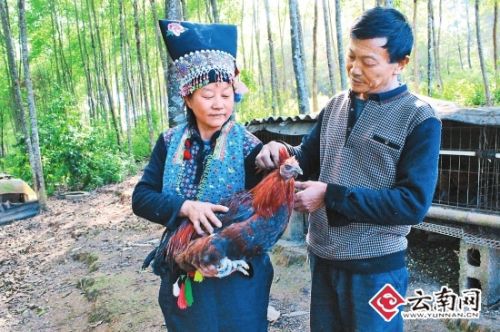
The couple at their chicken farm.
Although some time has passed, Zhang Yunxiang and Wei Zhen, a couple from Dazhong Village, Bailang Yi and Bulang Township, Shidian County, Baoshan City, Yunnan Province, still cannot contain their excitement. Last December, Li Jiheng, Secretary of the Provincial Party Committee, visited their family's chicken farming base and fully affirmed their efforts in developing an ecological chicken farming industry and leading fellow villagers to prosperity. The photo of Zhang Yunxiang shaking hands with the Provincial Party Secretary even made the front page of a newspaper.
Recently, reporters visited Zhang Yunxiang and his wife's chicken farm again to learn about the development of their ecological free-range chicken farming. At the farm, the couple was very happy. They wanted to tell Secretary Li Jiheng: "Through continuous learning, improving our farming techniques, and careful management, our ecological free-range chickens now sell well in both production and marketing. We have grown from more than 4,500 at that time to over 20,000. Please rest assured, Secretary, we will further expand our farming scale and help more farming households escape poverty and achieve prosperity."
Repeated Ventures, Unyielding Spirit
Dazhong Village, where Zhang Yunxiang lives, is a Bulang ethnic village with high mountains, steep slopes, and barren land. Due to the lack of water, this land cannot grow rice, and even the flue-cured tobacco planted there cannot fetch a good price because of its poor quality. For a long time, villagers could only make a living by growing traditional crops such as corn and wheat.
Li Xinzhao, Party Secretary of Dazhong Village, said, "Villagers can only rely on the mountains for their livelihood. Of the 467 households and 2,076 people across 9 natural villages and 12 villager groups, 278 households and 597 people are impoverished. The per capita net income of farmers is only 3,600 yuan."
Zhang Yunxiang is a native farmer of Dazhong Village Group 1. His ancestors made a living from the mountain fields for generations, and by his generation, life still showed no improvement. "Four brothers squeezed into the old house with our parents. Sometimes we couldn't even afford cornmeal." Zhang Yunxiang said that after he split from the family at age 23, he built 3 houses with timber-and-earth structure outside for his two children and himself, and only then did they have a bit more space.
Zhang Yunxiang is recognized in the village as a capable man, but in a mountainous area short of water and farmland, no matter how hard one toils in the fields, it is hard to dig out a golden nugget. At that time, his two sons were in school, and the family needed money. Seeing no hope in farming, he was as anxious as an ant on a hot pan.
To increase income and support their children's education, Zhang Yunxiang and his wife started working odd jobs. "Working as a veterinarian, making liquor, firing bricks and tiles, carrying manure, doing odd jobs - whatever we saw, we did; whatever made money, we did." Zhang Yunxiang said that after a year of hard work, they still could not earn much.
In 2006, after trying countless ways to make money, Zhang Yunxiang and his wife acquired 63 mu of land through land exchange and planted 63 mu of birch trees on the mountain slopes of Xiaosonglin. Unexpectedly, this forest land would later provide an excellent site for developing ecological chicken farming.
Ecological Chicken Farming: Finding the Path to Prosperity
Walking into Zhang Yunxiang and his wife's chicken farm, among the grass shaded by green trees, free-range chickens with bright feathers are foraging and growing freely. Thanks to these ecological free-range chickens, their family's life has improved day by day.
On December 29, 2012, their son Zhang Haibiao, then a sophomore at Yunnan Agricultural University, introduced his parents to work at the university's chicken farming base. "I was shocked the moment I walked in. On about 16 mu of mountain land, there were all kinds of chickens - laying hens, commercial chickens, breeding chickens." Wei Zhen said.
Incubation, seed selection, vaccination, artificial insemination... During more than 8 months at the chicken farming base, Zhang Yunxiang and his wife learned the skills of raising chickens. "Except for doing experiments, we learned everything. Working for others is not a long-term solution. We have over 60 mu of mountain forest at home and we have the skills. Let's go back and give it a try." Zhang Yunxiang had long thought about developing under-forest farming, but previously lacked the techniques, so it had been delayed. After much consideration, the couple decided to return home and start their own business.
On September 22, 2013, the couple returned home with more than 600 eggs bought from the university and began their entrepreneurial journey of ecological free-range chicken farming. "If we're going to raise chickens, we'll raise ecological free-range chickens, letting the chicks grow freely in nature. When hungry, they eat grass, corn, and distiller's grains; when full, they stroll and play in the woods. Chickens raised this way have tender meat, and the soup they make is pure and authentic." Wei Zhen said.
More than half a year later, the couple began selling their first batch of ecological free-range chickens. Although they were 7 to 8 yuan more expensive than ordinary chickens on the market, they were well received as soon as they hit the market. Now, more and more people come to the farm to buy chickens, and many customers from nearby counties and districts make special trips to purchase them. Last year, the gross income from selling free-range chickens was over 200,000 yuan, with a net income of about 90,000 yuan. Not only did they quickly escape poverty, but they also moved toward moderate prosperity. After years of struggling, Zhang Yunxiang and his wife finally found the path to escape poverty and achieve prosperity.
Currently, Zhang Yunxiang and his wife have expanded their farming scale to more than 20,000 chickens (including 7,600 chicks that have been removed from the brooder). Their son, who has professional skills and has returned after completing his studies, has also stayed at home to help his parents develop the chicken farming industry. But they are not satisfied with just this. Wei Zhen said that with the support of Shidian County's project support funds and discounted loans, they have invested more than 600,000 yuan to build the farm road, construct standard incubation rooms, chicken coops, and other facilities, and purchase two standard incubators that can hatch 5,560 chicks at a time. At the same time, they have established a cooperative relationship with Yunnan Agricultural University, which provides chicks to expand the scale of chicken farming.
Demonstration and Leadership: Villagers Have Something to Look Forward To
Yang Zixin, 43, is a villager from Lige Group in Dazhong Village. He has a 77-year-old elderly person to care for and two children in school. With considerable monthly expenses, he often could not make ends meet and was unable to go out to work. After seeing Zhang Yunxiang and his wife succeed in running a chicken farm, in July last year, Yang Zixin specifically asked them for knowledge and experience in raising chickens. After returning, he also raised more than 800 chickens. At the end of the year, these chickens all sold for a good price. Speaking of this, he was beaming with joy.
In Dazhong Village, every household has the habit of raising chickens, but most are scattered free-range operations, with villagers using them to earn pocket money, and no economies of scale have been formed. Zhang Yunxiang and his wife's large-scale, professional chicken farming has provided villagers with ideas for escaping poverty and achieving prosperity. Li Xinzhao said that because the land is barren, the village has not formed a competitive industry for many years, while every household has forest resources. The village's actual mountain forest area is nearly 20,000 mu, which had never been utilized. Zhang Yunxiang and his wife's development of ecological free-range chickens has found the path to prosperity, and their success has provided the village with experience that can be referenced and replicated.
Currently, Zhang Yunxiang and his wife have demonstrated and led 42 farming households to develop the ecological free-range chicken industry. Last June, in order to vigorously develop the breeding industry and improve the degree of scale, specialization, and organization, Dazhong Village registered Shanmao Breeding Professional Cooperative with a registered capital of 110,000 yuan, using Zhang Yunxiang's chicken farm as the base to develop under-forest farming. The cooperative adopts the model of "Party branch + cooperative + farming households + shares" and distributes dividends annually according to the proportion of shares. Li Xinzhao introduced that currently all 42 farming households in Dazhong Village have joined the cooperative, raising more than 10,000 ecological free-range chickens. Not only Dazhong Village, but villagers from nearby townships have also been inspired by Zhang Yunxiang and his wife to learn farming techniques and develop the ecological chicken farming industry.
Talking about the next steps, Li Xinzhao said they will actively integrate projects and funds invested by departments at all levels into the village to improve the cooperative's competitiveness and risk prevention capabilities; through business training, continuously improve the cooperative's farming techniques and management level; actively mobilize surrounding people to participate in the cooperative's development through land shares, and expand the farming scale. According to the plan, the cooperative's annual chicken inventory will reach 100,000 birds and 160,000 birds will be marketed. Through 3 years of effort, it will achieve collective economic income of 50,000 yuan, drive 60 households and 260 people, achieve annual sales revenue of 8 million yuan, profit of 3.2 million yuan, and increase average household income by 53,000 yuan.