Big data poverty alleviation has hidden worries, and the privacy of poor households is hard to protect
Original title: The advances and hidden worries of big data poverty alleviation
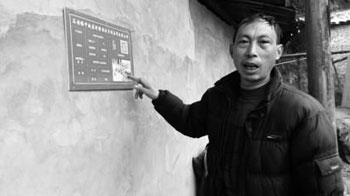
A poor household explains to a reporter how to use the QR code (online illustration: Sichuan Rural Daily)
In recent years, with the widespread application of "big data" in various fields, the use of big data to promote targeted poverty alleviation has also been repeatedly mentioned. The 2015 Mashan incident in Guangxi made people even more hopeful and convinced that big data has greater power in "targeted poverty alleviation." Indeed, China's poor population has a large base and complex circumstances. Previously constrained by the level of science and technology, relevant departments long relied mainly on manual methods to collect data and then analyze it later in order to formulate related policies, which to a certain extent affected the effectiveness of poverty alleviation.
Using the thinking and methods of "big data" is nothing less than gaining an extra pair of sharp eyes for distinguishing "true poverty" from "false poverty." Some media quoted a staff member of a poverty alleviation department as saying: "In the past, if his family had three storefront properties and he said they had one, I could only believe him. Now, I know where all three of their storefront properties are." According to another report, the poverty alleviation information systems in some areas also record in detail the causes of poverty of poor households (villages). Undoubtedly, this provides a more scientific basis for formulating poverty alleviation policies that suit actual conditions.
But the chorus of praise for "big data poverty alleviation" still, to some extent, gives rise to a trace of hidden worry. First, the focus of "big data poverty alleviation" is on "poverty," that is, the poor individuals or poor groups who are the targets of "alleviation." In the vision of big data, poor groups, along with their assets, income, work, and so on, can all be abstracted into a pile of cold data collectively called "poverty," while in real life, behind these data stand living, breathing people. They have their own marriages and funerals, births, aging, illness and death, and joys and sorrows. We all know that modern people value privacy, and no one wants their life data made public. Especially for the poor, meager income, cramped housing, harsh circumstances, a difficult life, and the so-called "causes of poverty" that created all this, and even the very fact of being "assisted" as a member of the poor population, are things they are unwilling and ought not to have casually exposed.
What is more, among this large number of poor families, there are also many minors. Perhaps because of the results of poverty alleviation, the favor of opportunities, and personal struggle, these children later changed their fate and lived decent lives; or perhaps for various reasons, they helplessly inherited the poverty of their parents' generation. No matter what, the experience of poverty in childhood should not be exposed before the world like a brand. And once all of this is turned into big data or moved to the cloud, the risk of its leakage also increases.
Therefore, in the era of big data poverty alleviation, because information on the poor population is grasped in greater detail, the task of poverty alleviation departments going door to door to verify information on the poor population has been reduced, but the task of safeguarding the information security of the poor population has become heavier. At the same time, in the process of carrying out poverty alleviation work, information on conditions in poor areas and among the population changes dynamically; moreover, the more effective the poverty alleviation work is, the greater the frequency and scope of information changes will be. Yet this information, which serves as the basis for decision-making, does not update automatically. This requires poverty alleviation departments to strengthen both hardware and software development and increase the frequency of data tracking and updating, so that the data can be as updated and accurate as possible, and only then can its reference value for work be maximized.
Second, because of the use of big data, processing "poverty data" will become a major task for poverty alleviation departments, which objectively requires staff to carry out more of their work inside the office. Opportunities to enter the homes of the poor and communicate with them face to face may therefore decrease. But we know that what the poor need is not only a bag of rice, a bottle of oil, or a job opportunity, but also emotional comfort through expressions of care. In fact, when poverty alleviation workers knock on the doors of the poor, they also open for them a psychological door to changing their fate. Of course, the convenience and efficiency that big data brings to work may also free poverty alleviation workers from heavy data-organizing work, allowing them to use more time and energy for in-depth communication with the poor, but all of this depends on institutional adjustment and design.
In fact, whether it is the Mashan incident in Guangxi or other problems exposed in poverty alleviation work in recent years, it is less a case of data "failure" than of institutional "failure"; or rather, big data is merely a tool used to "observe" poverty conditions, while truly "seeing" poverty and the pain it brings people, and taking effective action, depends on institutional development beyond big data. Otherwise, even if big data on poverty is placed before the relevant departments, they may still turn a blind eye to "true poverty" while constantly making eyes at "false poverty."
The progress of science and technology always reveals to us a beautiful new world to look forward to. In response, while warmly cheering, we should also maintain calm reflection. Whenever science and technology advances one inch, institutions often need to advance one foot, so that it can truly benefit people. The same is true of big data poverty alleviation. (Meijianchi)