Guangdong invests 200 million yuan to build 10 Internet+ towns in 3 years
Original title: Guangdong's multiple measures help large enterprises play a leading and driving role in "mass entrepreneurship and innovation"
This year, 200 million yuan to support the creation of the first batch of "Internet+" towns
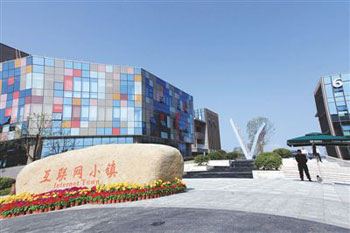
Internet towns (image from the internet)
Recently, the Ministry of Industry and Information Technology issued the "Guiding Opinions on Deepening the Integrated Development of Manufacturing and the Internet", which explicitly supports large manufacturing enterprises in building Internet-based "mass entrepreneurship and innovation" platforms, and encourages the open sharing of resources and socialized services of large enterprises' "mass entrepreneurship and innovation" platforms.
In recent years, Guangdong has actively implemented the innovation-driven development strategy and promoted large enterprises to play a leading and driving role in "mass entrepreneurship and innovation" work. A reporter learned from the Provincial Economic and Information Commission that at present more than 30% of large industrial enterprises in the province have established "five-haves" R&D institutions, 23 large backbone enterprises have established central research institutes, and 85 enterprises have been recognized as national enterprise technology centers.
Not only internal innovation, large enterprises also fully drive upstream and downstream of the industrial chain, cross-industry and cross-field players, and all sectors of society to actively engage in "mass entrepreneurship and innovation". At present, 35 large enterprises in the province participate in the construction of crowd innovation platforms, with cumulative investment exceeding 25 billion yuan, and more than 3,500 incubated projects. The whole province is relying on large enterprises to advance the creation of "Internet+" towns and build Internet innovation cluster zones.
Guangdong backbone enterprises participate in building crowd innovation platforms
More than 3,500 incubated projects
"Giving play to the leading and demonstrative role of large enterprises can effectively advance mass entrepreneurship and innovation." According to a relevant official of the Provincial Economic and Information Commission, since 2014, our province has vigorously implemented the innovation-driven strategy, promoted full coverage of R&D institutions in large enterprises, and striven to advance all large enterprises in the province to build "five-haves" R&D institutions with full-time R&D personnel, fixed R&D sites, special R&D funds, dedicated R&D equipment, and specific R&D projects.
Data shows that at present more than 30% of large industrial enterprises in the province have established "five-haves" R&D institutions, 23 large backbone enterprises have established central research institutes, the number of nationally recognized enterprise technology centers has reached 85, and 47 provincial-level engineering technology research centers have been recognized. 26 enterprises were selected as technology innovation demonstration enterprises jointly recognized by the Ministry of Industry and Information Technology and the Ministry of Finance. The province's technology self-sufficiency rate has reached 71%, and valid invention patents have reached 138,900.
In encouraging mass entrepreneurship, our province supports large enterprises in participating in the construction of crowd innovation and incubation platforms, investing in small and micro enterprises, and driving entrepreneurship across society. At present, 35 large enterprises in our province participate in the construction of maker spaces, science and technology incubators, small enterprise entrepreneurship bases, and more, with cumulative investment exceeding 25 billion yuan, and more than 3,500 incubated projects.
Among them, Tencent has built Tencent maker spaces in more than 20 cities across the country, becoming one of China's largest entrepreneurship platforms, with a planned area of more than 500,000 sq m, more than 200 quality projects settled in, a total of 176 incubated teams, 11 companies entering the listing process, 49 companies successfully financed, and a total valuation exceeding 20 billion yuan. (Huawei) Tian'an Cloud Park Group has built a 2.89 million sq m entrepreneurship incubation city in Shenzhen, which has so far incubated 450 cloud computing, Internet of Things, and Internet enterprises, and plans to incubate another 1,000 high-tech enterprises, with annual output value to reach 100 billion yuan.
Next, our province will further cultivate innovative backbone enterprises, give prominent attention to the action of achieving full coverage of R&D institutions in large industrial enterprises, and by the end of 2017 strive for all large industrial enterprises in the province and 20% of industrial enterprises above designated size to set up full-time R&D institutions.
More than 25% of large industrial enterprises
Relying on the Internet to build innovation platforms
At the same time, large enterprises also guide all forces to participate in innovation and drive the clustered development of crowd innovation. According to reports, at present more than 25% of large industrial enterprises in our province rely on the Internet to build innovation platforms and establish an open innovation model combining internal and external enterprise resources, and combining online and offline.
For example, Konka Group uses WeChat, QQ, and vertical websites to build an Internet innovation platform, and adopts forms such as crowdsourcing, crowd innovation, and crowdfunding to gather 15,000 social makers in industrial design, hardware design, software R&D, and more to participate in new product R&D, shortening the product update cycle by 15% and increasing product profit by more than 5%.
In collaborative innovation across the industrial chain, our province has adopted methods such as implementing major science and technology projects and providing financial fund support to guide large enterprises in organizing upstream and downstream enterprises in the industrial chain to carry out generic and key technology R&D, and to improve core technology R&D capabilities.
Among them, Huawei organized precision manufacturing enterprises such as Dongguan Ruibida Technology to jointly develop intelligent inspection robots, intelligent robotic arms, and industrial control systems, and its visual automatic recognition technology leads the country. Midea Electric established cooperative relationships with enterprises such as Tongfang Electronics and JD.com, building an industrial chain innovation platform covering the whole process from "industrial design and basic research" to "engineering application" and then to "product series", maintaining international leadership in technologies such as magnetic levitation variable-frequency centrifugal compressors and chillers, two-stage variable-frequency compressors, and rare-earth-free variable-frequency compressors.
In addition, our province also supports cross-border innovation, developing new business forms and new products through cross-border integration of Internet enterprises with manufacturing and other industries, vigorously advancing the deep integration of informatization and industrialization in industrial enterprises, and accelerating the information technology transformation of traditional industries. For example, major home appliance enterprises such as TCL, Skyworth, Midea, Gree, and Galanz cooperate with Internet enterprises such as LeTV, 360, Xiaomi, and JD.com to develop Internet smart home appliances supporting new functions such as effective human-machine interaction, smartphone intelligent control, and online information services. Tencent carried out strategic cooperation with Foxconn and Harmony Auto on "Internet+ smart electric vehicles". In 2015, Tencent's main business revenue exceeded 100 billion yuan for the first time, an increase of 30%.
Striving to build 10 industry-oriented
"Internet+" towns within 3 years
Guangzhou T.I.T Creative Park, driven by the Tencent WeChat headquarters, has attracted 76 enterprises in e-commerce, industrial design, mobile Internet software, and more to settle in, with more than 50,000 employees. In 2012, the park's output value reached 10 billion yuan.
Another example is China Mobile building a southern base in Guangzhou to create an ICT smart industry cluster, with a planned total construction area of more than 2,600 mu, building 10 international-level technology R&D centers, and driving more than 500 information service enterprises and more than 85,000 employees to develop through entrepreneurship. Such cases of actively developing "Internet+ entrepreneurship and innovation" and building Internet innovation cluster zones are worth learning from.
It is disclosed that, in order to drive the clustered development of crowd innovation, our province is carrying out the selection work for the first batch of "Internet+" towns, relying on large enterprises to advance the creation of "Internet+" towns.
This year, the Provincial Economic and Information Commission has arranged 200 million yuan to support the creation of the first batch of 10 "Internet+" towns centered on large enterprises such as Huawei, Tencent, and Midea, and to cultivate and strengthen new Internet business forms.
According to reports, "Internet+" towns are divided into industry-oriented and application-oriented types. Our province strives to create 10 industry-oriented "Internet+" towns and 50 application-oriented "Internet+" towns within 3 years, and cultivate 1,000 innovative Internet small and medium-sized enterprises.
Next, our province will promote large Internet enterprises and basic telecommunications enterprises to further open computing, storage, and data resources to entrepreneurs, providing information resource support for entrepreneurship and innovation. It will also hold an "Internet+" expo and Internet innovation competition to promote the transformation of Internet innovation achievements.
"Internet+" towns
"Internet+" towns are divided into industry-oriented and application-oriented types. Our province strives to create 10 industry-oriented "Internet+" towns and 50 application-oriented "Internet+" towns within 3 years, and cultivate 1,000 innovative Internet small and medium-sized enterprises.