Sisters who gave up high salaries to grow organic rice blossom in the fields
Original headline: Post-80s girls quit their jobs to start businesses growing rice; supply-side adjustment helps farmers increase income
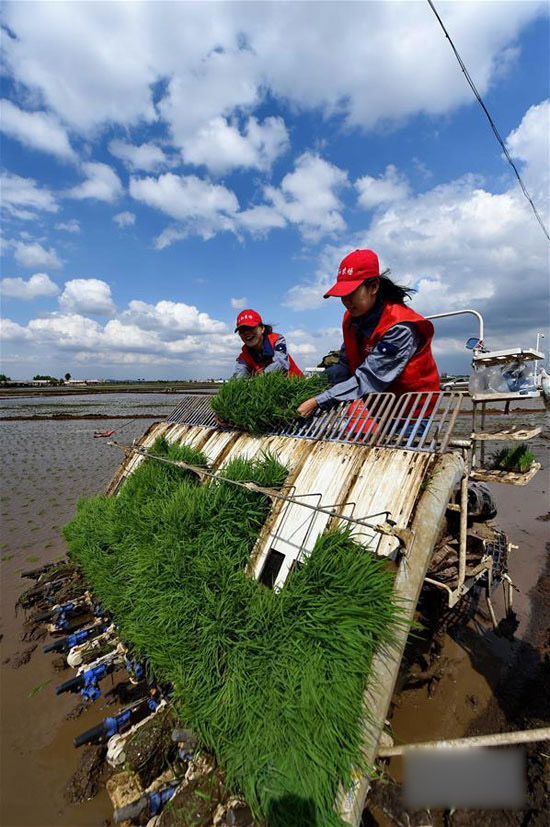
On May 27, Yan Kun (left) and Feng Qijun place rice seedlings into a transplanter.
Jilin girls Yan Kun and Feng Qijun are both post-80s, grew up together, and after graduating from university took jobs at well-known financial and automotive enterprises respectively, earning handsome incomes. In 2013, the two discovered business opportunities in organic agriculture, quit their high-paying jobs together to found a company, and entered the field of organic rice cultivation as entrepreneurs. After more than a year of preliminary research, the company decided to join with the rice cooperative of Xingde Village, Huinan County, Jilin Province, to operate nearly 1,000 mu of paddy fields held by more than 100 farmers under intensive management, establishing Sanhe Organic Farm. In the past, farmers in Xingde Village only chose to plant rice varieties with high yields, and to increase yields they used large amounts of chemical fertilizers and pesticides. Yields rose, but quality was poor and the rice could not fetch a good price. Yan Kun and Feng Qijun used big data methods to collect customers' lifestyles and dietary preferences, explained market demand bit by bit to the farmers, adjusted the product structure, and produced rice varieties meeting organic standards. The yield was only two-thirds of the original, yet the price rose from a few yuan per jin to several dozen yuan per jin. In 2015, Sanhe Farm's organic rice sales reached more than 8 million yuan, and in the slack farming season farmers could also work at the rice processing plant, increasing per capita annual income by more than 5,000 yuan. Photo by Xinhua News Agency reporter Zhang Nan
On May 27, Yan Kun (right) and Feng Qijun transplant rice seedlings in the field. Photo by Xinhua News Agency reporter Zhang Nan
On May 27, Yan Kun (left) and Feng Qijun put up a sign beside a field where crab seedlings have been released. The crabs loosen the soil for the rice while also eating some weeds and pests, and their droppings serve as organic fertilizer for the rice. Photo by Xinhua News Agency reporter Zhang Nan
On May 27, Yan Kun (right) and Feng Qijun discuss product packaging. Photo by Xinhua News Agency reporter Zhang Nan
On May 27, Yan Kun (left) and Feng Qijun inspect the storage condition of the rice grain in the warehouse. Photo by Xinhua News Agency reporter Zhang Nan