Hard Technology Innovation Alliance Builds Momentum and Adds New Driving Force
Original title: Technology Changes China, Innovation Drives the Future
-- Written on the eve of the National Conference on Science and Technology Innovation
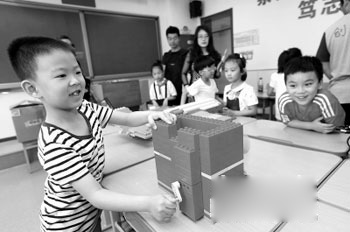
As Children's Day on June 1 approaches, the science and technology innovation carnival at Xinxing Primary School in Heping District, Tianjin, has kicked off. Students and parents take part together in science and technology innovation activities and experience the joy of innovative practice. Xinhua News Agency photo
Sometimes, coincidence reflects a kind of inevitability, a kind of broad trend --
"Hard technology can change the world." On May 28, at the exhibition center of the Zhongguancun National Independent Innovation Demonstration Zone, scientists and entrepreneurs from Beijing, Xi'an and other places announced the establishment of the Hard Technology Innovation Alliance, sounding the clarion call for hard technology innovation.
At the same venue, more than two years earlier, the collective study session of the Political Bureau of the CPC Central Committee moved its "classroom" here, and General Secretary Xi Jinping issued a call to the whole Party and society to "implement the innovation-driven development strategy well."
Since the 18th National Congress of the Communist Party of China, the CPC Central Committee with Comrade Xi Jinping as General Secretary has assessed the situation, placed science and technology innovation at the core of the overall national development, deepened deployment and pushed forward with full effort. Innovation-driven development has taken solid steps and is advancing toward the goal of becoming an innovative country.
The Fundamental Way Out Lies in Innovation, and the Key Is to Rely on the Power of Science and Technology
From New China's "poverty and blankness" to the march toward the great rejuvenation of the Chinese nation, scientific and technological innovation and progress have leveraged the rise and strength of the nation and upheld the hope of the nation
"I want to build a world-class quantum physics laboratory in China."
In 1996, in Austria. When faced with his advisor's question, "What is your dream?", Pan Jianwei, then 26 years old, answered exactly that.
In 2001, he gave up an overseas teaching position and returned to China to set up a laboratory at the University of Science and Technology of China; today, the Beijing-Shanghai quantum communication trunk line project is being actively built; the "Quantum Science Experiment Satellite" is about to travel into space...
"If we seize the initiative in quantum communication, we can hope to grasp the opportunity to change from a follower into a leader," said Pan Jianwei, academician of the Chinese Academy of Sciences and executive vice president of the University of Science and Technology of China. "Our research contains new national strength."
In fierce competition, only innovators advance, only innovators become strong, and only innovators win.
Science and technology are the kindling of the progress of human civilization. Innovation is the backbone supporting national rejuvenation. Entering the "13th Five-Year Plan" period and the key stage of realizing the "Two Centenary Goals," it is all the more necessary to firmly grasp science and technology innovation, this "bull's nose."
Shenzhou's spaceflight created "China's height," Jiaolong's deep-sea diving achieved "China's depth," high-speed rail's swift running refreshed "China's speed," and the large telescope broadened "China's dimension"...
Since the 18th National Congress of the Communist Party of China, innovation-driven development has become a national strategy and has been placed at the core of the overall national development. China has actively devoted itself to a new round of global scientific and technological revolution and industrial transformation.
Today, China's total economic output has leaped to second place in the world, with science and technology as an important support. A set of statistics from 2015 is encouraging: society-wide research and development expenditure reached 1,422 billion yuan; the number of international scientific and technological papers ranked second in the world; the contribution rate of scientific and technological progress reached 55.1 percent, and China's ranking in national innovation capacity rose to 18th in the world.
Bai Chunli, president of the Chinese Academy of Sciences, said: "China's science and technology innovation is showing two profound changes: first, a shift from accumulation in 'quantity' to a leap in 'quality'; second, a shift from breakthroughs at 'points' to improvement across 'areas.'"
Where does the mighty force of science and technology supporting comprehensive national strength and boosting economic transformation and upgrading come from?
-- From the bright path of China.
On June 9, 2014, at the Great Hall of the People. General Secretary Xi Jinping gathered with the scientific and technological backbone of the Republic -- academicians of the Chinese Academy of Sciences and the Chinese Academy of Engineering. The General Secretary stressed --
"The direction of our country's scientific and technological development is innovation, innovation, and more innovation."
The "13th Five-Year Plan" uses a dedicated section to deploy the implementation of the innovation-driven development strategy over the next 5 years and strengthen the leading role of science and technology innovation.
The just-released "National Innovation-Driven Development Strategy Outline" drew a roadmap and timetable for building a world power in science and technology innovation, and made the overall deployment of "adhering to dual-wheel drive, building one system, and promoting six major transformations."
-- From the powerful momentum of deepening reform.
Several opinions on accelerating the implementation of the innovation-driven development strategy were issued, breaking down the "barriers" of systems and mechanisms and promoting the free flow of talent, capital, technology and knowledge. In the implementation plan for deepening the reform of the science and technology system, more than 100 tasks focus on prominent contradictions constraining science and technology innovation and coordinate current and long-term measures.
One reform measure after another highlights China's new development "path": promptly switching the driving force of development to the innovation engine and realizing the "dual-wheel drive" of science and technology innovation and institutional innovation.
-- From passion-burning innovation and entrepreneurship.
Xiaomi phones have grown bigger and stronger, DJI Innovation's drones fly higher, and the intelligent companion robot independently developed by Xiaoyuer Technology quickly enters the market... A batch of technology enterprises are growing like bamboo shoots after a spring rain.
"Whatever we do, we start from the perspective of innovation and take innovative development as a value orientation and a way of thinking, and then we can create an even more brilliant future," said Mu Rongping, chairman of the China High-Tech Industry Development Promotion Association.
If Science and Technology Thrive, the Nation Thrives; If Science and Technology Are Strong, the Country Is Strong
On the road of pursuing a happy life, scientific and technological progress is a powerful guide, and innovative development is the source of driving force
Science and technology innovation has never influenced Chinese society as profoundly as it does today.
Pharmaceutical scientist Tu Youyou stood on the podium of the Nobel Prize, and artemisinin originally created by Chinese people saved the lives of millions; Lai Yuanming's team successfully solved the "world-class permafrost problem that could not be conquered" in the construction of the Qinghai-Tibet Railway and created the miracle of the "Sky Road"; Pei Duanqing's team discovered the key mechanism by which cells "rejuvenate" in structure...
From the laboratory to vibrant life, from the macro level to the micro level, the efforts and dedication of one scientist and team after another have gradually turned new scientific discoveries into applications; one instrument or key component after another has been successfully developed, and one detail of production technology after another has been improved and elevated, bringing little by little change to real production and life.
Science and technology change the trajectory of human destiny; innovation lets opportunity burst forth in entrepreneurship.
Mao Daqing, former senior vice president of Vanke Group, gave up a high salary and the "halo" of a top professional manager to build a maker service platform that nurtures science and technology innovation.
"The tide of science and technology innovation is unstoppable. This is a struggle for the fate of the nation. If I can participate in this struggle, the sense of achievement and happiness I gain is far more important than making money." This is Mao Daqing's life choice.
Science and technology innovation has become the "primary source of driving force," helping China's economy adjust its structure, promote transformation and move toward the "middle-to-high end."
Relying on science and technology innovation, emerging industries "overtake on the curve" and bravely stand at the forefront of the times. Big data, cloud computing, the mobile internet, the Internet of Things... The drumbeats of innovation sound densely, playing together a new strong note of China's economy.
A large number of enterprises such as Huawei, Lenovo and ZTE have entered the ranks of global high-tech industry leaders. In 2015, the added value of China's high-tech industry grew by 11 percent.