Purple yam grows lying down, and Yang Jiangkui, a young man from Pengshui, Chongqing, has a clever trick
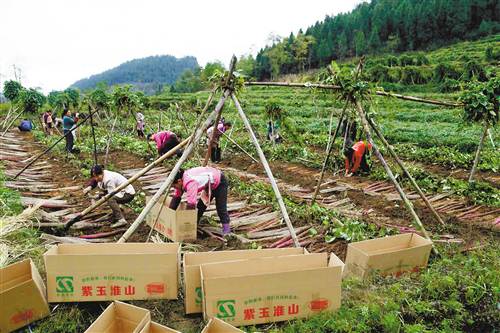
At the end of last year, Yang Jiangkui's purple yam field had a small-scale bumper harvest, and workers were digging them up and packing them into boxes.
Purple yam, also known as Chinese yam or long taro, belongs to the Dioscoreaceae family. This vegetable, known as the "purple ginseng," is rich in protein and also contains abundant saponins and various vitamins. In Taiwan, China, Guangdong, Fujian and other places, purple yam is regarded as a treasured health food of the Hakka people. However, due to unsuitable soil conditions, for a long time Chongqing has rarely grown purple yam.
In 2013, Yang Jiangkui, a young man from Pengshui, discovered the gap in Chongqing's purple yam market, searched everywhere, and tried the "shallow-growing planting method," changing the purple yam's habit of vertical growth and making it grow "lying" on the ground. After 3 years of trial planting, this year his purple yam base has officially gone into production. With 200 mu of purple yam fields, after deducting losses, output is expected to reach 350 tons.
Searching far and wide
He "brought" purple yam to his hometown
On May 20, in the Pengshu Agriculture purple yam base in Bailong Village, Sangzhe Town, Pengshui Miao and Tujia Autonomous County, shallow-growing troughs were neatly arranged one after another. Yang Jiangkui told reporters that today was the last day of the sowing stage. Barring accidents, in another half a year, this purple yam base that he has painstakingly run for 3 years will welcome its first big harvest.
Yang Jiangkui is 29 years old this year. After graduating from Southwest University, he worked in Beijing, Shenyang, Xichang and other places in different jobs including store management, market sales, and insurance sales. In 2013, he learned from a friend that purple yam was a hugely popular health food on the market at the time, with retail prices in Guangxi and Guangdong reaching as high as 10 yuan/jin. "I ran around to hotels, supermarkets, and vegetable markets of all sizes in the city and found that only a very few hotels sold purple yam juice." Yang Jiangkui said, yet this vegetable was actually not sold at all in Chongqing.
It turns out that purple yam is a crop that grows vertically and needs to take root and grow 1 to 1.5 m in the soil, so it can only grow in sandy soil. However, Chongqing's soil layer is thin and the soil is highly sticky, so purple yam cannot take root, and therefore for a long time no one had grown purple yam on a large scale in Chongqing.
"If this problem is solved, a new market can be opened up." After this idea took shape, Yang Jiangkui went to Guangxi, Guangdong, Fujian and other places to investigate in many ways. Later he discovered that local people were using a new technology, the "shallow-growing planting method," to improve the yield and quality of purple yam. This method changed the purple yam's habit of vertical growth and could just overcome the problem of a "thin soil layer and high stickiness."
At the end of 2013, Yang Jiangkui returned to Pengshui with the "shallow-growing planting method" technology and trial-planted 30 mu of purple yam.
Finding a new technology
The purple yam grown is more nutritious
One shallow-growing trough, one handful of rice husks, one sheet of plastic mulch, the "shallow-growing planting method" does not look very profound. The shallow-growing trough is a semicircular plastic tube about 1 m long. Rice husks are spread inside the trough, and a space is reserved at the top for placing the seed. Then the shallow-growing trough is laid vertically and flat on a 10 to 15 degree earthen slope, after which a 5 cm thick layer of soil is scattered on top, and then the purple yam seed is placed into the reserved space. Yang Jiangkui demonstrated this "shallow-growing planting method" for reporters. "Finally, a layer of plastic mulch must also be laid on the surface, which reduces weeds and also plays a role in preserving moisture and warmth." Yang Jiangkui said.
Why can this planting method make purple yam grow "lying down"?
"The shallow-growing trough and the slope are key." Yang Jiangkui picked up a shallow-growing trough and explained to reporters that the shallow-growing trough wrapping the purple yam blocks the path for the purple yam to grow into the ground. Second, seed growth will show geotropism because of gravity. "So the shallow-growing trough must be placed on a small slope, so that it can grow downward along the tube trough."
And the "shallow-growing planting method" not only solves the soil problem, but also brings benefits to the quality and yield of purple yam. In appearance, purple yam grown this way is larger, straighter, and smoother on the surface. In addition, because only a thin layer of soil covers the surface, the effect of the day-night temperature difference on the crop is greater, making its nutrient content richer.
Compared with traditional planting methods, the "shallow-growing planting method" can also save more labor costs. Yang Jiangkui said that purple yam planted with traditional methods takes root relatively deep, and the labor cost required for digging it up is 60% higher than with the "shallow-growing planting method."
From production to sales
Wanting to build a purple yam industry chain
With 200 mu of purple yam fields, a yield of about 3000 kg per mu, a purchase price of 4.5 yuan/kg, and a planting cost of 4000 yuan per mu, after further deducting labor costs and base operating expenses, by this calculation Yang Jiangkui's gross income per mu can reach 6000 yuan. "I have already reached cooperation with Renrenle and Shuangfu International Agricultural Trade City to supply them." Yang Jiangkui is calculating that he will continue to invest the first pot of gold he earns into production.
In Yang Jiangkui's eyes, the most urgent thing right now is to improve inventory capacity. Not far beside the purple yam field is an empty plot that has already been leveled, and this empty plot will have a 1000 cubic meter cold storage built within the year. "To cooperate with large supermarkets and large markets, long-term supply must be guaranteed." Yang Jiangkui said that with this cold storage, the supply period for purple yam can be extended from 3 months to about half a year.
"I want to build a purple yam industry chain from production to sales." Yang Jiangkui told reporters that he has now brought in two more investors and has also driven 5 nearby farming households to grow purple yam together. Within this year, Yang Jiangkui will open online stores on the WeChat and JD.com platforms to do retail. "Doing retail and wholesale together and fully opening up sales channels is what will help the formation of the industry chain in the future." He said.