Cutting down 28 low-quality walnut trees earned him over 7,000 yuan more, without hardship
Original title: Cutting down 28 trees, earning over 7,000 yuan more——what a skilled walnut grower teaches us about industrial poverty alleviation
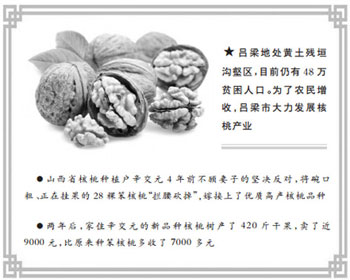
Xin Jiaoyuan grows walnuts
Xin Jiaoyuan, a walnut grower in Shanxi Province, went against his wife's firm opposition 4 years ago and cut down at the waist 28 low-quality walnut trees, as thick as a bowl's mouth and in fruit, grafting on high-quality, high-yield walnut varieties. Two years later, Xin Jiaoyuan, who lives in Zhaizishang Village, Longjiao Township, Shilou County, Lyuliang City, harvested 420 jin of dried nuts from his new-variety walnut trees and sold them for nearly 9,000 yuan, more than 7,000 yuan more than he used to earn from low-quality walnuts.
By contrast, Xin Yunping, an impoverished household in the same village, planted nearly 20 mu of low-quality walnuts; more than 2 mu had entered full bearing, yet he sold them for only a little over 1,300 yuan. Some villagers with 7 mu of walnuts earned only a little over 1,000 yuan in a whole year.
Zhaizishang Village is flanked by mountains on two sides, with more than 160 households living against the hillsides. To alleviate poverty, the local government began helping villagers plant walnuts more than 10 years ago. But today, more than 3,000 mu of walnuts already cover the village's hilltops, yet the poverty-alleviation results are not ideal. Only Xin Jiaoyuan not only put 3 children through university but also became a walnut expert, earning 30,000 to 40,000 yuan a year just from grafting walnuts for others. Xin Jiaoyuan says he was never an impoverished household; what he relied on was walnut-growing technique.
At the entrance to Xin Jiaoyuan's home lies a small walnut orchard covering 1.2 mu, with 28 trees in all. "What we used to grow were low-quality walnuts: big in size, small in kernel, with thick, hard shells that wouldn't fetch a price." But Xin Jiaoyuan felt this was a way to make a living, and that he could not let ignorance turn a way out into a dead end. With this in mind, 7 years ago Xin Jiaoyuan gritted his teeth, packed his bags and left home to learn walnut growing. Three years later, as soon as Xin Jiaoyuan returned home, he "beheaded" the 28 low-quality walnut trees.
Xin Jiaoyuan said: "My wife was firmly against it at the time. Trees as thick as a bowl's mouth had grown for 10 years and were just at the fruiting stage; who wouldn't feel heartache at cutting them down at the waist?" But he understood in his heart that although cutting the trees meant no income for the time being, once the grafted new varieties bore fruit, the returns would increase markedly.
Last year, Longjiao Township specially set up a walnut association and hired Xin Jiaoyuan as its chairman, to teach fruit growers growing techniques and lead more than 30 people in carrying out the improvement and efficiency increase of 1,000 mu of walnuts across the township.
Because he is responsible for grafting 260 mu of villagers' walnut trees, Xin Jiaoyuan is very afraid of something going wrong, and every few days he cannot resist going up the hill for a look. Gazing at the stretch of bowl-thick walnut trees cut off at the waist before him, 57-year-old Xin Jiaoyuan told the reporter: "In another 10-plus days, once the buds grow a little bigger, these walnut trees can be grafted."
"All the varieties we graft now are high-quality ones like Gift No. 2 and Liaohe No. 2. Small trees need only 3 to 5 buds grafted, while large trees need 20 to 30 buds; grafting one bud costs 2 yuan." Xin Jiaoyuan told the reporter that grafted new varieties can bear fruit the next year and reach full bearing in 8 years, with 1 tree producing 30-40 jin of dried nuts; but traditional varieties take nearly 10 years to bear fruit and 15 years to reach full bearing, with 1 tree yielding only 10-plus jin, some not even 10 jin, and the price is also considerably lower than that of new varieties.
To reduce losses for impoverished farmers, the Longjiao Township government subsidizes farmers 100 yuan per 1 mu of walnut land and has also provided some walnut-growing insurance. "Our whole township has more than 30,000 mu of walnuts in total, 3 mu per person. To give full play to the poverty-alleviation effect, we must guide the common people to change their thinking and carry out comprehensive grafting and improvement." said Guo Yongdong, Party secretary of Longjiao Township.
Similar problems exist not only in Longjiao Township but throughout the Lyuliang region as well. Lyuliang lies in the loess broken plateau and gully area, and still has 480,000 impoverished people, making it the toughest "hard bone" to gnaw in Shanxi's poverty-alleviation campaign. To increase farmers' income, a few years ago Lyuliang City vigorously developed the walnut industry, adding 500,000 mu every year. But while the quantity went up, walnut varieties became very mixed, with some 1 mu of land containing six or seven varieties.
"One variety can sell for 10-plus yuan per jin, but mixed together it can only sell for five or six yuan." said Chen Linqiang, director of the Lyuliang City Poverty Alleviation Office. Because walnuts of different varieties differ in size and shell thickness, mixing them together makes them hard to process: either the small ones are not fully peeled during hulling, or the thin-shelled ones get scorched during drying. So mixed walnuts fetch a low price, and no one is willing to buy them.
In response to this phenomenon, Lyuliang City is currently carrying out quality and efficiency improvement of 2 million mu of dried-fruit economic forest, but at present there is a severe shortage of local talent who understand fruit-tree techniques in each county. Although Shilou County's Longjiao Township has now set up a dedicated walnut association, only Xin Jiaoyuan alone is truly competent, and although there are quite a few related training sessions, the results fall short of expectations.
Xin Jiaoyuan said: "Everyone understands that poverty alleviation must first support people's knowledge, but the key is how to make it effective. Quite a lot of training has been done, and the people invited are experts, yet after listening the common people are still the same as before, simply because they have no foundation and cannot understand." When he first learned techniques, his master taught him hand-to-hand in the field, which made it easy to pick up. So supporting knowledge must also be down-to-earth and vigorously promote field teaching. "Take walnut grafting, for example: it must be completed within a few dozen seconds, otherwise the cut surface oxidizes and lowers the survival rate. If you just sit indoors and talk (without mastering the key techniques), talking is useless." (Xinhua News Agency reporter Lyu Mengqi)