Greenhouse upgrades: integrated technology helps grow "golden vegetables"
Original headline: As the protected vegetable industry develops, greenhouses are constantly being upgraded. A reporter visits Shouguang City in Shandong Province, the "hometown of Chinese vegetables," to show you --
High-tech vegetable greenhouses boost industrial upgrading
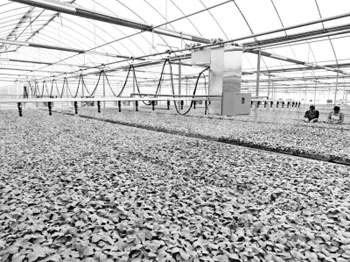
Standardized vegetable seedling greenhouse
A robot is picking tomatoes inside a greenhouse
The protected vegetable industry in Shouguang City, Shandong Province, holds a leading position nationwide. In particular, the new generation of vegetable greenhouses integrates all of Shouguang's advanced cultivation and management technologies. It is a concentrated expression of Shouguang's modern agricultural science and technology, and also represents the future development direction of Shouguang's protected vegetables, and even of China's protected vegetables.
Open fields converted to protected facilities, old greenhouses converted to new ones; vegetable greenhouses are constantly being upgraded
The "two conversions project" for vegetable production currently being advanced in Shouguang refers to converting open fields to protected facilities and old greenhouses to new ones. Wang Huiling, deputy mayor of Shouguang City, said the purpose of advancing the "two conversions project" is to promote the upgrading of vegetable greenhouses, build the newest high-standard vegetable greenhouses, and thereby improve the production methods of greenhouse vegetables and build a high-standard greenhouse vegetable production system.
Greenhouses have the functions of heat preservation, moisture retention and full use of light, and can provide a suitable growth environment for vegetable cultivation. Shouguang's "two conversions project" is intended, first, to continue tapping the production potential of protected vegetables, and second, to raise the production level of protected vegetables and enhance the industry's competitiveness.
Converting open fields to protected facilities is mainly about tapping production potential. According to estimates, Shouguang City still has 110,000 mu of farmland suitable for vegetable cultivation. If all of it were built into greenhouses, each mu would increase income by at least 20,000 yuan, directly increasing the city's farmers' income by more than 2 billion yuan each year.
Replacing old greenhouses with new ones aims to advance the construction of fifth-generation high-standard greenhouses and enhance industrial competitiveness. So what advantages do the new greenhouses have compared with the old ones? It is understood that the new greenhouses, as upgraded versions of the old ones, have greatly improved in length, width and height. Fifth-generation greenhouses generally reach 150 m in length, 17-18 m in width and up to 7.5 m in height, with an interior area of more than 2,500 sq m, basically twice that of the old greenhouses.
"Shouguang City began small-scale trials of winter-warm vegetable greenhouses in 1989. In production, farmers continuously adjusted, improved and created greenhouse forms conducive to vegetable growth. In the process of linear development, we found that farmers constantly lengthened, widened and heightened the greenhouses. The current fifth-generation greenhouses are also based on greenhouse types recognized by farmers, with the government promoting them. In the process of converting old greenhouses to new ones, the government provides financial subsidies ranging from 200 to 500 yuan per mu," said Liu Ligong, director of the Shouguang City Vegetable Technology Guidance Station.
Because the new greenhouses consolidate old greenhouses on the original land, land transfer is the prerequisite for the "two conversions project." Shouguang City has explored "four models" of land transfer, namely unified overall transfer by the village collective; spontaneous land exchange between households; "reverse leasing and subcontracting," with unified planning and transfer; and encouraging farmers with planting experience to form groups for cross-regional transfer. Only when land use efficiency is improved can large-scale planting become possible and high-standard greenhouses be established.
New greenhouses are larger and more automated, making management easier for farmers
Sangjiayingzi Village in Wenjia Subdistrict is a traditional vegetable-growing village, and the village's 900 mu of farmland is divided into 340 vegetable greenhouses. "Last year, through unified planning by the village collective and land transfer, all 340 old-style greenhouses were converted into 160 new-style greenhouses," said Sang Xiangde, director of the village committee.
The renovated new greenhouses make use of the previously idle areas in front of and behind the original 340 old greenhouses, and with the reduced footprint from removing the two north and south walls of the greenhouses, the total greenhouse land area increased by one quarter. "With the increased interior area, some mechanized equipment, such as integrated water and fertilizer machines, rolling shutter machines and ventilation machines, can be installed, the degree of automated production is higher and labor is greatly reduced," said Sang Xiangde.
Walking into any farmer's greenhouse, the length is so great that the end cannot be seen at a glance. Farmer Zhu Cuiling told the reporter that her family now has only this one greenhouse, which exactly occupies the area of the previous two greenhouses. The new greenhouses have better heat and moisture preservation and make fuller use of light. Because temperature, humidity, water and fertilizer are properly controlled, pests and diseases are also lighter than in previous years. Because the new greenhouse body is large, farmers basically operate electric tricycles inside, and the labor for picking has also been greatly reduced.
How much does such a new greenhouse equipped with automated equipment cost? Zhu Cuiling did a detailed calculation for us: the steel-structure greenhouse body costs 180,000 yuan to build, integrated water and fertilizer equipment 20,000 yuan, one set of automatic rolling shutter machines 40,000 yuan, and the greenhouse film 4,000 yuan per year. And what about the returns? The average planting yield per mu increased by 30%, and labor use was nearly halved. Zhu Cuiling's family grows round eggplants, picking once every 3-4 days. In the two months around the 2016 Spring Festival, income exceeded 140,000 yuan. Although the initial investment in the new greenhouse is not low, it can almost pay for itself in about a year.
"Now pest and disease management for greenhouse vegetables is mainly preventive, pesticides are used very little, biological fertilizers are used appropriately, and chemical fertilizers are also used less and less. The eggplants come out black and shiny, with good appearance, and the price cannot be low either," said Zhu Cuiling.
Xin Junren, an ordinary cadre in the Shouguang City Agriculture Bureau, is 54 this year and has witnessed the development of Shouguang's vegetable greenhouses. "Starting in 1989, we began developing winter-warm vegetable greenhouses in Sanyuanzhu Village, Sunjiaji. At first, cadres of the agriculture bureau promoted the benefits of greenhouses in various villages and called on farmers to build greenhouses. The 17 greenhouses built that year had an average income of more than 20,000 yuan, which became explosive news at the time. Gradually, farmers recognized the huge benefits of greenhouses. Not only did they take the initiative to build greenhouses themselves, they also constantly pondered upgrades and renovations of greenhouses. Today's fifth-generation new greenhouses are not the result of government theoretical planning, but the crystallization of farmers' own labor and creation," said Xin Junren.
Integrating cutting-edge technology, high-end vegetable greenhouses lead the development direction
Shouguang City's annual Vegetable Science and Technology Expo is a grand event in the vegetable field and a platform for the latest exchange and transformation of vegetable achievements. In addition to new varieties and new technologies being displayed in a concentrated way here, there are also booths of units related to greenhouse engineering construction.
Meng Xiangchang, president of the Shouguang City Vegetable Technology Service Association, said that in Shouguang there are steel-frame greenhouses and mixed-structure greenhouses suitable for farmers' production, as well as glass greenhouses suitable for agricultural parks and agricultural enterprises. The former has moderate costs, while the latter is the integrated use of the latest cutting-edge technologies.
In the park of the Shouguang City Vegetable Industry Group, compared with farmers' greenhouses, the high-end vegetable cultivation greenhouse here presents another scene: 137 m long from east to west, 52 m wide from north to south, with a total area of 7,142 sq m and an actual planting area of 6,000 sq m. The core equipment is all imported from the Netherlands or Israel, with shale cultivation, one of the most advanced soilless cultivation models at present. The year-round climate is controlled by computer and is equipped with a carbon dioxide supplementation system, a water circulation treatment system, an automatic drip-arrow irrigation system, a plant supplemental lighting system and a complete plant protection plan. The tomatoes grown here reach Green AA grade, with an annual output value of 3.6 million tons. The successful cultivation of this high-end vegetable model is, on the one hand, a technological demonstration, and on the other hand, it also represents the future development direction of the vegetable industry.