Guangdong fisheries achieves flat management through informatization
Original title: Riding the giant ship of "Internet + modern fisheries"
Guangdong fisheries informatization construction sets sail
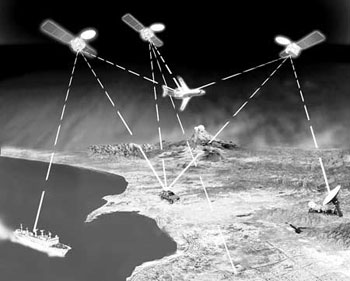
Schematic diagram of BeiDou Satellite Navigation System application (image from the internet)
In recent years, the Guangdong Provincial Ocean and Fisheries Bureau has coordinated and solidly advanced fisheries informatization construction. Through the means of "borrowing intelligence, borrowing strength, borrowing platforms," and adhering to the philosophy of "saving money, saving trouble, saving effort," it has promoted the transformation of information systems from decentralized and closed types to intensive and open types, achieving the goal of information systems that are "usable, practical, and easy to use."
Facing informatization construction work with a relatively high technical threshold, the Guangdong Provincial Ocean and Fisheries Bureau took the lead in establishing an informatization consulting expert database, and successively signed framework cooperation agreements with the National Ocean Technology Center, the National Marine Hazard Mitigation Service, the Satellite Application Center, the China Academy of Space Technology, China Telecom Guangdong Branch, the Provincial Meteorological Bureau and other units, "borrowing intelligence" from professionals; at the same time, with the support of the National Marine Hazard Mitigation Service and the China Academy of Space Technology, it "borrowed strength" to carry out the construction of a storm surge early warning and forecasting system, and upgraded and renovated the fisheries safety production command system and the BeiDou terminals on fishing vessels; with the help of China Telecom's "Global Eye" platform, it adopted renting instead of building, "borrowing the platform" to implement the construction of the fishing port video surveillance system, saving 90% of the funds.
"Borrowing IT, building a flat management model for fisheries," Guangdong fisheries informatization construction has blossomed and set sail. After years of continuous integration and upgrading, the Guangdong Provincial Ocean and Fisheries Bureau has built a comprehensive information management platform containing 5 sections and 28 systems. Through interconnection and data sharing between systems, the Guangdong fisheries informatization platform has preliminarily achieved visualization of fishing ports and fishing vessels, flat management of fisheries, and convenient services for fishermen, promoting the dual improvement of Guangdong's fisheries management capabilities and service quality.
New situation
Interfaces, accounts, platforms, and devices achieve "grand unification"
According to the person in charge of the Guangdong Provincial Ocean and Fisheries Bureau, the bureau's informatization construction has begun to take shape, coordinating the creation of the Guangdong comprehensive information management platform, preliminarily achieving centralized management and operation of servers and other hardware, and establishing a unified application display platform with the comprehensive conference room as the core. It has created a comprehensive information management platform integrating application management, real-time monitoring, emergency command, and communication and reporting functions, laying a good foundation for the next step of achieving fisheries management informatization.
The Guangdong Provincial Ocean and Fisheries Bureau is committed to building application systems as part of the comprehensive information management platform. The bureau currently has 19 various business systems and websites, covering 14 units including the office, the planning and finance division, and the policy and law division. After building the comprehensive information management platform, the system content includes five aspects: fisheries production management, comprehensive sea area management, remote online monitoring, e-government office work, and basic data applications, and has formed a unified login portal, achieving unified interfaces and unified accounts, so that all business systems can be accessed with a single login.
In terms of the infrastructure supporting the application systems, the bureau has built supporting infrastructure such as server rooms, networks, and host storage. The central server room has a total area of 160 sq m and was built according to the national Class II server room standard, achieving unified management, unified planning, and coordinated application of all informatization equipment throughout the bureau.
On this basis, the Guangdong Provincial Ocean and Fisheries Bureau strictly manages network classified equipment. The bureau's existing network has been managed in a standardized manner according to security levels. The system strictly distinguishes three scopes: classified systems, internal systems, and external network application systems. Classified systems are deployed on classified networks, and all application terminals are strictly managed as classified equipment. The network of internal systems is logically isolated from the internet through security equipment. At present, most of the bureau's business applications are unified onto one network, laying the foundation for advancing informatization applications and comprehensive data applications.
In addition, the bureau began building an ocean and fisheries data center in 2015, with the ultimate goal of creating "one map" and "one data center," achieving unified data storage, unified management, and comprehensive sharing, and ensuring the reliability and completeness of data.
Through data collection, organization, and system development in the second half of 2015, the ocean module of the data center has currently collected data on sea areas, islands, the marine environment, marine monitoring, and maritime surveillance law enforcement, while the fisheries module has collected data on fishing vessels, fishing ports, enterprises, and fisheries law enforcement, forming the prototype of provincial data standards and providing various types of database sharing interfaces.
Promoting development
"Six major systems" create a smart management model
The Guangdong Provincial Ocean and Fisheries Bureau integrates modern information technology with advanced management concepts, integrating internal and external resources, transforming business processes, traditional management methods, and organizational forms, and creating "six major systems," namely the sea area dynamic supervision system, the fisheries safety production communication command system, the fisheries vessel information management system, the fishing port information management system, the fishing port high-definition video surveillance system, and the online service hall system. With the help of the "six major systems," the bureau achieves communication and interconnection, real-time monitoring, and timely early warning. Even in the office, one can see Guangdong's fishing ports and fishing vessels and hear the voices of coastal cities and counties.
In 2008, the construction work of the "Guangdong Provincial Fisheries Safety Production Communication Command System" was officially launched at the bureau. Subsequently, 1 provincial-level command center, 14 coastal municipal sub-centers, 42 coastal county-level stations, 15 230-megahertz communication base stations, and 15 AIS base stations were completed, enabling fishing vessel positioning and monitoring, rescue command, collision avoidance navigation, information release, fishing port video surveillance, and fishing vessel track playback, escorting fishing vessels safely back to port.
According to statistics, since the fisheries safety production communication command system was put into use, it has successfully rescued more than 280 fishermen in distress and saved more than 100 million yuan in economic losses; through track playback, it has assisted maritime authorities in investigating and handling more than 50 fishing vessel collision accidents.
In order to ascertain the actual situation of fishing vessels in Guangdong Province and solidly advance basic fishing vessel management, in April 2014, the Guangdong Provincial Ocean and Fisheries Bureau decided to use Maoming as a pilot to carry out an actual vessel census of marine fishing vessels across the province, and took the lead in using mobile communications and other high-tech means to build the "Guangdong Fisheries Vessel Information Management System" to carry out marine fishing vessel census and information entry work.
It is understood that the system has functions such as information collection and entry, information completeness review, on-site verification, verification information upload, verification information review, and supervision of census work progress in various places, and achieves the integration of webpages, computers, and mobile phones. After using smartphones for on-site verification, real-time and on-the-spot information upload can be achieved. Up to now, Guangdong has conducted boarding verification and registration of domestic marine capture fishing vessels one by one, with a verification rate of 96%.
In order to meet daily management needs, the Guangdong Provincial Fishing Port High-Definition Video Surveillance System began construction in February 2014. The system mainly conducts real-time surveillance operations for 50 fishing ports of Class II or above in 14 coastal cities of Guangdong Province, with 2 dome cameras and 2 bullet cameras installed at each fishing port, basically achieving full coverage of the fishing port area. Since the system was put into use in July 2014, it has played an obvious role in daily management such as fishing vessel entry and exit, catch transactions, and fishing port facility maintenance, and also played an important role in defending against Typhoon Kalmaegi and Typhoon Rammasun.
At the same time, what is highly praised by citizens is the online hall convenience system, whose "zero-visit" approval process and "three substitutions service" have won five-star recognition.
Through the provincial online service hall, applicants only need to upload relevant materials online to handle matters, achieving "zero-visit" approval processing for applicants, changing the previous phenomenon where applicants had to make at least two trips to the bureau to handle business. At present, a total of 32 administrative approval items of the bureau have entered the provincial online service hall, of which 18 do not require the public to handle them on site. In addition, in order to solve situations such as some fishermen being unable to use computers and some remote areas having no internet, the bureau provides free "substitute entry, substitute express delivery, and substitute receipt" services for fishermen. Grassroots service agencies enter online applications and express paper materials on behalf of fishermen, accept applications online, and after verifying identity, certificates, and paper materials, directly mail the completed certificates to grassroots agents so that they can deliver them to the hands of the certificate-applying public, truly achieving considerate service for the people.