Inner Mongolia Lamb Traceability Supervision Covers the Entire Industry Chain
Original title: Inner Mongolia builds a lamb traceability system, using big data to achieve full industry-chain supervision of breeding, processing, distribution, and consumption
Herders raise sheep with peace of mind, consumers eat meat with confidence
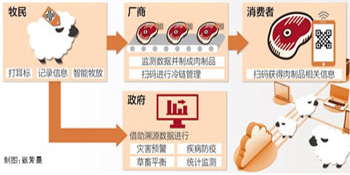
Inner Mongolia Lamb Traceability System
The poplar catkins flying everywhere have finally stopped completely, and summer is here.
A group of people gather around a steaming hot pot, with beer in hand, dipping thin slices of fresh lamb with bits of crushed ice into a divided hot pot, then dipping them in sesame oil and garlic before putting them in their mouths... Such a scene makes people envious, but have you ever worried that the lamb you eat might have problems? In recent years, the frequently exposed "adulterated lamb" incidents have each time sparked concerns about food safety.
Starting in 2014, Inner Mongolia launched a traceability project. Through lamb safety traceability information management, information from every stage - breeding, rearing, disease prevention and control, processing, storage and transportation, and sales - is interconnected, giving grassland lamb an "ID card." At present, Inner Mongolia already has full industry-chain information storage and traceability supervision for over a million sheep.
Online shopper: Scanning the code reveals all the details
Despite having tasted foods from all over, Old Li, who lives in Beijing, has a particular love for the meat of black-headed sheep (Sunite sheep) from the grasslands. Whether for hot pot, ice-boiled, barbecue, or stuffing, the meat is delicious, fatty but not greasy, and completely free of any gamy odor. It was just that in the past, authentic grassland lamb was not easy to get - you had to make a special trip to the grasslands. As for the "grassland lamb" sold in markets and promoted in hot pot restaurants, Old Li had no confidence in it.
On the other hand, online shopping has long been widespread in recent years, but Old Li did not dare to place orders casually - the dazzling array of meat products online was mixed with fakes. Indeed, if you buy fake clothes you can still wear them, but eating inferior food is no joking matter.
Starting last year, Old Li learned about "traceable lamb" online, which gave him the confidence to place orders, because after buying the lamb he could know which sheep from which pasture every piece of meat came from.
Old Li took a pack of traceable lamb slices out of the refrigerator. From the packaging there was no difference, except for an added QR code. Old Li scanned it with his phone, and the screen displayed the traceability information for this pack of lamb: an 8-month-old lamb, from the grasslands of Sunite Left Banner in Xilin Gol League, the processing procedures and inspection and quarantine were all fine, and it had traveled quite a distance - safe to eat.
No more need to travel all the way to the grasslands or specially ask someone to buy it - authentic grassland lamb can be bought right at home. The only thing is, when others at the dinner table take out their phones to take photos and post to social media, Old Li takes out his phone to scan the QR code and check information.
Traceability company: Behind the database is a "great treasure trove"
Behind the simple QR code is a complete traceability supervision platform, providing seamless supervision of lamb across the entire industry chain - from breeding, slaughtering and processing, logistics and distribution, to terminal consumption. It establishes a sheep flock database, so that when consumers buy lamb, they can learn all the information about the sheep since birth: the herder, weight, growth cycle, grazing distance, epidemic prevention markers, slaughtering and processing stages, and more.
Inner Mongolia Wutong Tianxia Network Technology Co., Ltd. is the builder and operator of this traceability platform. With the construction and development of the traceability platform, the company's executive director Zhang Wankai increasingly feels that the whole team has "struck a great treasure trove."
Zhang Wankai told reporters that lambs included in the traceability system are fitted with electronic ear tags after leaving the pen. The ear tags are their "ID cards" for entering the slaughterhouse. Meat production goes through multiple stages including slaughtering, cutting, processing, and packaging. Among these, pre-slaughter quarantine information, slaughtering and cutting compliance information, and processing hygiene information are important contents of the safety traceability system. The company has dedicated technicians on site to enter data and supervise the entire process.
After meat products are produced and packaged at the slaughterhouse, they are transported to cold storage facilities for storage. The company supervises the warehouse, warehouse personnel, and storage time. "Meat products must be scanned when entering and leaving the cold storage, and all data is uploaded to the database archive," Zhang Wankai added. Finished products are loaded onto cold-chain transport vehicles and electronically sealed, monitored throughout the journey, and finally transported to retail or online shopping markets.
However, the traceability platform is not limited to traceability queries and standardized production. It can provide complete data sources for industry authorities, government regulatory departments, and others. Government departments can use it for disaster early warning, disease prevention and control, epidemic prevention, grass-livestock balance, grassland utilization, statistical monitoring, and other work within their jurisdictions.
"Through big data analysis of sheep flocks, we in turn help herders with precision feeding, rational grazing, and improving herders' production activities according to market demand and resource conditions," Zhang Wankai said.
On the other hand, through e-commerce platforms selling traceable lamb, supported by the big data of the traceability platform, customized grassland livestock products are provided to end consumers. "We are currently connecting with Tmall and JD.com to install traceability information query portals on their online shopping sales interfaces, making it convenient for consumers to verify authenticity at the first opportunity," Zhang Wankai said. "As the traceability platform extends and the database improves, its functions can continue to be explored."
Grassland herders: Earn more money and herding becomes easier
Herders like Xite Zaorige have recently found that herding has become much easier. No need to follow the flock wandering across the grasslands every day - sitting indoors, you can know the location and movement trajectory of the flock, and you don't have to worry about mixing them up with other families' sheep.
However, this "convenience" started from "trouble."
In 2014, Xilin Gol League began promoting the lamb traceability project on the grasslands. For Xite Zaorige, this meant following requirements to put an ear tag on every newborn lamb, and also using a handheld device to enter information such as the lamb's birth weight and his own personal information. That was not all - from then on, whenever the flock had regular epidemic prevention inspections or disease medication, information had to be entered each time, much more troublesome than before. But fortunately, the traceability company promised that all instruments and equipment would be free, herders would hold shares through cooperatives, and in the future when lamb was sold through e-commerce, each sheep would fetch a higher price. So Xite Zaorige "reluctantly" gave it a try.
Of course, the traceability project was not just about putting ear tags on sheep and entering information. The traceability company also renovated Xite Zaorige's sheep shed and pen, installing an automatic sorting system and automatic flip doors, which made him feel that a little effort was not a loss.
During the traceable sheep breeding and rearing process, Xite Zaorige discovered a "surprise": the handheld device could not only record information, but with a GPS locator installed on the neck of the lead sheep, the device could display the flock's location at any time - which pasture, by the river, etc. - while also recording the daily distance traveled. This was much more convenient - sitting indoors watching the handheld device was like herding. Moreover, the traceability company installed high-resolution cameras on the roof, so sitting at home looking at the computer monitor, one could see the surrounding flock conditions. With this equipment, unless it was windy or rainy or time to drive the sheep back to the pen at night, Xite Zaorige really could stay indoors all day.
Also, the ear tags had another benefit - no need to worry about mixing up sheep with other families. If there was a dispute, just scan with the handheld device.
However, what truly made Xite Zaorige happy about the entire traceability project was earning more money. In 2015, sheep included in the traceability project and sold through e-commerce fetched an average of 120 yuan more per head than those sold directly on the market. Moreover, with good e-commerce sales, each herding household could also receive year-end rebates from the company. In January of this year, Xite Zaorige himself received over 10,000 yuan.