Sanshui's sightseeing agriculture features technical services as its main characteristic
Original title: Soilless cultivation and aquaponics explore high-value-added fields
The "tech-driven" transformation of Sanshui's agriculture
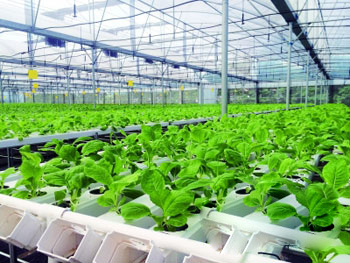
Kangxilai has built Sanshui's largest soilless cultivation vegetable base.
A few days ago, the first vegetable soilless cultivation base in Baini Town, Sanshui, was completed and officially put into use. In the newly built vegetable greenhouse, vegetables no longer grow from fertile soil, but on PVC water pipes. Soilless cultivation vegetables have become another breakthrough for Kangxilai Vegetable Professional Cooperative (hereinafter referred to as Kangxilai) in growing green, pollution-free vegetables. Relying on technology, Kangxilai has provided a new path for the intensive and industrialized development of agricultural transformation.
In the northern part of the Datang Agricultural Park in the northern section of Sanshui, at Baote Beier Farm, there are both ornamental melon and fruit planting bases and facilities for fishing and barbecuing that combine agriculture with sightseeing tourism. This is Sanshui's exploration of transforming agriculture into modern sightseeing and leisure agriculture.
Baini and Datang, one in the south and one in the north, according to the characteristics of the agricultural parks in their towns and subdistricts, their agricultural cooperatives continuously adjust themselves amid the tide of the market, either riding the east wind of technology for intensive development or joining hands with the tourism industry to push agriculture into more value-added fields. This has become a new trend in the transformation of Sanshui's traditional agriculture.
Sanshui's largest soilless cultivation vegetable base is born
In Kangxilai's newly built soilless cultivation vegetable greenhouse, verdant water spinach, Shanghai bok choy and pai cai are arranged in rows on white PVC water pipes. The square-tube cultivation troughs are about more than one meter above the ground. Each square cultivation trough has a circular planting hole with a diameter of 5 cm every 15 cm or so, and the whole site has a total of 160,000 planting holes.
The cultivation troughs are connected by water pipes, and the water pipes are in turn connected to the entire automatic circulation system. The automatic circulation system irrigates nutrient solution to each cultivation trough through water pipes covering the entire base, nourishing the growth of vegetables. "Vegetables grow in plastic pipes with planting holes raised above the ground. They grow entirely by absorbing the 'nutrient solution' circulating through the pipes, avoiding pollution of their living environment by pesticides and chemical fertilizers," said Wu Chaojiang, the person specially responsible for Kangxilai's hydroponic vegetable project.
In addition to vegetables growing in a greener and cleaner way, another feature of hydroponic vegetables is intensive production. "Each crop of leafy vegetables takes only about 15 to 20 days from planting to harvest," Wu Chaojiang said. After 10 mu of land is planted, the daily vegetable output can reach 400 kg.
Because the production cycle is shorter than that of normal greenhouse vegetables, and the yield is stable, allowing uninterrupted production year-round, this became an important consideration for Li Guangbin, head of the Kangxilai cooperative, in launching this new project. "Some green and pollution-free vegetables are produced according to the season, which leads to problems of concentrated market supply and price fluctuations during off-seasons, but now they can be produced all year round, which can ensure that the vegetables we supply remain basically at a stable price."
In fact, continuously upgrading vegetable cultivation through technology has always been Li Guangbin's strategy in operating Kangxilai. Previously, Li Guangbin mainly promoted the cultivation of three new varieties: purple cabbage, Japanese Chinese cabbage and Jinlv shaocai. "To do agriculture well now is already very different from the past. Technology is an aspect that cannot be ignored," Li Guangbin said. Previously, in order to improve members' cultivation techniques and production management levels, the cooperative established an industry-university-research base with the Vegetable Research Institute of the Guangdong Academy of Agricultural Sciences, seizing the season, seizing opportunities, seizing the market and planting at staggered peak times. In addition, he often invited experts and professors from provincial and municipal academies of agricultural sciences to hold training classes for members and surrounding farmers.
Agriculture "joins hands" with tourism
Similar in approach to the hydroponic vegetable project carried out by Kangxilai in Baini, Zhaolifeng Huinong Vegetable Professional Cooperative in Datang Town (hereinafter referred to as Zhaolifeng) tried "aquaponics" this year, that is, in a large pond, raising fish underwater and growing vegetables on the water surface, thereby achieving an ecological symbiotic effect in which fish can be raised without changing the water and without water quality worries, and vegetables can grow normally without fertilizer, a three-dimensional display of fish, vegetables and technology. "This, like cultivating vegetables in PVC water pipes, belongs to the field of soilless cultivation; it is just that the two adopt different models," said Teng Shaozhu, head of Zhaolifeng.
Unlike Kangxilai's plan to build a 60-mu hydroponic vegetable base, Zhaolifeng's aquaponics system is only more than 2,000 sq m. "But this is also a rare large-circulation system in the province. It is somewhat difficult. After a year of effort and overcoming numerous difficulties, it can now operate well," Teng Shaozhu introduced.
Zhaolifeng's soilless cultivation vegetable project is not as large as Kangxilai's because it is positioned as sightseeing agriculture. It is reported that Zhaolifeng plans to build eight major scenic areas to construct a leisure sightseeing system. In mid-to-late June, Zhaolifeng will hold a scarecrow-making activity and a watermelon festival, mainly attracting parent-child tour groups. Zhaolifeng's sightseeing agriculture development path is the direction being explored by many cooperatives in the Datang Agricultural Park.
At Baote Beier Farm, there are orchards of nearly 500 mu of watermelon and more than 100 mu of passion fruit. In the season when the melons and fruits ripen, tourists can go to the farm to pick melons and fruits, and can also fish and barbecue, creating a real-life version of "QQ Farm." It is reported that last year, Baote Beier Farm cooperated with surrounding scenic spots. When tourists came to the farm to pick watermelons, at the peak of visitor flow, it welcomed 1,000 people a day. In more than one hour, the watermelons picked from 100 mu of watermelon fields reached more than 3,000 jin.
This undoubtedly makes many agricultural cooperatives more inclined to turn agriculture into tourism. Aonong Vegetable Planting Co., Ltd. has already carried out projects such as fishing, self-service picking and flower viewing. Jinruikang Agricultural Cooperative has now carried out a self-service picking project and plans to develop a catering service project this year.
Exploration of the transformation of traditional agriculture
Datang Modern Agricultural Park is one of the three major modern agricultural parks in Guangdong Province and also one of the five five-star modern agricultural parks in Foshan City. As an important pollution-free agricultural product production base in Guangdong Province and even South China, the park currently has 29 agricultural enterprises and 17 farmers' professional cooperatives, and the agricultural park is mainly based on traditional planting.
As the labor costs and land rents of traditional agriculture continue to rise, the profit margin of agricultural products themselves continues to shrink. How can agriculture, under the laying of new technologies and channels, increase the added value of agricultural products and find new profit growth points? The transformation of traditional agriculture has become a consensus among practitioners deeply engaged in the agricultural field, but what to transform into and how to transform perplexes many agricultural cooperatives.
In recent years, Datang Town has gradually accelerated the adjustment of its agricultural industrial structure, introducing projects such as high-grade flower cultivation, deep processing of agricultural products and agricultural leisure sightseeing, and guiding enterprises in the park to explore transformation paths under market demand.
"Experiential sightseeing agriculture not only takes into account agricultural cultivation; to some extent, it is more like the tourism industry and places great emphasis on service models." In Teng Shaozhu's view, the offline experience of agricultural products must be carried out on the basis of standardized agricultural production. Through similar experiential activities, not only can the agricultural product quality issues that citizens worry about most be solved, but it is also the most direct way to build a good reputation.
The transformation direction of sightseeing agriculture, as a recently booming field, has been recognized by many industry leaders. A cooperative head once admitted that relying solely on selling agricultural products makes it hard to earn a profit, and it may even be that "buying other people's agricultural products costs less than growing them yourself." This has also become the reason why Kangxilai's Li Guangbin seeks technological leadership for agricultural breakthroughs and intensive, large-scale development.