Circular "food chain" layout is key to reducing agricultural pollution
Original title: Circular agriculture opens the door to Taihu ecological protection
Aerial view of the ecological park
The Taihu Basin is one of the most economically developed and investment-vibrant regions in China. Rapid economic development and massive population concentration have caused severe water quality pollution in the Taihu Basin. In recent years, eutrophication control and cyanobacteria bloom management in Taihu Lake have remained ecological and environmental issues of great concern to the state and local governments.
At present, eutrophic pollutants from point sources such as industrial and mining enterprises have been substantially reduced, while non-point source pollution from surface runoff in agricultural, rural and farm areas has not yet been well controlled due to factors such as technical means and economic costs. Therefore, how to effectively control non-point source pollution remains an important challenge for eutrophication control and cyanobacteria bloom management in Taihu Lake.
Based on the understanding of the above problems, the Wujiang Dongzhitianmu Ecological Park (hereinafter referred to as the Ecological Park), in cooperation with Nanjing Agricultural University, Fudan University and others, after more than ten years of meticulous design and practical refinement, has embarked on a circular agriculture development path featuring low input, high output and low emissions.
"The circular agriculture development model should become a development direction that China's agriculture ought to take in the future, and this also provides a completely new approach for non-point source pollution control in the Taihu Basin." Ren Bomin, head of the Ecological Park, said this in an interview with a reporter from China Science Daily.
Combining planting and breeding for circular utilization
For many years, the Ecological Park has made use of its superior natural environment and persistently followed the path of circular economy development, organically combining agriculture, forestry, animal husbandry and fisheries in accordance with the principle of "plant production, animal conversion, microbial reduction."
After more than 10 years of arduous exploration and strenuous entrepreneurship, "at present, a relatively complete circular agricultural economic complex ecosystem has been formed, with breeding and planting as the main businesses, biogas digesters as the waste conversion hub, and closed encircling ecological wetlands as the means of runoff interception and purification." Ren Bomin said.
It is understood that the breeding system of the Ecological Park mainly focuses on Bama miniature pig farming, which has high added value, low resource consumption and low pollutant discharge, while also incorporating poultry and livestock such as chickens and rabbits, as well as special aquaculture such as rice field eels, loaches and soft-shelled turtles.
In the Ecological Park, it can be seen that chickens and rabbits are raised in the understory space, which not only makes full use of the shade provided by the fruit tree orchard and the understory grass, but also controls pests in the understory weeds to a certain extent. Special aquaculture such as eels, loaches and soft-shelled turtles is carried out in ecological ditches and ponds, which not only utilizes these water spaces for economic output, but also effectively controls harmful organisms within them, and transforms and utilizes submerged plants that absorb nutrients such as nitrogen and phosphorus.
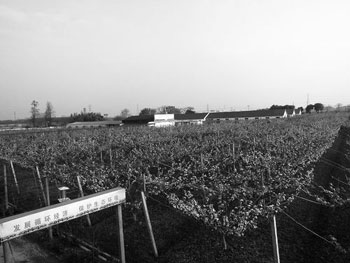
The planting system mainly focuses on the Cuiguan pear fruit, while also making full use of the open space in the pear orchard and the characteristic of winter leaf fall to plant high-quality forage grass, vegetables or Chinese medicinal herbs. The forage grass can provide feed for the breeding system, and at the same time can absorb excess biogas fertilizer that the pear trees cannot absorb in time during drip irrigation with biogas slurry, reducing surface runoff, lowering summer surface temperatures, and creating a better surface environment for pear tree growth.
In recent years, Wang Shoubing, a professor in the Department of Environmental Science and Engineering at Fudan University, has provided important technical support for the further improvement of the circular industrial chain in the Ecological Park. In Wang Shoubing's view, what is worth mentioning in the circular agriculture model is the closed encircling ecological wetland system set up around the entire boundary of the park.
"This system receives surface runoff from the orchard on rainy days to prevent external discharge pollution; and when irrigation is needed, it provides water, facilitating irrigation and saving energy. In addition, ornamental plants and aquatic vegetables with strong purification effects and high economic value (such as water spinach, water dropwort, etc.) are planted in the ecological wetland. On the one hand, they play a purifying role by absorbing nutrients such as nitrogen and phosphorus; on the other hand, they can make full use of spatial resources and yield certain economic output." Wang Shoubing introduced in an interview with a reporter from China Science Daily.
According to the introduction, multiple circular economy industrial chains have been established and are operating in the Ecological Park, among which there are 4 representative circular economy chains: the "pig-biogas-pear-human" ecological industrial chain, the "pig-biogas-grass-chicken (rabbit)-human" ecological industrial chain, the "pig-biogas-vegetable-human" ecological industrial chain, and the "pig-biogas-ditch and pond-fishery (vegetable)-human" ecological industrial chain.
Ren Bomin stated that in the entire circular economy system, various substances have been utilized to the greatest extent, truly achieving the goals of reduction, resource utilization, harmlessness and industrialization, with remarkable benefits in energy saving, water saving, material saving, comprehensive resource utilization and clean production.
Scientific matching and continuous improvement
At present, many agricultural production bases in many places have separated planting and breeding and one-sidedly pursued scale, resulting in excessively large breeding operations. In addition, the demand for organic fertilizer in planting is limited, causing excess manure and urine, and environmental pollution occurs from time to time.
"Each unit in this park is scientifically quantified and laid out according to the ecological carrying capacity and economic efficiency of each trophic level of the 'food chain.'" Ren Bomin introduced that, for example, based on the amount of fertilizer needed for normal production of the park's orchards and vegetable plots, the amount of biogas residue and liquid fertilizer is determined, thereby determining the treatment scale of the anaerobic tanks and biogas digesters. Then, based on the scale of the biogas digesters and anaerobic tanks, combined with pollutant production and discharge coefficients, the scale of Bama miniature pig farming and the allowable pollution discharge from daily life in the site area are determined.
Following this process, the park uses 21.2 hectares of land to safely absorb the livestock and poultry manure discharged by 5,000 Bama miniature pigs each year. This method is similar to that of the European Union and other countries, which determine breeding scale based on the safe carrying capacity of the soil for pollutants such as livestock and poultry manure. "This not only avoids waste of resources, but also avoids environmental pollution, and reduces the additional costs of waste transportation and disposal." Wang Shoubing said.
Although biogas digesters can treat waste, in the view of experts, their economic value is still relatively low. For this reason, Wang Shoubing provided a completely new "path" for the Ecological Park.
"We suggest that animal manure such as pig manure and chicken manure can be used to raise black soldier fly insects. This insect is a saprophytic insect of the family Stratiomyidae, with strong adaptability, and can reliably survive by feeding on poultry and livestock manure." Wang Shoubing said.
Studies have shown that black soldier fly larvae can reduce layer chicken manure or pig manure by 50% or more, can reduce available phosphorus in cow manure by 61%-70% and nitrogen by 30%-50%, while requiring no consumption of other resources (such as energy). Black soldier fly larvae also inhibit bacterial growth and housefly oviposition, effectively improving the sanitary conditions of livestock farms.
Experts point out that these insects are also high-value animal protein feed (containing 40%-44% crude protein), which can be used to feed chickens, fish, etc., further improving economic and environmental benefits.
"The intervention of science and technology has helped the Ecological Park further increase added value and improve the circular chain." Wang Shoubing said.
Now, black soldier fly insects have already been bred in the Ecological Park, and the breeding staff are still exploring their optimal living conditions and habits.
A model for agricultural non-point source pollution control
The Taihu Basin is rich in water, light and heat resources, and has favorable conditions for developing agriculture, forestry, animal husbandry and fisheries. There are more than 20 million mu of arable land in the basin, with a multiple cropping index as high as 200%. The livestock and poultry breeding industry is very developed, becoming one of the important sources of water pollution.
After years of treatment, although the trend of water quality deterioration in Taihu Lake has improved somewhat, it is still generally in a mildly eutrophic state, cyanobacteria blooms still occur from time to time, and the overall situation is still not optimistic.