Chongqing Dazu's small vegetable base makes a big splash
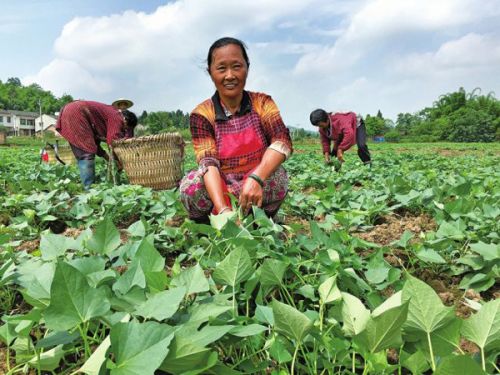
Workers picking sweet potato shoots in the vegetable fields.
Guo Maoyong, who has run a vegetable base for more than ten years, has met with good fortune. Recently, the wholesale price of sweet potato shoots has been 4 yuan per kilogram, which means that after deducting planting costs, transport costs and labor costs, there is about 50% profit. This good market has already lasted for more than two months.
Guo Maoyong had briefly encountered such a high profit margin before. This year's steady high price was somewhat unexpected, making Guo Maoyong feel especially delighted and encouraged——he had already tasted the sweetness of the vegetable field reform at the beginning of the year.
“Only when scale goes up can profit go up”
Guo Maoyong's vegetable base is located in Group 2 of Ciyun Village, Yongxi Town, covering more than 13 hectares, a scale that is second to none locally. Of this, 1.3 hectares are vegetable greenhouses.
Such a large scale stems from one of Guo Maoyong's vegetable-growing ideas: growing vegetables depends on economies of scale, and only when scale goes up can the profit from output go up. He has always firmly believed that only when the scale reaches more than 1 hectare is there money to be made from growing vegetables.
This idea is clearly marked along his vegetable-growing path. In 2003, Guo Maoyong, a native of Tongliang, began developing a vegetable base in Yongxi Town, and the first plot of vegetable land he rented in Shibao Village was 2 hectares. By 2012, the poised Lao Guo moved to Ciyun Village to open a new base and try economies of scale on a larger level.
At the new base, Lao Guo at first grew seasonal vegetables as before, including winter melon, pumpkin, radish, cabbage, caitai and green vegetables, with a complete range of varieties, each occupying a corner of the vegetable fields. This arrangement was partly out of the consideration of “when one side fails, the other side shines.” However, when a certain type of vegetable really hit a bad market, Lao Guo again regretted having planted too little of the vegetables with good market prices, so that he did not make much money, which fell far short of his expectations.
Lao Guo soon realized that he still had to increase scale, preferably by developing high-output protected agriculture. However, protected agriculture requires large investment and professional technical personnel. Considering that current conditions were not yet in place, Lao Guo decided to carry out vegetable field reform and grow only one vegetable, namely sweet potato shoots, which grow quickly and have a long growing cycle.
Starting the year before last, Lao Guo gradually expanded the planting area of sweet potato shoots. Last year, after finding a wholesale boss in Chongqing to cooperate with, sales were no longer a problem. This year, Lao Guo's 13-hectare base is uniformly filled with sweet potato shoots.
From March to October, the base supplies 1.5 to 2 tons of sweet potato shoots every day, shipped to the Chongqing Shuangfu wholesale market for distribution. Such stable and massive sales gave Lao Guo an unprecedented sense of achievement.
“Primary processing has more prospects than selling vegetables directly”
During the gap period after the sweet potato shoot growing cycle, Lao Guo also planted only radishes, and radish output rose at once. In the past two years, Lao Guo carried out a “supply-side reform” exploration focused on radishes and figured out the ropes.
This reform is making pickles. In the Sichuan and Chongqing region, radish pickles are indispensable on the dining table.
The year before last, Lao Guo tried making pickles on a large scale for the first time, pickling more than one hundred jars of radishes at once, one ton per jar. A year later, when the jars were opened, the pickles were crisp, and they were sold to Dazu, Tongliang, Bishan and other places, all sold out.
“Doing primary processing will definitely have more prospects than selling vegetables directly.” Lao Guo's long-held view was finally strongly confirmed in pickle processing: fresh radishes grown on one mu of land can earn 200 yuan after costs are deducted. One mu of land produces 3 tons of radishes, which can make three jars of pickles. Compared with selling only fresh radishes, each jar of pickles brings in 300 yuan more. Calculated this way, the profit from one mu of land can be raised to 1,100 yuan.
With high output plus guaranteed profit, Lao Guo is determined to carry pickle production through to the end. The radishes used for making pickles were not enough from his own base, so he bought them from surrounding farmers. This year, Lao Guo's pickles have expanded to more than 360 jars.
One recent piece of good news is that this year's pickles from Lao Guo have already been fully reserved by merchants from many places.
Compared with the situation a few years ago when he was attending to one thing and losing another, the vegetable-growing situation is very different, and he is increasingly confident in his control of the market. Lao Guo has begun new plans. He is looking for suitable partners, hoping to invest together and expand the greenhouse area, so that the base's planting scale can reach another new level.