Village builds fertilizer filling station, liquid fertilizer ensures nitrogen supply
Original title: Inner Mongolia fertilizer control and efficiency demonstration zone builds fertilizer filling stations in villages, farmers self-serve fertilizer purchases with more choices——
"Boss, fill me up with two barrels of liquid fertilizer!"
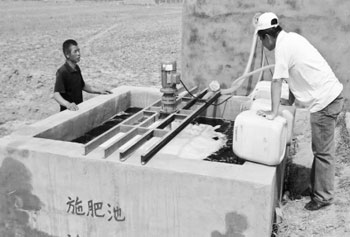
Farmers pour liquid fertilizer into the fertilization pool (photo)
How can zero growth, reduction and efficiency improvement of chemical fertilizers be achieved? How can agriculture in arid regions break through the water resource bottleneck? In recent years, Inner Mongolia has taken the lead in promoting and applying new-type liquid fertilizers in fertilizer control and efficiency demonstration zones through implementing integrated water and fertilizer management, and has explored and summarized a set of practical field methods. This section welcomes submissions from all regions to share experiences related to zero growth of chemical fertilizers.
"Boss, fill me up with two barrels of fertilizer. The wheat I grow at home is about to get its first watering." Gao Laicheng, a farmer from Lianzeng Village, Hanggin Rear Banner, Bayannur City, Inner Mongolia Autonomous Region, came to the filling station. He was not refueling an agricultural vehicle, but adding fertilizer for the wheat in his field. According to Wei Yuhai, director of the banner's Agricultural Technology Extension Center, this kind of fertilizer "filling station" is a liquid fertilizer filling station that the banner focused on promoting in the 2016 fertilizer control and efficiency demonstration zone. It uses new-type liquid fertilizer instead of traditional solid fertilizer to achieve topdressing with irrigation water and integrated water and fertilizer management, so as to achieve the goal of fertilizer control and efficiency improvement.
Liquid fertilizer is a new type of water-soluble fertilizer that can quickly and evenly mix with irrigation water. It can not only achieve integrated water and fertilizer management through water-saving irrigation technologies such as sprinkler irrigation and drip irrigation, but can also be integrated with traditional irrigation methods such as furrow and border irrigation, applying fertilizer with water and achieving the same integrated water and fertilizer effect, greatly improving water and fertilizer use efficiency and increasing crop yields. According to statistics, liquid fertilizer is widely used in developed countries. In the United States, liquid fertilizer accounts for more than half of nitrogen fertilizer consumption, and in Israel more than 90%. In 2015, China's urea ammonium nitrate solution output exceeded 400,000 tons, breaking the traditional pattern in which urea dominated nitrogen fertilizer production.
Benefits must be guaranteed, demonstrations must keep up
"With just this little fertilizer, can the crops grow well?" At the Inner Mongolia region-wide fertilizer control and efficiency on-site meeting, farmers who came to visit had many doubts about the liquid fertilizer application technology that technicians were highlighting. Reducing fertilizer while still increasing yield was hard for farmers accustomed to heavy water and heavy fertilizer to believe.
Liu Gen from Lianzeng Village was the first local person to eat the crab in applying liquid fertilizer. As early as 2014, technicians from the Hanggin Rear Banner Agricultural Technology Center first tested liquid fertilizer in his wheat field, and the effect was very obvious. In the second year, when there was no experimental fertilizer left, he spent his own money to buy liquid fertilizer in a town 10 kilometers away. This year, when the village built a liquid fertilizer filling station, he was the most supportive. Why does Liu Gen insist on using liquid fertilizer? He calculated an account for the author. Lianzeng Village is in the Hetao Irrigation District, and wheat planting customarily uses heavy water and heavy fertilizer. Each mu of land applies 35 kg of base fertilizer per year and also requires 25 kg of urea as topdressing. Altogether, one mu of land requires 60 kg of chemical fertilizer, costing 137 yuan; after applying liquid fertilizer, each mu only needs 20 kg of base fertilizer, plus 8 kg of urea ammonium nitrate solution as topdressing, and 2 kg of high-potassium water-soluble fertilizer as a supplementary application, so the total fertilizer application per mu is only 40 kg, costing 130 yuan.
By applying liquid fertilizer, Liu Gen not only used 20 kg less chemical fertilizer per mu, but also saved 7 yuan in fertilizer costs. Correspondingly, wheat yield per mu could reach about 500 kg, nearly 40 kg more per mu than under traditional fertilization habits. Calculated at a wheat purchase price of 3.4 yuan per kg, this increased income by 143 yuan per mu. "Using liquid fertilizer not only increases yield and income, but also saves worry and effort. In the past, we had to walk all over the field spreading urea when fertilizing. Especially when planting corn, we had to go into the field, and our arms and faces were often scratched. Now, what used to take a whole morning can be finished in two hours." Liu Gen recounted the benefits of liquid fertilizer to the author as if enumerating his treasures, just like a seasoned expert. In Lianzeng Village, there are many farmers like Liu Gen who actively accept new technology. While carefully calculating costs, they also simply believe in science. This year, the Inner Mongolia Autonomous Region Soil and Fertilizer Station uniformly issued "Fertilizer Control and Efficiency Science and Technology Demonstration Household" signs to these farmers, hoping that through their demonstration role they can drive the whole society to value scientific fertilization and achieve zero growth of chemical fertilizers.
Varieties must be improved, technologies must be matched
The more chemical fertilizer is used, the harder the soil becomes, and yields stagnate. This is a common confusion among farmers. "For a long time, farmers in the Hetao Irrigation District have been accustomed to heavy water and heavy fertilizer. If promoting liquid fertilizer is to succeed at once, it cannot be separated from the support of matching technologies." Zhang Zhizhong, director of the Bayannur City Agriculture and Animal Husbandry Technology Extension Center, told the author that at present many core agricultural technology contents are already mature, but because supporting facilities are disconnected, overall technology promotion has been affected.
"We have focused on promoting liquid fertilizer for 5 years. In the earlier years it was neither too popular nor too cold, until last year when self-service fertilizer filling machines were introduced and liquid fertilizer varieties were enriched, which finally met farmers' diverse needs." Liu Yujie from the Hanggin Rear Banner Agricultural Technology Extension Center shared liquid fertilizer promotion experience with the author. In the past, liquid fertilizer sold on the market was mainly urea ammonium nitrate solution, with uniform packaging specifications. The fertilizer price included packaging costs, which increased planting costs. Last year they cooperated with Sinochem Fertilizer to introduce a liquid fertilizer distribution system and fertilizer filling machines. Farmers can bring their own containers to fill fertilizer, and the amount filled is no longer limited by packaging. They can determine the filling amount themselves according to plot area and crop variety, purchase fertilizer according to demand, and achieve precision fertilization. Now the filling station offers more varieties. It not only sells urea ammonium nitrate solution, but also macro-element liquid fertilizer, organic liquid fertilizer and trace-element liquid fertilizer for self-service selection.
Fertilize according to formula, farm according to guidance
Bai Yunlong, section chief of the Water-Saving Section of the Autonomous Region Soil and Fertilizer Station, said that as early as the 1980s Inner Mongolia had already carried out related research on applying liquid fertilizer in protected agriculture, and around 2007 it was applied on a large scale in protected agriculture. With the promotion of integrated water and fertilizer technology for field crops, new-type liquid fertilizers such as urea ammonium nitrate solution and liquid compound fertilizer began exploratory application on crops such as potatoes and corn. Especially in recent years, as the state encouraged large-scale agricultural operations, the development of liquid fertilizers and new-type water-soluble fertilizers also began to accelerate.
To guide farmers in purchasing liquid fertilizer, local agricultural technicians formulated fertilization guidance opinions for different crops according to actual conditions, from the timing and amount of base fertilizer to topdressing, and from macro-element to trace-element fertilizer combinations, providing farmers with full-process package-style guidance.
"Apply 1 more kg of liquid fertilizer, harvest 100 more kg of grain, and the total amount of chemical fertilizer is also reduced quite a bit. Can you say we wouldn't trust their formula?" said Liu Baosheng from Lianzeng Village. In 2015, he planted corn according to the fertilization guidance opinions and applied an additional 1 kg of fulvic acid chelated zinc fertilizer per mu during topdressing. At harvest, his corn yielded more than 100 kg more per mu than others. He only invested an additional 20 yuan for zinc fertilizer, and calculated at a corn purchase price of 1.6 yuan per kg, this added 140 yuan in net income. Now, whenever he meets farmers seeking advice, he says: "Fertilize according to formula, farm according to guidance." (Li Xiaolong)
——Related products——
[Organic liquid fertilizer]
On the basis of the three major elements nitrogen, phosphorus and potassium as well as medium and trace elements, it contains large amounts of active cells and efficient nutritional enzymes, rich organic matter, and also contains multiple nutritional components such as amino acids, humic acid and water-soluble protein. Organic liquid fertilizer can improve crops' resistance to pests and diseases, drought, cold and other stresses. At the same time, it is green, environmentally friendly, pollution-free and residue-free, can effectively increase soil nutrients and be quickly absorbed by crops, and is an ideal fertilizer for increasing crop yields and improving the quality of agricultural products.