How to tell real pesticides from fake ones? Scan the QR code for traceability and verification
Original title: First unified standard for pesticide QR codes issued
Expected to form big data enabling full-chain traceability of pesticides, effectively supervising fake and inferior pesticides, highly toxic pesticides and packaging waste disposal
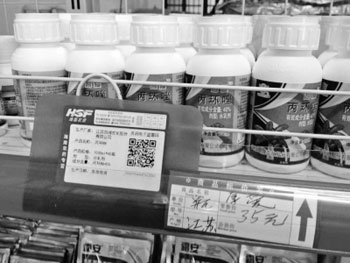
Previously, some localities and enterprises had built their own QR code traceability and supervision systems. File photo
A few days ago, the group standard "QR Code Encoding Rules for Pesticide Products" was officially released. This is China's first published standard regulating QR code encoding rules in the traceability system for pesticide products.
The "QR Code Encoding Rules for Pesticide Products" was proposed by the China Crop Protection Industry Association (CCPIA) and jointly developed by a drafting committee composed of pesticide industry experts, manufacturing enterprises, and companies involved in QR code technology. The standard specifies the characteristics, format and symbol quality requirements of the QR code data structure for pesticide products, and applies to information processing and information exchange in the production, transport, storage, sales, service and traceability of pesticide products.
In recent years, issues such as counterfeiting and inferior quality, abuse of highly toxic pesticides, and disposal of packaging waste in the production and use of pesticides have drawn increasing public attention. Many regions and enterprises have been trying to build QR code traceability systems, but they also face some problems in application: First, information content is not standardized and coding identifiers are not unified. Standards vary across regions and enterprises; most are web addresses (with no code) or merely internal codes, so QR codes do not truly play their role as an "identity card." Second, system software is not compatible, and traceability information cannot be shared or exchanged, creating "information islands." In agricultural supply retail stores, it is common to see several or even a dozen barcode scanners. Third, the safety traceability systems built by various localities and enterprises are numerous and incompatible, which is very unfavorable for the construction of big data. Big data emphasizes information sharing and is one of the important supporting conditions for government and social supervision and for government and enterprise decision-making.
The "QR Code Encoding Rules for Pesticide Products" was formulated with the goal of ensuring interconnectivity of information in all links of pesticide production, circulation and use, and full-chain access to and recognition of product information. After the standard is implemented, establishing a QR code traceability system from the source of production will change the situation of poor information flow and inconsistent traceability system interfaces.
The "QR Code Encoding Rules for Pesticide Products" takes into account the different management priorities of various regulatory departments. For example, based on the code information of product toxicity level, the data information of highly toxic pesticides can be easily read, facilitating supervision of highly toxic pesticides; based on the code information of material category, information on the smallest packaging of pesticide products can be read, facilitating supervision of the treatment and recycling of pesticide packaging waste. Counterfeit and inferior pesticides can be quickly identified by scanning the QR code. In addition, the launch of this standard and its large-scale adoption by enterprises will greatly promote the "Internet Plus" of the agricultural materials industry, leaving fake and inferior agricultural materials nowhere to hide, and playing a positive role in standardizing industry development and supporting the excellent while eliminating the inferior.
On the one hand, the "Pesticide QR Code Traceability Platform" provides query and traceability management services for government departments at all levels, enterprises and consumers, and establishes product quality and safety files and enterprise reputation files for the industry. On the other hand, enterprises can use QR codes to trace detailed product production, warehousing, logistics and consumer information, providing real and scientific data for their production plans, reducing inventory risk and financial costs, while also providing manufacturing enterprises with an integrated mobile internet solution for product anti-counterfeiting, anti-channel-conflict, brand promotion, e-commerce and market promotion.
On May 26, at the fifth meeting of the ninth council held by the China Crop Protection Industry Association, a signing ceremony was held for the CCPIA Pesticide Product QR Code Traceability Platform. Shenzhen Noposion Agrochemicals Co., Ltd. and Guangxi Tianyuan Biochemical Co., Ltd. respectively signed strategic cooperation framework agreements on pesticide QR code adoption with the China Crop Protection Industry Association. More enterprises will participate in the future, and it is expected to form big data enabling full-chain traceability of pesticides. In addition, more than ten normative group standards, including the clean production specification for pesticide suspension concentrates and pesticides dedicated to aerial plant protection, are also in preparation. (Zhang Xiaoxia)