Pesticide zero growth needs youth ambassadors to help
Original title: Finding a spokesperson image for the pesticide zero growth action
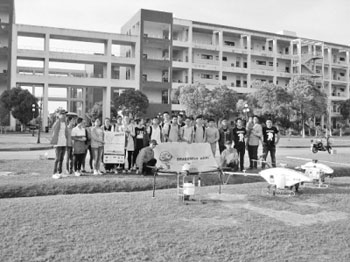
The "Zero Growth in Action" pesticide knowledge popularization activity held at East China University of Science and Technology.
In February last year, the Ministry of Agriculture issued an action plan for zero growth in the use of chemical fertilizers and pesticides by 2020. Among a series of specific measures, it especially required strengthening publicity and training for the pesticide zero growth action. To this end, the "Zero Growth in Action" series of pesticide knowledge popularization public welfare activities initiated by the Ministry of Agriculture's Pesticide Use Zero Growth Application and Research Project Team recently launched its first stop at East China University of Science and Technology. Through a series of activities including on-site demonstrations of plant protection drones, a symposium on innovative and integrated development of the pesticide use zero growth action, and the launch ceremony of the "Zero Growth in Action" cartoon image solicitation activity, the concept of the zero growth action was brought into university campuses, guiding a generation of students to become the "spokespeople" for China's modern agriculture.
How will "zero growth" be achieved?
Are pesticides good or bad? Most people think the latter. But the entire activity tells us that this understanding is biased. Pesticides play an important role in preventing and controlling damage from crop diseases, insects, weeds, and rodents and in regulating plant growth. The pesticide industry recovers about 200 billion jin of grain losses each year, accounting for more than 15% of total output, equivalent to increasing grain production from more than 100 million mu of cultivated land. With climate change and changes in farming systems, crop diseases and insect pests are showing a trend of frequent, recurrent, and severe outbreaks. Agriculture's dependence on pesticides is growing, and the ecological pressure brought by pesticides is also increasing.
The essence of zero growth in pesticide use is to raise the level of agricultural modernization. As a major country in pesticide production and use in the world, China's relatively high pesticide dosage and relatively low utilization rate are prominent problems in agricultural pest control. "Zero growth" means achieving "controlled volume and improved efficiency" by reducing the number of applications, reducing the dosage, reducing pesticide loss, and improving control effects.
"Controlled volume and improved efficiency" is a major topic that needs innovation to drive forward. Shan Weili, director of the Pesticide Policy Division of the Institute for the Control of Agrochemicals, Ministry of Agriculture, said: How can Internet thinking be used to optimize the regulatory model of the traditional pesticide industry? How can the current situation of relatively low pesticide utilization be changed? Only through innovation.
Can China's pesticide enterprises do it?
Will zero growth in pesticide use affect pesticide enterprises' sales? Will it be ignored by pesticide and pesticide equipment enterprises? At the launch ceremony of the "Zero Growth in Action" cartoon image solicitation activity, Shan Weili said that the project received active participation from a group of enterprises including Sinochem Lihua, Yongnong Bio, Shangge Zhilu, Binnong Technology, Yanhua Yongle, and Sichuan Guoguang. Meanwhile, "Nongfeike," Dragonfly Agricultural Services, and Jingbo Agrochemical, which participated in the on-site plant protection drone demonstrations, not only showed the performance of plant protection drones but also demonstrated innovation in pesticide service models.
"Nongfeike" is a professional plant protection company relying on Anyang Quanfeng Aviation Plant Protection Technology Co., Ltd. Anyang Quanfeng is China's first agricultural aviation integrated service provider, has developed multiple drone models, owns multiple patents, and has established a networked operating system. Their slogan is: "You farm, I spray! Undertaking aerial control operations of more than 2,000 mu." In the next three to five years, Quanfeng Aviation Plant Protection will establish highly integrated and informationized cross-regional plant protection aerial control operation alliances nationwide. Yu Lecheng, manager of the Anhui aerial control department of "Nongfeike," told reporters that we at "Nongfeike" simply want to make pesticide equipment better. Future aerial control will fly toward the pesticide-saving rate proposed by users.
Xin Chengyou, manager of the New Business Development Department of Jingbo Agrochemical, told reporters: "For pesticide reduction, the most important thing is to study compound substitution and develop high-efficiency, low-toxicity pesticides. The ordinary application method for carbendazim is 50 grams per mu, while what we are developing now is 8 grams per mu. Three years ago, Jingbo cooperated with Wuxi Hanhe Company to develop aerial control pesticides. Previous pesticide formulations were used for sprayers, with 1 kg of pesticide diluted in 45-50 kg of water. Now for aerial control, the dilution water is 0.5-1 kg. The pesticide cannot be changed, so what should be done? We developed aerial control formulations and solved the problem of integrating pesticides and equipment."
What can we students do?
At the unmanned plant protection aircraft demonstration site, Li Yulin, a sophomore majoring in pharmacy in the Department of Pharmaceutical Sciences at East China University of Science and Technology, kept watching on site. He comes from Xiao County, Anhui, and his family has 10 mu of cultivated land, growing wheat and corn. He said he likes his major very much, and using drones to apply pesticides makes him feel that his major has a promising future. Yuan Pengtao and Zhu Ling, doctoral students in pesticide science, participated in organizing the activity throughout. They said that such an activity is like a major thesis.
Xin Zhong, vice president of East China University of Science and Technology, said at the launch ceremony that the social evaluation of pesticides is not very high, but without pesticides, people definitely cannot eat well. Our university participates in the pesticide zero growth action in the hope that through such a national action, a broad range of students will actively participate in communication, so that the whole society can scientifically understand pesticides and scientifically understand agricultural product safety, thereby promoting the process of China's agricultural modernization.
Professor Qian Xuhong, an academician of the Chinese Academy of Engineering and an expert of the advisory group of the Pesticide Use Zero Growth Application and Research Project, gave a science popularization lecture at the launch ceremony: "Ultimate Care: The Spring of Natural Ecology." His views enlightened the students present: First, both the concept of sustained human development and the concept of sustainable development began with pesticides. Second, human survival is increasingly inseparable from pesticides. Third, realizing natural ecology is ultimate care. He asked: Is organic food safe? Relevant tests show that the concentration of patulin in organic apples is 4 times that in ordinary apples. Patulin can cause kidney failure. The way out is that green pesticides must be developed. Is it safe if pesticides are not used? Japan's pesticide dosage is larger than ours, but Japan uses fewer varieties of a single pesticide. The way out is that pesticides must be used scientifically.
The students should take action. The task is to produce a spokesperson image to clear the name of pesticides. Let it become an explainer for pesticide science popularization, a little teacher for farmers in pesticide use, a manager for pesticide equipment enterprises, and a supervisor of public opinion. Zhu Hui, chairman of Beijing Huaxia Agricultural Enterprise Cultural Exchange Center, announced the rules of the activity at the launch ceremony. The solicitation content includes the name of the "Zero Growth in Action" cartoon spokesperson image, supporting characters and equipment of the zero growth family, and zero growth stories. Supporting character images include multiple forms such as graphics, videos, and emojis. Story scripts can also be presented in forms such as text, animation, and PPT. Finalists will have the opportunity to become official promotion ambassadors and special contributors for "Zero Growth in Action." The activity will continue until June 30. (Reporter Sun Luwei, text/photos)