Your succulents do poorly at home? It turns out these wrong practices are the reason
Yesterday's Highlights
This article is compiled from the internet
Now the main text begins:
With the improvement of living standards, growing flowers at home is becoming more and more common. While flowers bring freshness and beauty to the home, they also bring troubles to many flower lovers. For example, despite careful care, the plants still get worse and worse; succulent flowers that were brilliantly colorful when bought soon wither and die...
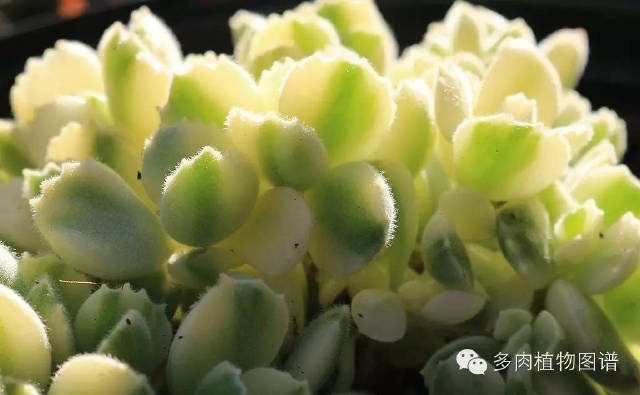
Image: White Bear (Cotyledon tomentosa)
For enthusiasts who love succulents, these problems trouble them all. Below we have gathered some common misconceptions, hoping that growing succulents will no longer be difficult!
Everyone take a look and see whether you have ever made these mistakes!
Image: White Chrysanthemum
Misconception 1: Watering not thoroughly, only watering "halfway"
Correct practice: When watering, you must water thoroughly, not just "halfway" (that is, only wetting the surface of the potting soil).
Only wetting the surface soil for a long time will leave the plant's root system with insufficient water supply and lead to underdeveloped roots. Beginners should follow "do not water until dry, and water thoroughly when you do": that is, do not water when the potting soil is not dry, and if you water, water thoroughly in one go!
Image: Maruba Hime Shigure (Graptopetalum mendozae)
If it is hard to judge whether you have watered thoroughly, you can try the soaking method of watering.
Misconception 2: Not paying attention to watering time, the same in all four seasons
Correct practice: The timing of watering requires great care and should be adjusted with changes in season and temperature.
In summer, the temperature at noon is relatively high. At this time, watering must be avoided. If you water, the soil temperature will suddenly drop, water absorption will slow down, causing insufficient water supply and scorching the upper leaves of the plant.
Image: Egg Mountain (Graptopetalum paraguayense)
But generally speaking, the more suitable watering time in summer is in the morning or around three or four in the afternoon near sunset; in winter, try to choose after sunrise in the morning.
The most important point: When watering, you must check the weather forecast in advance!!
Misconception 3: Liking to trim roots and repot
Correct practice: After a succulent has settled into its pot, try not to repot or change the soil frequently, especially in high summer temperatures and low winter temperatures. The settling-in time for succulents will be relatively longer and will also consume more nutrients.
Image: Rain Swallow Seat (Echeveria 'Raindrops')
Misconception 4: Pouring leftover tea or drinks on succulents to supplement nutrients
Correct practice: Pouring leftover tea into flower pots will raise the soil's pH, easily causing chlorosis and even possibly leading to the death of the plant. In addition, leftover tea leaves during decomposition will also breed miscellaneous bacteria, affect environmental hygiene, consume soil oxygen, and be harmful to plant growth.
Image: Laura (Sedum clavatum)
Rainwater or tap water are relatively easy water sources to obtain. In order for succulents to successfully get through the summer, everyone should still not play too many tricks~
Misconception 5: Sick and weak plants need more fertilizer
Correct practice: Sick and weak plants have thin, weak branches, poor photosynthesis, and slow metabolism. If you fertilize casually, it is easy to cause fertilizer damage. It is just like people: if someone is already sick and still desperately takes supplements, it not only increases the body's burden but may also worsen the condition.
Image: Yu Shan & Qian Chuan (Haworthia truncata & Crassula perforata)
The same principle applies to plants. Therefore, sick and weak plants must never be blindly given extra fertilizer, lest the result be the opposite of what is desired.
A well-developed root system is a necessary condition for the healthy growth of succulents. Rather than fertilizing, it is better to learn how to grow a good root system for succulents.
Misconception 6: Thinking the stronger the fertilizer, the better when fertilizing
Correct practice: If the fertilizer concentration is too high or the amount used is too much for potted flowers, it is easy to cause fertilizer damage. In mild cases, it leads to poor growth of the plant; in severe cases, it may lead to the death of the plant, which is what everyone often calls "burning the roots."
Image: Ji Long Yue (Graptopetalum paraguayense 'Bronze')
Fertilizing should follow the principle of "thin fertilizer applied frequently," and "three parts rely on fertilizer, seven parts rely on water" is best.
Misconception 7: Growing flowers next to the television
Correct practice: Some people, in order to reduce radiation, like to place succulents, especially cacti and the like, next to the television.
Image: Miracle of Spring (Sedum 'Spring Miracle')
In fact, this practice is wrong. The vast majority of plants have very little ability to absorb radiation, and succulents are the same. Moreover, insufficient indoor light more easily causes succulents to become leggy and flatten out like a big pancake, making their constitution weaker and even more likely to die.
Misconception 8: Indoor flowers get little ventilation
Correct practice: Poor air circulation is the primary killer of succulent black rot and water-based rot. Doors and windows should often be opened to create good ventilation conditions so as to ensure normal respiration of the plants.
Image: Otome Kokoro (Sedum pachyphyllum)
Keep in mind: High temperature + no ventilation = water-based rot / black rot
Too much water + no ventilation = water-based rot / black rot
High temperature + too much water + no ventilation = empty pot
Misconception 9: Plants kept indoors all the time
Correct practice: Flower growers often overlook a problem: they think that as long as indoor plants are kept indoors, that is enough, and they rarely or never change their position. But in fact, if potted flowers are displayed indoors for too long, they often grow poorly due to insufficient sunlight. Potted flowers should be moved outdoors for open-air growing at appropriate times or at intervals.