Bulrush Is About to Disappear: Do You Know This Aquatic Plant?
| Looking at the lonely bulrush, recalling the green that once filled the eyes (all photos taken on May 28, 2016) |
Bihai Yinsha Net report(Photos/Yan KeText/Tang XiaoEditor/Chang Sheng Shao QiongIn Lushan Village, Taiping Town, Mazhang District, what impressed me most was the stretch of green in the farmland in front of the village. In the paddy fields in front of the village, the villagers all planted bulrush. When a gentle breeze blew, the bulrush rose and fell in waves, swaying gracefully, and the distinctive fresh fragrance of bulrush wafted over, refreshing the heart and delighting the senses, comfortable and pleasant!
| Walking among the bulrush, searching for childhood fun |
| Picking grass seeds |
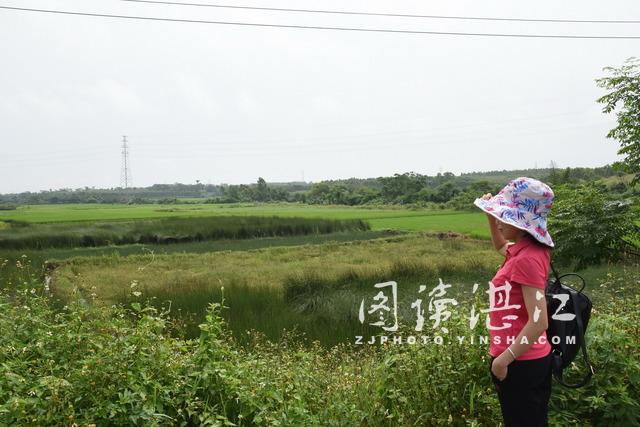
I had always been haunted by the memory of that field of green bulrush and wanted to go looking for childhood memories. I went full of expectation, only to find that the green that once filled the eyes had long since become sparse. A few small patches of bulrush field, squeezed to one side by other plants, looked so lonely and forlorn. Fortunately, although the ranks were no longer strong, their grace was no less than in years past, and they still grew vigorously in the gaps among other plants. In the early morning, the grass seeds topped with dew, accompanied by the breeze, danced to their heart's content even without an audience.
At first I thought the villagers had moved the bulrush planting site, or that bulrush was difficult to grow, forcing the villagers to part with it reluctantly.
After asking the villagers, I finally learned that it was not that the planting site had been moved, but that the area planted with bulrush had truly decreased. Uncle Hong told me that growing bulrush is even easier than growing rice. It does not need careful tending or round-the-clock care, and it can be planted in all four seasons and harvested in one year. Usually it is planted in summer: the bulrush seedlings are bent in the middle, and both the head and tail ends are inserted into the field, then fertilizer is applied, and new shoots of bulrush will grow from the head and tail ends inserted into the field. During the growing and management process, no pesticide needs to be sprayed; it is only necessary to ensure that the field has water year-round and is fertile. After harvesting, the remaining bulrush stubs can grow new shoots again, and after fertilizing, there will be another crop the following year. Repeating this way, one planting can be harvested for three or four years. With good management, bulrush with good growth can reach more than two meters tall. After the bulrush is harvested, these bundles of bulrush are transported back to the "grass bed," sorted by length, spread out in the sun to dry, flattened by a cart, and then they can be used to weave grass mats. Those who like pretty colors can also use dye powder, boiled and melted in boiling water, to dye the bulrush. After dyeing, colorful grass mats can be woven, and the color will not fade.
If it is not difficult to grow, forcing the villagers to part with it reluctantly, then why is the area planted with bulrush shrinking day by day? Thinking carefully, I looked into the reason.
The main reason should be the influence of industrial development. In the wave of industrialization, the villagers' idea of working at sunrise and resting at sunset and living off the farmland was changed. Many villagers chose to go out to work, and basically all the young and middle-aged people in the village went out to work. The lack of labor is an indisputable fact behind the reduction in the area planted with bulrush.
| The grass seeds topped with dew dance freely in the breeze |
| Although the ranks are no longer strong, their grace is no less than in years past, and they still grow vigorously in the gaps among other plants |
Second, affected by bamboo mats, rattan mats and the like, the price of grass mats is not high. At one older sister's home, I saw a pile of already dyed bulrush and was very happy. I asked her whether she still wove grass mats. She smiled and said, "The price of grass mats is too low. After busying for a day, weaving one mat, I can only sell it for twenty or thirty yuan. My children do not really know how to weave either. This pile of bulrush has been here for several years. In recent years I have stopped growing bulrush and keep it to weave grass mats for my own family or relatives to use."
Walking out from the older sister's home, along the way, I could hardly see any scene of villagers weaving grass mats under the shade of trees. In my memory, in Lushan Village, the most common scene was: the men, women, old and young of the village, under the shade of trees, among the bulrush, with ten fingers flying, weaving grass mats. While their fingers were busy, their mouths were not idle either. Family gossip, mythical stories, and models of respecting the old and caring for the young came out from time to time, and even more, popular and nostalgic songs, and Leizhou opera, unwilling to be left out, burst out from time to time. Besides weaving grass mats, the clever villagers also made use of waste materials. With their pair of skillful hands, they wove those short pieces of bulrush that could not be used for weaving grass mats into fans, hats, and little baskets for holding things one after another...
| The bulrush squeezed to one side by other plants, lonely and forlorn |
Less and less bulrush is planted, and perhaps one day, bulrush will face the crisis of disappearing. Where should we look for the distinctive fresh fragrance and the green that fills the eyes that belong to bulrush? Fewer and fewer people weave grass mats, and among the younger generation, very few can weave grass mats. Will this craft of weaving grass mats be lost?