Rural village affairs disclosure: Why has a good system been used to death?
Many systems are well designed, but in the process of implementation they become distorted and deformed, so that a good system effectively "cuts off its own feet" as soon as it is launched. Rural village affairs disclosure is one such example.
I. The ten items that village affairs disclosure needs to make public
As early as 2006, the General Office of the State Council issued the document "Opinions of the General Office of the CPC Central Committee and the General Office of the State Council on Strengthening the Building of Party Conduct and Clean Government at the Rural Grassroots Level," requiring the promotion of administration according to law and the strengthening of ties between officials and the masses. It required further strengthening the disclosure of rural government affairs, village affairs and Party affairs in all townships (offices) and all administrative villages (neighborhood committees) throughout the county. The specific contents include ten items:
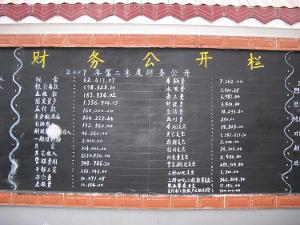
(1) The situation of agricultural support and benefit-farming policies of governments at all levels and the distribution of funds reaching villages and households;
(2) Projects supported by all sectors of society for the building of a new countryside, and the various funds for new countryside construction and their use;
(3) The allocation and use of homestead land. This includes the number of households approved for house building according to law during the year, the area, the amount of fees charged, and the management and use situation;
(4) The use of village collective economic income;
(5) The remuneration and other benefits of village officials, and expenditures on official activities;
(6) The handling of public welfare undertakings within the village, the distribution of land expropriation compensation and resettlement fees, rural
land circulation, and the raising of funds and labor through "one case, one discussion";
(7) The democratic appraisal, assessment and auditing of village officials;
(8) Family planning, including the decomposition of that year's birth quotas, penalties for births outside the plan, and the collection, remittance, distribution and use of fees;
(9) The distribution of disaster relief funds and materials, including the amounts and distribution standards, procedures, and the allocation and distribution situation.
(10) Other matters that more than one-tenth of the village's villagers or more than one-third of the village representatives request to be made public
II. What is the current state of implementation of village affairs disclosure?
Is the policy good? Of course it is good, but how is it actually implemented? Basically 99% of it is mere formality. Either what should be made public is not made public, or they simply cannot even be bothered to go through the motions. Specifically, this manifests in five aspects:
1. The disclosure time is not timely. For some matters that need to be made public, disclosure is not carried out according to the required time. In some cases, disclosure happens only once every half a year or more or once a year, with the interval between disclosures being too long; in some cases it is completely arbitrary, disclosing whenever they feel like it and not disclosing when they do not; in some cases disclosure occurs only when higher authorities come to inspect, and at ordinary times no one pays attention to it.
2. The form of disclosure is single, and the disclosure location is not appropriate. At present, the form of rural village affairs disclosure is limited to disclosure boards. Some are made too simply and are mere formalities, with a single form, making it inconvenient for most villagers to understand and learn about village affairs. Some build the disclosure board in places inconvenient for the masses to visit, making it difficult for the masses to view and supervise; some villages lack management and protection of the disclosure board, which is seriously damaged by wind, sun, rain and human action, making it difficult to use; some do not even have a disclosure board, treating village affairs disclosure as an incidental matter and merely announcing relevant information in passing during meetings or while doing other things.
3. The disclosed content is incomplete. Some only publish expenses of relatively small amounts and do not publish large expenditures. A few villages only disclose some innocuous content, while obscuring the "hot" and "key" issues about which the masses have strong opinions, unwilling to disclose or even not disclosing, half-disclosing, and avoiding the important and dwelling on the trivial;
4. The disclosure procedure is not rigorous. Some disclosure procedures are too simple, publishing only the results of handling matters while lacking the legally required procedures. The relevant matters in disclosure are mainly a "one-man show" performed by townships and village officials, and have not passed review by the democratic financial management group and the village affairs disclosure supervision group according to procedure, making village affairs disclosure lack persuasiveness.
5. The disclosure system is not adhered to sufficiently. Although some have systems, they lack operability and are not closely enough integrated with the actual situation of the village. Once the system is put up on the wall, it becomes mere decoration.
III. Village affairs disclosure also has a supervision mechanism, but basically no one knows about it
In fact, there is also a system used to constrain the work of village affairs disclosure, namely the village affairs disclosure supervision group. A village establishes a village affairs disclosure supervision group composed of three to seven people, whose members are elected by the villagers' meeting or the villagers' representative meeting. The term of the village affairs disclosure supervision group is the same as the term of the villagers' committee. Members of the villagers' committee and their close relatives may not serve as members of the village affairs disclosure supervision group. The village affairs disclosure supervision group is responsible to the villagers' meeting or the villagers' representative meeting.
Duties of the village affairs disclosure supervision group: The village affairs disclosure supervision group is responsible for supervising the implementation of the village affairs disclosure system. It shall perform its duties according to law, carefully review whether the various contents of village affairs disclosure are comprehensive and true, whether the disclosure time is timely, whether the disclosure form is scientific, and whether the disclosure procedure is standardized, and promptly report the supervision situation to the villagers' meeting or the villagers' representative meeting. For members of the village affairs disclosure supervision group who do not perform their duties, the villagers' meeting or the villagers' representative meeting has the right to remove them from qualification. At the same timeit must take on the main duties of supervising the implementation of resolutions of the villagers' meeting and the villagers' representative meeting, supervising whether the villagers' committee and other village-level organizations perform their duties according to law, and actively collecting and conscientiously handling villagers' opinions and suggestions on village affairs management, with emphasis on strengthening supervision over village affairs decision-making, village affairs disclosure, village-level "three assets" management, engineering project construction, and the implementation of benefit-farming policies and measures.
The "Opinions of the General Office of the CPC Central Committee and the General Office of the State Council on Improving and Perfecting the System of Village Affairs Disclosure and Democratic Management" clearly stated that if the masses have doubts about the published content, they may complain orally or in writing to the village affairs disclosure supervision group. The village affairs disclosure supervision group shall promptly investigate the problems reported by the masses, and if there is indeed omitted or untrue content, it shall urge the villagers' committee to republish it; they may also directly inquire with the village Party organization or the villagers' committee, and the villagers' committee shall provide an explanation and reply within 10 days.
For more content, please follow the Quandier WeChat public account: quandiernews
Reproduction must obtain the consent of the author of this Toutiao account; without authorization, reproduction is not permitted.