Lychees are red again, the king of fruits is so delicious you cannot stop eating
"A galloping horse raises dust, the imperial concubine smiles, no one knows it is lychees arriving" -- Du Mu of the Tang Dynasty wrote this in his quatrain "Passing by Huaqing Palace," making the Feizixiao variety famous throughout the land. However, Feizixiao is only one of many lychee varieties, and not even the best one. Even in my hometown -- Dianbai, Guangdong -- there are Heiye, Baila, Baitangying, Guiwei, Sanyuehong and so on. Sanyuehong hits the market earliest, commands the highest price, yet has the worst taste, and is not well regarded locally, but the farmers who grow Sanyuehong do make money.
The provinces in China that produce lychees include Hainan, Guangxi, Guangdong, Fujian and others. In western Guangdong, Gaozhou has the most prestigious reputation, but lychee cultivation actually began earliest in the Dianbai area. As early as the 1970s, my hometown already had a lychee orchard, with trunks so thick that a child could not wrap their arms around them, about 30cm in diameter, and the trees were at least a hundred years old, while the fruiting trees today are generally only about 10cm in diameter. Generally speaking, lychees from old trees taste better than those from young trees, with clearer flesh and a sweeter flavor, so old-tree lychees are more popular.
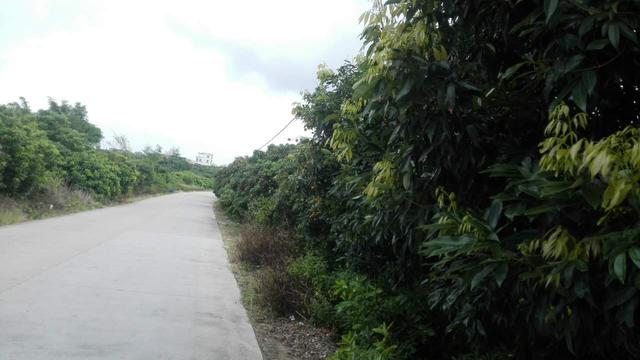
As a true Lingnan native who could eat three hundred lychees a day, I am taking everyone today to see the lychees in my hometown. Dianbai, Guangdong, as the earliest county-level city to cultivate lychees, is not as famous as Gaozhou lychees, for one reason: there is no government-supported large-scale cultivation. Second: there was a certain someone who planted a lychee tree in Gaozhou, and he did not plant one in Dianbai. If he had planted one in Dianbai, things would be different. On the way home, lychee trees line both sides of the road, but some bear fruit and some do not.
(The following photos were taken around June 1, the lychees were not yet ripe)
Lychees, like other fruits, have on-years and off-years. Last year was a bumper harvest, and as a result many trees were depleted, so this year they bear no fruit or little fruit. Unexpectedly, the several trees at my home all bear fruit, and the fruits are large and densely set. The photo below is a tree at the front door, bearing nice fruit.
The tree in the yard:
A few close-up shots:
I really could not resist, so first a few jin:
Depending on the variety, some lychees have large pits and some have small pits, popularly called "sparse pits." Generally speaking, Heiye has large pits, while Guiwei, Baitangying, Baila and others have both large and small pits. In other respects, Heiye is large, juicy, and on the sweet side, very satisfying to eat; Guiwei has a slight glutinous fragrance, a clean sweet taste, and small pits, making it more popular. But since this year is an off-year, Guiwei production is relatively low, and its ripening period is later, so to eat Guiwei you need a bit more patience and renminbi. But Baitangying is also a very good choice; the photo above is Baitangying.
Lychees are difficult to keep fresh; the best taste comes from eating them right after picking. Once picked, the fragrance changes in one day, the color changes in two days, and the taste changes in three days. Therefore, for the past N years, only Lingnan people could eat three hundred lychees a day, and north of Lingnan only emperors or officials could get a taste. Today, thanks to Comrade Ma Yun for making the express delivery industry flourish, food lovers outside the province can now eat fresh lychees picked within 48 hours.
The photos above were taken a week ago; compare them with the ones taken today: