Focusing on transportation boosting new urbanization, the sub-forum was successfully held
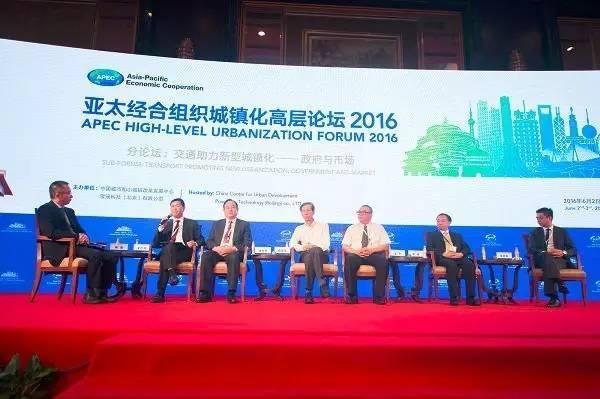
On June 2-3, 2016, the "APEC High-Level Forum on Urbanization 2016" was held in Ningbo City, Zhejiang Province. This forum was the first large-scale high-level event under the APEC framework with urbanization as its theme, and also an important part of China's international cooperation on urbanization. The theme of the forum was "Urbanization and Inclusive Growth."
Yang Yu, CCTV special commentator and researcher at the China Center for Urban Development, presided over this sub-forum
On June 3, the sub-forum of the "APEC High-Level Forum on Urbanization 2016," "Transportation Boosting New Urbanization," was successfully convened. Political and academic circles from across the country focused on new urbanization construction and discussed how, in the context of the Internet, transportation can advance urbanization construction.
Zhang Guohua, Dean of the Comprehensive Transportation Institute of the China Center for Urban Development
Zhang Guohua, Dean of the Comprehensive Transportation Institute of the China Center for Urban Development, said, "How to enable social forces to participate in urban development, this is the development opportunity of the future, especially the transportation of the Internet and urbanization, because the core feature of 'Internet Plus' is a virtual network, while transportation is a physical network." Dean Zhang Guohua particularly emphasized that while promoting transportation to boost new urbanization construction, attention must also be paid to the relationship between the government and the market.
Wang Renzhou, Vice Mayor of Ningbo City
Wang Renzhou, Vice Mayor of Ningbo City, said that transportation is a booster for urban construction and also a symbol of the level of urban development. Ningbo's comprehensive transportation system is very well developed. Zhoushan Port is the world's number one seaport, and in addition to maritime transport, Ningbo's inland river shipping, railway transport, highway transport, air transport, and pipeline transport all play important roles.
Wang Renzhou admitted that although Ningbo's current level of urbanization development is relatively high, the fly in the ointment is that the transportation links between Ningbo and cities in its hinterland still need to be further strengthened. The improvement of urbanization depends on radiating outward, and the best means of transport is first of all railway. In the process of building transportation facilities in Ningbo, the biggest problem currently encountered is investment, and it is hoped that private capital can be continuously brought into the construction of Ningbo's transportation infrastructure.
Qiang Xiao'an, Director of the Xi'an Municipal Development and Reform Commission
As an inland city, Xi'an is highly typical in how transportation boosts new urbanization construction. Qiang Xiao'an, Director of the Xi'an Municipal Development and Reform Commission, said: "Xi'an is not along a coast, river, water, or sea. We have chosen a path of inland development, building a sound aviation network, railway network, national road network, and urban transportation network, creating a charming Xi'an and radiating new brilliance of the era."
In the process of Xi'an's transportation development, apart from the issue of construction funding, the second thing that gave Qiang Xiao'an the most trouble was technical problems. As is well known, Xi'an is an ancient historic capital, and every inch of land has a rich historical and cultural heritage. In places involving cultural relic protection, for example, the technology in the area of the South Gate of the city wall for the subway is very complex.
Yang Baojun, President of the China Academy of Urban Planning and Design
In the view of Yang Baojun, President of the China Academy of Urban Planning and Design, transportation boosting new urbanization must keep pace with the times and achieve data sharing and interconnection. "We need to think about what kind of transportation mode or model is needed when promoting new urbanization. For example, the export strategy mainly relies on coastal ports, while when transforming to domestic demand, the weak points in transportation will be different."
Wang Gang, Director of the Toll Highway Networked Settlement Management Center of the Ministry of Transport
Wang Gang, Director of the Toll Highway Networked Settlement Management Center of the Ministry of Transport, focused on introducing the development of China's ETC networked toll collection system. In September 2015, China achieved ETC networked toll collection on highways nationwide. In recent years, the number of ETC users in China has experienced explosive growth. By March 2016, ETC users had reached 32 million, more than 5 times the 6.06 million users in 2014. The ETC system can greatly improve the efficiency of highway toll collection, and networked toll collection can eliminate some "black hole" links in the transportation field. Director Wang Gang said that in the process of transportation boosting new urbanization, ETC technology also has great potential in the field of urban transportation.
At this forum, Baosheng Technology signed a strategic agreement with Southern Industry Asset Management Co., Ltd. of China South Industries Group Corporation. Southern Industry will allocate 10 billion yuan to support the production and manufacturing of equipment related to e-Tongxing. Ma Jingquan, Chairman of Baosheng Technology (Beijing) Co., Ltd., said that the company's flagship brand, Yitongxing, uses ETC to solve urban parking problems and cooperates with the government to use Internet thinking to solve people's travel problems.
It is reported that this forum was hosted by the National Development and Reform Commission, co-organized by the Ministry of Foreign Affairs, and undertaken by the China Center for Urban Development and the Ningbo Municipal People's Government. More than 200 guests attended the forum, including ministerial-level officials and high-level government representatives from APEC member economies, city mayors, entrepreneurs, scholars, and media.
————————————
WeChat editor: Chen Di