The First Citrus War: The Showdown Between Orange and Lime
Last time we said: citron (citron or citron fruit), pomelo and mandarin are the true three elders of the citrus family.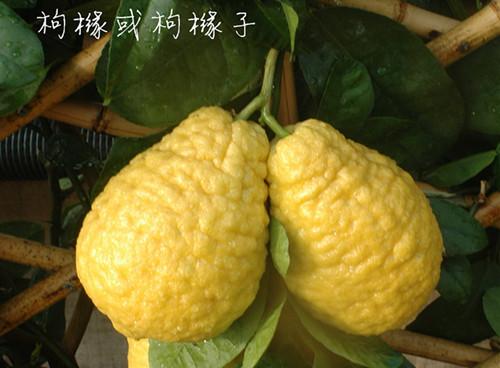
So before explaining the "chaotic hybridization" of the three elders, it is necessary to introduce the "hybridization military rules" of citrus.
Researchers from the Sichuan Academy of Agricultural Sciences found that the offspring of citrus hybridization will follow these rules:
First, after hybridization, the size will tend toward the smaller parent. That is to say, whichever parent is smaller in size, the offspring will resemble it.
Second, the appearance (the shape of the fruit) will take an intermediate value, combining the average level of both parents;
Third, the sugar content (sweetness) will take an intermediate value;
Fourth, which is what we do not want to see, the acidity will tend toward the more acidic parent. So give up hope, sweet orange cannot save the lemon.
(This is also citron or citron fruit, it seems not quite like the picture above - -!)
The first orange I came into contact with was called Guanggan. Only after a very, very long time did I figure out that this thing has nothing to do with mandarins at all, because these oranges combine the characteristics of pomelo and mandarin.
According to the "hybridization military rules" we just mentioned, we can infer: the size of the sour orange is about the same as that of the mandarin, and as for the taste, obviously it follows whichever parent is sour. Fortunately, among mandarins and pomelos there are both sour and sweet ones, otherwise it would be terrible. This is probably the reason why oranges can be either sour or sweet.
The sour orange was formed by hybridization of pomelo and mandarin. As for the corresponding "sweet orange", it is now generally considered merely a cultivated group under the sour orange. Other characteristics of oranges are also as expected: their peel is not as thin as that of mandarins, nor as thick as that of pomelos; it is not as easy to peel as mandarins, nor as difficult to peel as pomelos. (Applause should be heard here)
So were these oranges cultivated artificially? Actually not. As natural hybrids of pomelo and mandarin, before people discovered hybridization techniques, they were already showing off their fruits on the hills. Archaeological evidence shows that as early as 2500 BC, China began cultivating oranges. It was much later that Westerners came to know oranges. Around the 14th century, oranges were brought back to Europe by the Portuguese and planted along the Mediterranean coast. It was only in 1493, when Columbus visited the New World for the second time, that oranges landed on the American continent and found their true paradise there. Although many sweet oranges on the market claim to be native to the United States, this does not mean their homeland is in the Americas. This is quite similar to the story of Chinese kiwifruit returning from studying in New Zealand, transforming into "kiwifruit" and multiplying in value.
At the same time, the low-key citron produced another low-key descendant - the lime. The names of lime and lemon differ by only one character, and their characteristics are not far apart either, only the leaves are narrower and the flowers are smaller. It was once thought that the other parent of lime was pomelo, but the truth may not be so simple. Besides pomelo, mandarin and kaffir lime may all have participated in the "lime-making movement". So yellow, so violent, what a disgraceful history of ethics!
At this point, the chaos of the citrus family began to emerge, and at least the orange - the most important citrus fruit in the world today - had appeared. But the chaos was far from over. Just when oranges had not yet rushed out of Asia and gone global, the second wave of natural hybridization began again.
Preview:
The Second Citrus War - Grapefruit, Mandarin and Lemon